
Catalogue Search | MBRL


Are you sure you want to remove the book from the shelf?

{{itemTitle}}
13
result(s) for
"Book industries and trade France History 18th century."
Sort by:


The Literary Market
A central theme in the history of Old Regime authorship highlights the opportunities offered by a growing book trade to writers seeking to free themselves from patrons and live \"by the pen.\" Accounts of this passage from patronage to market have explored in far greater detail the opportunities themselves-the rising sums paid by publishers and the progression of laws protecting literary property-than how and why writers would have seized on them, no doubt because the choice to do so has seemed an obvious or natural one for writers assumed to prefer economic self-sufficiency over elite protection. InThe Literary Market, Geoffrey Turnovsky claims that there was nothing obvious or natural about the choice. Writers had been involved in commercial book publication since the earliest days of the printing press, yet had not necessarily linked these activities with their freedom to think and write. The association of autonomy and professionalism was forged, not given. Analyzing the literary market as a key articulation of the association, Turnovsky explores how in eighteenth-century polemics a rhetoric of commercial authorship came to signify independence for intellectuals. He finds the roots of the connection not in the claims of entrepreneurial writers to rights and income but in a world to which that of the modern author has been contrasted: the aristocratic culture of the seventeenth century. Aristocratic culture, he argues, generated a disparaging view of the professional author as one defined by activities tainting him or her as greedy and arrogant and therefore unworthy of protection and socially isolated.The Literary Marketexamines the story of the \"birth of the author\" in terms of the revalorization of this negative trope in Enlightenment-era debates about the radically changing role of writers in society.
eBook

A literary tour de France : the world of books on the eve of the French Revolution
\"The publishing industry in France in the years before the Revolution was a lively and sometimes rough-and-tumble affair, as publishers and printers scrambled to deal with (and if possible evade) shifting censorship laws and tax regulations, in order to cater to a reading public's appetite for books of all kinds, from the famous Encyclopâedie, repository of reason and knowledge, to scandal-mongering libel and pornography. Historian and librarian Robert Darnton uses his exclusive access to a trove of documents-letters and documents from authors, publishers, printers, paper millers, type founders, ink manufacturers, smugglers, wagon drivers, warehousemen, and accountants-involving a publishing house in the Swiss town of Neuchatel to bring this world to life. Like other places on the periphery of France, Switzerland was a hotbed of piracy, carefully monitoring the demand for certain kinds of books and finding ways of fulfilling it. Focusing in particular on the diary of Jean-Franًcois Favarger, a traveling sales rep for a Swiss firm whose 1778 voyage, on horseback and on foot, around France to visit bookstores and renew accounts forms the spine of this story, Darnton reveals not only how the industry worked and which titles were in greatest demand, but the human scale of its operations. A Literary Tour de France is literally that. Darnton captures the hustle, picaresque comedy, and occasional risk of Favarger's travels in the service of books, and in the process offers an engaging, immersive, and unforgettable narrative of book culture at a critical moment in France's history\"-- Provided by publisher.
Book

Books Without Borders in Enlightenment Europe
Though the field of book history has long been divided into discrete national histories, books have seldom been as respectful of national borders as the historians who study them-least of all in the age of Enlightenment when French books reached readers throughout Europe. In this erudite and engagingly written study, Jeffrey Freedman examines one of the most important axes of the transnational book trade in Enlightenment Europe: the circulation of French books between France and the German-speaking lands. Focusing on the critical role of book dealers as cultural intermediaries, he follows French books through each stage of their journey-from the French-language printing shops where they were produced, to the wholesale book fairs in Leipzig, to retail book shops at locations scattered widely throughout Germany. At some of those locations, authorities reacted with alarm to the spread of French books, burning works of the radical French Enlightenment and punishing the booksellers who sold them. But officials had little power to curtail their circulation: the political fragmentation of the German lands made it virtually impossible to police the book trade. Largely unimpeded by censorship, French books circulated more freely in Germany than in the absolutist monarchy of France. In comparison, the flow of German books into the French market was negligible-an asymmetry that corresponded to the hierarchy of languages in Enlightenment Europe. But publishers in Switzerland produced French translations of German books. By means of title changes, creative editing, and mendacious advertising, the Swiss publishers adapted works of the German Enlightenment for an audience of French-readers that stretched from Dublin to Moscow. An innovative contribution to both the history of the book and the transnational study of the Enlightenment, Freedman's work tells a story of crucial importance to understanding the circulation of texts in an age in which the concept of World Literature had not yet been invented, but the phenomenon already existed.
eBook

The Role of Transportation in the Industrial Revolution
Addressing the question of why the Industrial Revolution occurred first in England, Rick Szostak demonstrates the crucial role played by the development of a nation-wide network of land and water transport. He rejects revisionist arguments that downplay the significance of transportation to the Industrial Revolution, underrate the amplitude and influence of the English Industrial Revolution, and deny French economic retardation.
eBook
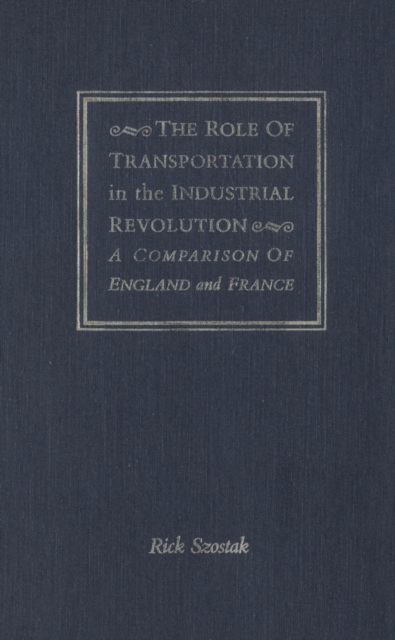
Role of Transportation in the Industrial Revolution
Szostak develops a model that establishes causal links between transportation and industrialization and shows how improvements in transportation could have a beneficial effect on an economy such as that of eighteenth-century England. This model shows the Industrial Revolution to involve four primary phenomena: increased regional specialization, the emergence of new industries, an expanding scale of production, and an accelerated rate of technological innovation.
eBook

Global trade, smuggling, and the making of economic liberalism : Asian textiles in France 1680-1760
Imported from India, China, the Levant, and Persia and appreciated for their diversity, designs, fast bright colours and fine weave, Asian textiles became so popular in France that in 1686 the state banned their import, consumption and imitation. A fateful decision. This book tells the story of smuggling on a vast scale, savvy retailers and rebellious consumers. It also reveals how reformers in the French administration itself sponsored a global effort to acquire the technological know-how necessary to produce such textiles and how the vitriolic debates surrounding the eventual abolition of the ban were one of the decisive moments in the development of Enlightenment economic liberalism.
eBook

Erotic Exchanges
In Erotic Exchanges, Nina Kushner reveals the complex world of elite prostitution in eighteenth-century Paris by focusing on the professional mistresses who dominated it. In this demimonde, these dames entretenues exchanged sex, company, and sometimes even love for being \"kept.\" Most of these women entered the profession unwillingly, either because they were desperate and could find no other means of support or because they were sold by family members to brothels or to particular men. A small but significant percentage of kept women, however, came from a theater subculture that actively supported elite prostitution. Kushner shows that in its business conventions, its moral codes, and even its sexual practices, the demimonde was an integral part of contemporary Parisian culture.
Kushner's primary sources include thousands of folio pages of dossiers and other documents generated by the Paris police as they tracked the lives and careers of professional mistresses, reporting in meticulous, often lascivious, detail what these women and their clients did. Rather than reduce the history of sex work to the history of its regulation, Kushner interprets these materials in a way that unlocks these women's own experiences. Kushner analyzes prostitution as a form of work, examines the contracts that governed relationships among patrons, mistresses, and madams, and explores the roles played by money, gifts, and, on occasion, love in making and breaking the bonds between women and men. This vivid and engaging book explores elite prostitution not only as a form of labor and as a kind of business but also as a chapter in the history of emotions, marriage, and the family.
eBook

BEYOND THE FORBIDDEN BEST-SELLERS OF PRE-REVOLUTIONARY FRANCE
Robert Darnton's acclaimed 1995 work on the late eighteenth-century francophone illegal book trade, The forbidden best-sellers of pre-revolutionary France, has become one of the most cited and studied texts in its field. The culmination of thirty years' archival research and reflection, it roots Darnton's previous case-study-driven articles and monographs in a wide-ranging empirical survey of the order books of the Swiss printer-booksellers, the Société typographique de Neuchâtel. It claims to offer readers a picture of what illegal books went into bookshops everywhere in pre-revolutionary France. The first fruits of the French Book Trade in Enlightenment Europe project, a digital humanities initiative that has created an on-line database revealing the STN's entire trade, this article challenges Darnton's interpretation of the nature and utility of the Neuchâtel archive. It demonstrates that the STN's order books are an unreliable gauge of general French demand. It goes further. It argues for a nuanced polycentric understanding of the eighteenth-century Francophone book trade, and outlines a bibliometric digital humanities pathway that might lead us there.
Journal Article

Indigenous Women and Work: From Labor to Activism
Alice Littlefield, Kathy M'Closkey, and Melissa Rohde's chapters share an em- phasis on continuity and innovation in 20th-century Indian women's reserva- tion labours. Littlefield's chapter exam- ines Michigan Anishinaabeg women's contributions to the 18th-century French fur trade, their shift toward wage labour in the late 19th century, and their entry into industrial and professional jobs after boarding school training in the first half of the 20th century. Littlefield advocates for further inquiry into Native women's work within modern tribal communities, naming casinos as a starting point for scholars, and I would add tribal colleges, non-profits, and social service agencies to the list of tribal sites where Native women workers predominate. Kathy M'Closkey's essay on Navajo women weavers' partici- pation in the wool and textile industries between 1880 and World War II similarly challenges readers to centre Indigenous women within their studies of tribal economies and to consider tribal com- munities as sites of globalization. She expertly challenges previous scholars' depictions of Navajo women weavers as hobbyists working in their spare time to accommodate a niche Southwestern aes- thetic. Rohde chronicles Ojibwe women's transition from a timber and mining economy to a tourist industry in north- ern Wisconsin. Her depiction of Indian women's efforts to maintain tribal and personal autonomy over land and work as they participated in cultural commodi- fication is a well-balanced history of the place I grew up. Many of the issues she describes between 1900 and 1940 contin- ue to reverberate in debates over resource distribution and economic development since the region remains dependent on tourism and troubled by poverty and racism. The next set of essays considers wom- en a generation younger than those fea- tured in [Margaret D. Jacobs], O'[Neill], and [Cathleen D. Cahill]'s chapters. Aroha Harris and Mary Jane Logan McCallum write about the Indian Homemakers' Clubs in Ontario and the Maori Women's Welfare Organizations in New Zealand, both nationally sponsored organizations, in the post-war era. They challenge prior depictions of these insti- tutions as conservative agents of the state to demonstrate that aboriginal women co-opted paternalist and racist assump- tions and formed a unique brand of citi- zenship identity infused with indigeneity and womanhood. Brenda J. Child's chap- ter on Ojibwe women's leadership as ur- ban organizers and community activists among Removal-era Indians living and working in Minneapolis adds an impor- tant modern dimension to the collec- tion, and illustrates the ways Indigenous women worked within and outside of federal and tribal agencies to affect change. Cybele Locke's essay concludes the book's historical discussion with her assessment of the Black Unity movement of radical Maori feminists ousted from New Zealand's Auckland Trade Union Center in 1982. Importantly, she places Maori workers within the context of New Zealand's trade union history, explores the basis of Black Unity's leaders' racial- ized and gendered philosophies, and then considers the group's association with feminism and Maori sovereignty. Her chapter, rooted in an event more com- monly associated with the modern labour movement, may be the most recognizable to 20th-century labour historians who consider transnational feminisms.
Book Review