
Catalogue Search | MBRL


Are you sure you want to remove the book from the shelf?

{{itemTitle}}
1,295
result(s) for
"Book-burning"
Sort by:


Ray Bradbury's Fahrenheit 451 : the authorized adaptation
A retelling--in graphic novel format--of Bradbury's story about the dangers of censorship.
Book
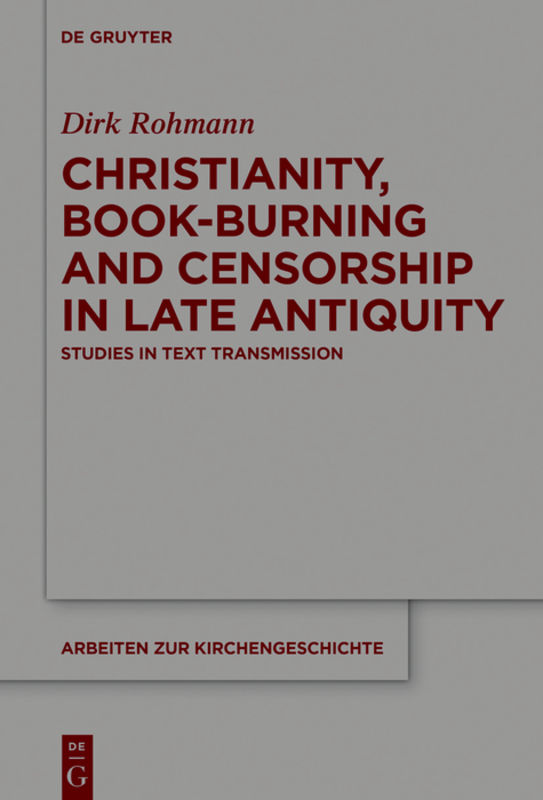
Christianity, Book-Burning and Censorship in Late Antiquity
It is estimated that only a small fraction, less than 1 per cent, of ancient literature has survived to the present day. The role of Christian authorities in the active suppression and destruction of books in Late Antiquity has received surprisingly little sustained consideration by academics. In an approach that presents evidence for the role played by Christian institutions, writers and saints, this book analyses a broad range of literary and legal sources, some of which have hitherto been little studied. Paying special attention to the problem of which genres and book types were likely to be targeted, the author argues that in addition to heretical, magical, astrological and anti-Christian books, other less obviously subversive categories of literature were also vulnerable to destruction, censorship or suppression through prohibition of the copying of manuscripts. These include texts from materialistic philosophical traditions, texts which were to become the basis for modern philosophy and science. This book examines how Christian authorities, theologians and ideologues suppressed ancient texts and associated ideas at a time of fundamental transformation in the late classical world.
eBook

Fahrenheit 451
In a society in which books are outlawed, Montag, a regimented fireman in charge of burning the forbidden volumes, meets a revolutionary school teacher who dares to read. Suddenly he finds himself a hunted fugitive, forced to choose not only between two women, but between personal safety and intellectual freedom.
Book

Book-Burning and the Uses of Writing in Ancient Rome: Destructive Practice between Literature and Document
This article examines the burning of written material at Rome from the Republican period until the rise of Christianity, using the lens of book history. It considers why and how Romans burned written material, gathering for the first time all testimony of burning any kind of writing, and examines responses to these burnings in ancient discourse. A capacious, book-historical approach to Roman book-burning shows that differences in practice and uses — of books as opposed to documents, for example — account for the different consequences Romans saw for burning different written media.
Journal Article

Fahrenheit 451
In a future totalitarian state where books are banned and destroyed by the government, Guy Montag, a fireman in charge of burning books, meets a revolutionary schoolteacher who dares to read and a girl who tells him of a past when people did not live in fear ... This sixtieth-anniversary edition commenmorates Ray Bradbury's masterpiece with a new introduction by Neil Gaiman ; personal essays on the genesis of the novel by the author; a weath of critical essays and reveiws by Nelson Algren, Harold Bloom, Margaret Atwood, and others; rare manuscript pages and sketches from Ray Bradbury's personal archive; and much more ... --- From back cover.
BOOK

Fahrenheit 451, Books and History of Book Burnings
Books are written sources of information that contribute to the history of civilization and culture. In certain periods of history books have been banned, destroyed, stolen, and removed for the personal interests of those responsible for their protection. The most effective and widespread way to destroy books has been to burn them. Incidents of book burnings that have happened for various reasons have mostly occurred in situations such as chaos and rebellion. Books have been burned in Athens, China, Jerusalem, England, Sarajevo, and Baghdad. The aim of this study is to examine the historical process and reasons for burning books through the events evoked by Fahrenheit 451 and stories of Fahrenheit 451 by Ray Douglas Bradbury (1920-2012). Fahrenheit 451 is a novel in the science fiction genre. Accor ding to Bradbury, science fiction is also a sociological study of the future. The work stands out with the way it deals with social issues and people’s problems. Fahrenheit 451 builds a future based on a simple question: What if books were now just objects that were burned? Based on this question, it is necessary to emphasize that the book was written to prevent the feared situation from happening. Fahrenheit 451 is a book of warning. Bradbury envisions a future with advanced technology to stress that dependence on technology would change the structure of society and how people live as he fears that people will not read books in the future. In this study, information about books and book burning is given, based on the events in the Fahrenheit 451 novel and Fahrenheit 451 stories.
Journal Article


Encounters: Reflecting on the Trajectory of an Art Object
Reflects on the artwork 'Dreamwork' (the carbonised remains of a copy of 'The interpretation of dreams ' by Sigmund Freud) to explore the dark history of book burning and to provoke discussion about the provenance of an art object and the multiple stories that become attached to it, depending on the context in which it is placed. Source: National Library of New Zealand Te Puna Matauranga o Aotearoa, licensed by the Department of Internal Affairs for re-use under the Creative Commons Attribution 3.0 New Zealand Licence.
Journal Article