
Catalogue Search | MBRL


Are you sure you want to remove the book from the shelf?

{{itemTitle}}
154
result(s) for
"Books and reading Europe History."
Sort by:

Reading and the First World War : readers, texts, archives
What role did reading play in the lives of those who experienced the First World War? This volume demonstrates that reading was both the prime leisure occupation and the main means for transmitting information for combatants and civilians during the war. Ranging from ordinary soldiers to conscientious objectors and from to war artists to civilians in occupied Belgium, the readers uncovered in this volume read for a multitude of reasons. Letters and books sent from home could bring soldiers in touch with family members and memories of lives lived before the war. Newspapers and trench journals helped maintain morale in the trenches and communicated war news and propaganda to civilian audiences. Bringing together respected specialists and emerging scholars, 'Reading in the First World War' reveals the diversity of reading practices at the time and the central importance of reading in the experience of conflict, at the front and at home.
Book

Reading and the History of Race in the Renaissance
Elizabeth Spiller studies how early modern attitudes towards race were connected to assumptions about the relationship between the act of reading and the nature of physical identity. As reading was understood to happen in and to the body, what you read could change who you were. In a culture in which learning about the world and its human boundaries came increasingly through reading, one place where histories of race and histories of books intersect is in the minds and bodies of readers. Bringing together ethnic studies, book history and historical phenomenology, this book provides a detailed case study of printed romances and works by Montalvo, Heliodorus, Amyot, Ariosto, Tasso, Cervantes, Munday, Burton, Sidney and Wroth. Reading and the History of Race traces ways in which print culture and the reading practices it encouraged, contributed to shifting understandings of racial and ethnic identity.
eBook


Authorship and publicity before print
Widely recognized by contemporaries as the most powerful theologian of his generation, Jean Gerson (1363-1429) dominated the stage of western Europe during a time of plague, fratricidal war, and religious schism. Yet modern scholarship has struggled to define Gerson's place in history, even as it searches for a compelling narrative to tell the story of his era.Daniel Hobbins argues for a new understanding of Gerson as a man of letters actively managing the publication of his works in a period of rapid expansion in written culture. More broadly, Hobbins casts Gerson as a mirror of the complex cultural and intellectual shifts of the fourteenth and fifteenth centuries. In contrast to earlier theologians, Gerson took a more humanist approach to reading and to authorship. He distributed his works, both Latin and French, to a more diverse medieval public. And he succeeded in reaching a truly international audience of readers within his lifetime. Through such efforts, Gerson effectively embodies the aspirations of a generation of writers and intellectuals. Removed from the narrow confines of late scholastic theology and placed into a broad interdisciplinary context, his writings open a window onto the fascinating landscape of fifteenth-century Europe.The picture of late medieval culture that emerges from this study offers neither a specter of decaying scholasticism nor a triumphalist narrative of budding humanism and reform. Instead, Hobbins describes a period of creative and dynamic growth, when new attitudes toward writing and debate demanded and eventually produced new technologies of the written word.
eBook

Translation and the book trade in early modern Europe
\"This volume provides the first transnational overview of the relationship between translation and the book trade in early modern Europe. Following an introduction to the theories and practices of translation in early modern Europe, and to the role played by translated books in driving and defining the trade in printed books, each chapter focuses on a different aspect of translated-book history - language learning, audience, printing, marketing, and censorship - across several national traditions. This study touches on a wide range of early modern figures who played myriad roles in the book world; many of them also performed these roles in different countries and languages. Topics treated include printers' sensitivity to audience demand; paratextual and typographical techniques for manipulating perception of translated texts; theories of readership that travelled across borders; and the complex interactions between foreign-language teachers, teaching manuals, immigration, diplomacy, and exile\"-- Provided by publisher.
Book

Protestants and mysticism in Reformation Europe
Protestants and Mysticism in Reformation Europe, edited by Ronald K. Rittgers and Vincent Evener, is a research handbook on the Protestant reception of mysticism, from the beginnings of the Reformation through the mid-seventeenth century.
eBook

Postcards on parchment : the social lives of medieval books
\"Medieval prayer books held not only the devotions and meditations of Christianity, but also housed, slipped between pages, sundry notes, reminders, and ephemera, such as pilgrims' badges, sworn oaths, and small painted images. Many of these last items have been classified as manuscript illumination, but Kathryn M. Rudy argues that these pictures should be called, instead, parchment paintings, similar to postcards. In a delightful study identifying this group of images for the first time, Rudy delineates how these objects functioned apart from the books in which they were kept. Whereas manuscript illuminations were designed to provide a visual narrative to accompany a book's text, parchment paintings offered a kind of autonomous currency for exchange between individuals--people who longed for saturated color in a gray world of wood, stone, and earth. These small, colorful pictures offered a brilliant reprieve, and Rudy shows how these intriguing and previously unfamiliar images were traded and cherished, shedding light into the everyday life and relationships of those in the medieval Low Countries. \"-- Provided by publisher.
Book
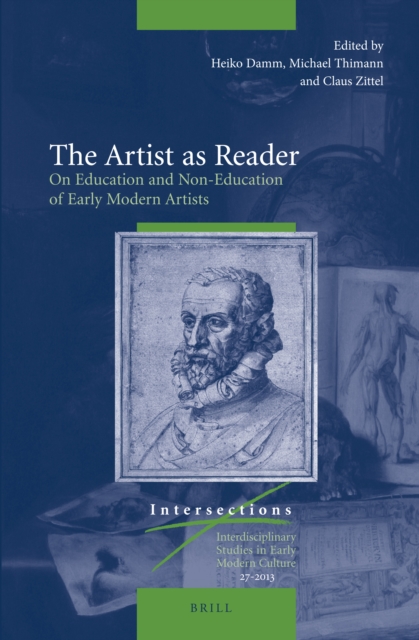
The artist as reader : on education and non-education of early modern artists
Based on the history of knowledge, the contributions to this volume elucidate various aspects of how, in the early modern period, artists' education, knowledge, reading and libraries were related to the ways in which they presented themselves.
eBook

Reading and the history of race in the Renaissance
\"Elizabeth Spiller studies how early modern attitudes towards race were connected to assumptions about the relationship between the act of reading and the nature of physical identity. As reading was understood to happen in and to the body, what you read could change who you were. In a culture in which learning about the world and its human boundaries came increasingly through reading, one place where histories of race and histories of books intersect is in the minds and bodies of readers. Bringing together ethnic studies, book history and historical phenomenology, this book provides a detailed case study of printed romances and works by Montalvo, Heliodorus, Amyot, Ariosto, Tasso, Cervantes, Munday, Burton, Sidney and Wroth. Reading and the History of Race traces ways in which print culture and the reading practices it encouraged, contributed to shifting understandings of racial and ethnic identity\"--Provided by publisher.
Book
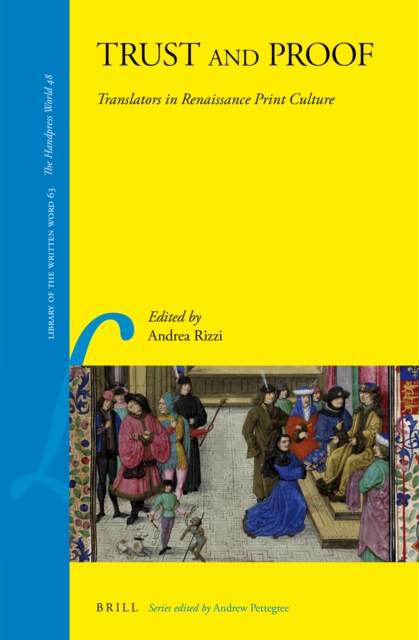
Trust and Proof
Translators' contribution to the vitality of textual production in the Renaissance is still often vastly underestimated. Drawing on a wide variety of sources published in Spanish, Portuguese, Italian, Latin, German, English, and Zapotec, this volume brings a global perspective to the history of translators, and the printed book. Together the essays point out the extent to which particular language cultures were liable to shift, overlap, shrink, and expand during one of the most defining periods in the history of print culture. Interdisciplinary in approach, Trust and Proof investigates translators' role in the diffusion of discourse about languages and ancient knowledge, as well as changing etiquettes of reading and writing.
eBook