
Catalogue Search | MBRL


Are you sure you want to remove the book from the shelf?

{{itemTitle}}
240,498
result(s) for
"Border patrols"
Sort by:

U.S. Border Patrol
This photo-illustrated book describes the life of US Border Patrol Agents, including the work they do to keep criminals, weapons, and drugs out of the United States. Describes what it takes to get a job as a border patrol agent, the training required, and what a day in the field is like.
Book

Excerpts and memories from the periods of border security in Hungary
Aim: The purpose of this study is to enhance understanding of the evolution of the Hungarian Border Guard, by providing an overview of the various historical events and forces that shaped the organization throughout different periods. Methodology: By drawing on a broad literature covering various periods in the history of border surveillance in Hungary, this study provides a detailed examination of the history of the Hungarian Border Guard. Findings: It is imperative to work to preserve the memory and traditions of the Border Guard, as this is the only path to maintaining its spirit into the future. Value: This study provides the reader with an understanding of the history, spirit, and messages of the Hungarian Border Guard. A great deal of recent work has been conducted to preserve these memories. Several significant monuments have been created, including the Apátistvánfalva Border Guard Memorial Site, established in the former Apátistvánfalva border guard post, and the Border Guard Memorial Room at the Border Guard Department of the National University of Public Service, Faculty of Law Enforcement. The dedication of those working to protect these traditions is exemplary; the significance of their work is unquestionable. The protection of the values of the Border Guard and the preservation of its traditions is arguably a matter of public interest.
Journal Article


Border Policing
An extensive history examining how North American nations have tried (and often failed) to police their borders, Border Policing presents diverse scholarly perspectives on attempts to regulate people and goods at borders, as well as on the ways that individuals and communities have navigated, contested, and evaded such regulation. The contributors explore these power dynamics though a series of case studies on subjects ranging from competing allegiances at the northeastern border during the War of 1812 to struggles over Indian sovereignty and from the effects of the Mexican Revolution to the experiences of smugglers along the Rio Grande during Prohibition. Later chapters stretch into the twenty-first century and consider immigration enforcement, drug trafficking, and representations of border policing in reality television. Together, the contributors explore the powerful ways in which federal authorities impose political agendas on borderlands and how local border residents and regions interact with, and push back against, such agendas. With its rich mix of political, legal, social, and cultural history, this collection provides new insights into the distinct realities that have shaped the international borders of North America.
eBook

Undocumented : immigration and the militarization of the United States-Mexico border
\"Moore has photographed the entire length of the U.S. southern border, and traveled extensively throughout Central America and Mexico, as well as to many immigrant communities in the United States ... [This book is a] record on the prevailing U.S. domestic topic of immigration and border security\"--Amazon.com.
Book

Migra!
This is the untold history of the United States Border Patrol from its beginnings in 1924 as a small peripheral outfit to its emergence as a large professional police force. To tell this story, Kelly Lytle Hernández dug through a gold mine of lost and unseen records stored in garages, closets, an abandoned factory, and in U.S. and Mexican archives. Focusing on the daily challenges of policing the borderlands and bringing to light unexpected partners and forgotten dynamics,Migra!reveals how the U.S. Border Patrol translated the mandate for comprehensive migration control into a project of policing Mexicans in the U.S.-Mexico borderlands.
eBook

The border : journeys along the U.S.-Mexico border, the world's most consequential divide
\"David Danelo has traveled the U.S.-Mexico border and his investigative report about a complex issue examines the border in human terms. As topical today as it was when he made his trek, this updated edition asks and answers the core questions: Is a fence or wall the answer? Is the U.S. government capable of fully securing the border?\"-- Provided by publisher.
Book

The (in)securitization practices of the three universes of EU border control
What practices of (in)securitization involve the notions of border and border control in the European Union? How do these practices operate? How are they assembled? In the resulting assemblage, is the notion of borders – understood as state borders – still relevant for the control of individuals and populations moving across the frontiers of the EU? Drawing on empirical observations and with a specific focus on how border control is translated into different social universes, this article seeks to show that practices of control are routinely embedded in a practical sense that informs what controlling borders does and means. This practical sense is itself informed by different professional habitus and work routines involving deterrence and the use of force, interrogation and detention, surveillance of populations on the move and the profiling of (un)trusted travellers. Its strength varies in relation to its shared dimension by most of the operators, and is adjusted to the materiality of borders as well as to the local contexts in which it is deployed. It activates, or does not activate, the maximal use of various control technologies (satellites, pre-registration and interoperable exchange of data between the state and private bureaucracies, biometrics identifiers, body-scanners). For understanding practices of (in)securitization, actual work routines and the specific professional ‘dispositions’ are therefore more important than any discourses actors may use to justify their activities.
Journal Article

Border towns and border crossings : a history of the U.S.-Mexico divide
\"This is a compelling and revealing look at the history of the U.S.-Mexican border as a place and symbol of cross-cultural melding and a source of growing anxiety over immigration and national security\"-- Provided by publisher.
Book
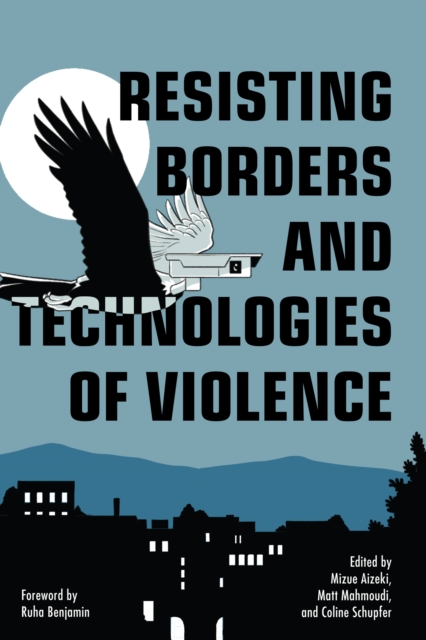
Resisting Borders and Technologies of Violence
The border regimes of imperialist states have brutally oppressed migrants throughout the world. To enforce their borders, these states have constructed a new digital fortress with far-reaching and ever-evolving new technologies. This pathbreaking volume exposes these insidious means of surveillance, control, and violence. In the name of \"smart\" borders, the U.S. and Europe have turned to private companies to develop a neocolonial laboratory now deployed against the Global South, borderlands, and routes of migration. They have established immigrant databases, digital IDs, electronic tracking systems, facial recognition software, data fusion centers, and more, all to more \"efficiently\" categorize and control human beings and their movement. These technologies rarely capture widespread public attention or outrage, but they are quietly remaking our world, scaling up colonial efforts of times past to divide desirables from undesirables, rich from poor, expat from migrant, and citizen from undocumented. The essays and case studies in Resisting Borders and Technologies of Violence shed light on this new threat, offering analyses of how the high-tech system of borders developed and inspiring stories of resistance to it. The organizers, journalists, and scholars in these pages are charting a new path forward, employing creative tools to subvert the status quo, organize globally against high-tech border imperialism, and help us imagine a world without borders.
eBook