
Catalogue Search | MBRL


Are you sure you want to remove the book from the shelf?

{{itemTitle}}
1,503
result(s) for
"Border security History."
Sort by:

The dynamics of interstate boundaries
This title explains why some borders deter insurgents, smugglers, bandits, and militants while most suffer from infiltration and crisis.
Book

Border Policing
An extensive history examining how North American nations have tried (and often failed) to police their borders, Border Policing presents diverse scholarly perspectives on attempts to regulate people and goods at borders, as well as on the ways that individuals and communities have navigated, contested, and evaded such regulation. The contributors explore these power dynamics though a series of case studies on subjects ranging from competing allegiances at the northeastern border during the War of 1812 to struggles over Indian sovereignty and from the effects of the Mexican Revolution to the experiences of smugglers along the Rio Grande during Prohibition. Later chapters stretch into the twenty-first century and consider immigration enforcement, drug trafficking, and representations of border policing in reality television. Together, the contributors explore the powerful ways in which federal authorities impose political agendas on borderlands and how local border residents and regions interact with, and push back against, such agendas. With its rich mix of political, legal, social, and cultural history, this collection provides new insights into the distinct realities that have shaped the international borders of North America.
eBook

The INS on the line : making immigration law on the US-Mexico border, 1917-1954
\"For much of the twentieth century, Immigration and Naturalization Service (INS) officials recognized that the US-Mexico border region was a special case. Here, the INS confronted a set of political, social, and environmental obstacles that prevented it from replicating its achievements at the immigration stations of Angel Island and Ellis Island. In response to these challenges, local INS officials resorted to the law--amending, nullifying, and even rewriting the nation's immigration laws for the borderlands, as well as enforcing them. In The INS on the Line, S. Deborah Kang traces the ways in which the INS on the US-Mexico border made the nation's immigration laws over the course of the twentieth century. While the INS is primarily thought to be a law enforcement agency, Kang demonstrates that the agency also defined itself as a lawmaking body. Through a nuanced examination of the agency's admission, deportation, and enforcement practices in the Southwest, she reveals how local immigration officials constructed a complex approach to border control, one that closed the line in the name of nativism and national security, opened it for the benefit of transnational economic and social concerns, and redefined it as a vast legal jurisdiction for the policing of undocumented immigrants. Despite its contingent and local origins, this composite approach to border control, Kang concludes, continues to inform the daily operations of the nation's immigration agencies, American immigration law and policy, and conceptions of this border today\"-- Provided by publisher.
Book

China's borders
This diverse collection of papers ranges from full historical accounts to sharp battle-field reports, from Mao Zedungs musings on war to the machinations of wily British politicians bent on breaking their word. The study of Chinas dealings with border problems through the centuries shows imperial aggressions, bluff and deceit, cartographic trickery, diplomatic forgeries, wilful follies and stubborn refusal to correct mistaken policies. There is, however, a brighter side too, with an occasio.
eBook


Migra!
This is the untold history of the United States Border Patrol from its beginnings in 1924 as a small peripheral outfit to its emergence as a large professional police force. To tell this story, Kelly Lytle Hernández dug through a gold mine of lost and unseen records stored in garages, closets, an abandoned factory, and in U.S. and Mexican archives. Focusing on the daily challenges of policing the borderlands and bringing to light unexpected partners and forgotten dynamics,Migra!reveals how the U.S. Border Patrol translated the mandate for comprehensive migration control into a project of policing Mexicans in the U.S.-Mexico borderlands.
eBook

The medieval March of Wales : the creation and perception of a frontier, 1066-1283
\"This book examines the making of the March of Wales and the crucial role its lords played in the politics of medieval Britain between the Norman conquest of England of 1066 and the English conquest of Wales in 1283. Max Lieberman argues that the Welsh borders of Shropshire, which were first, from c. 1165, referred to as Marchia Wallie, provide a paradigm for the creation of the March. He reassesses the role of William the Conqueror's tenurial settlement in the making of the March and sheds new light on the ways in which seigneurial administrations worked in a cross-cultural context. Finally, he explains why, from c. 1300, the March of Wales included the conquest territories in south Wales as well as the highly autonomous border lordships. This book makes a significant and original contribution to frontier studies, investigating both the creation and the changing perception of a medieval borderland\"--Provided by publisher.
Book

Line in the Sand : A History of the Western U.S. -Mexico Border
\"Line in the Sand\" details the dramatic transformation of the western U.S.-Mexico border from its creation at the end of the Mexican-American War in 1848 to the emergence of the modern boundary line in the first decades of the twentieth century. In this sweeping narrative, Rachel St. John explores how this boundary changed from a mere line on a map to a clearly marked and heavily regulated divide between the United States and Mexico. Focusing on the desert border to the west of the Rio Grande, this book explains the origins of the modern border and places the line at the center of a transnational history of expanding capitalism and state power in the late nineteenth and early twentieth centuries. Moving across local, regional, and national scales, St. John shows how government officials, Native American raiders, ranchers, railroad builders, miners, investors, immigrants, and smugglers contributed to the rise of state power on the border and developed strategies to navigate the increasingly regulated landscape. Over the border's history, the U.S. and Mexican states gradually developed an expanding array of official laws, ad hoc arrangements, government agents, and physical barriers that did not close the line, but made it a flexible barrier that restricted the movement of some people, goods, and animals without impeding others. By the 1930s, their efforts had created the foundations of the modern border control apparatus. Drawing on extensive research in U.S. and Mexican archives,\"Line in the Sand\" weaves together a transnational history of how an undistinguished strip of land became the significant and symbolic space of state power and national definition that we know today.
eBook

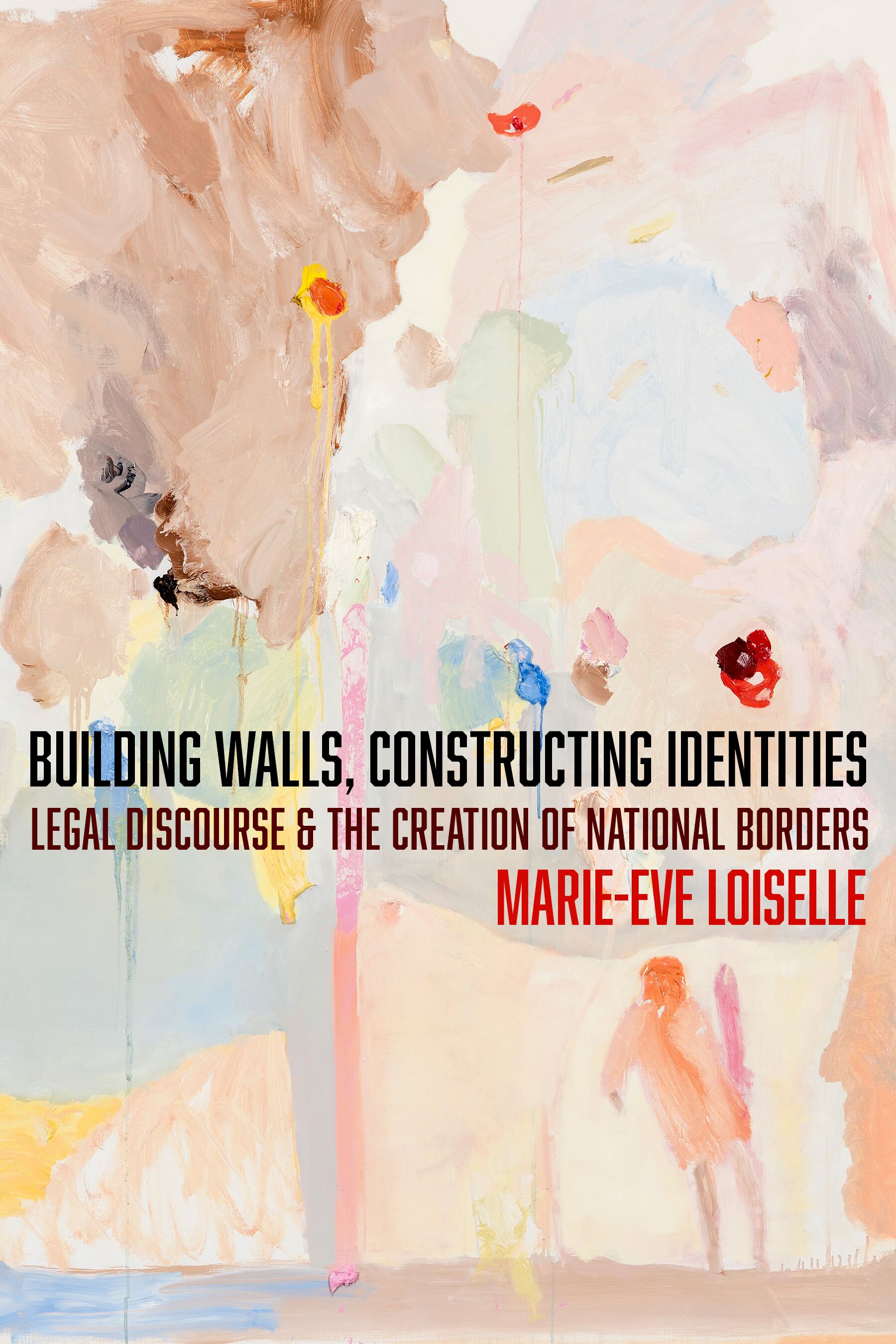
Building Walls, Constructing Identities
States are erecting walls at their borders at a pace unmatched in history, and the wall between the United States and Mexico stands as an icon among these dividing structures. Much has been said about the US-Mexico border wall in the last few decades, yet American walling projects have a much longer history, dating back almost a century. Building Walls, Constructing Identities offers a rich account of this legal history, informed by two episodes of wall-building—the Act of August 19, 1935, and the Secure Fence Act of 2006. These two legislative periods illustrate that today's wall imprints onto the landscape a grammar of racial inequality underpinned by a settler colonial rationality. Marie-Eve Loiselle argues in favor of an account of the law that considers its material translation into space and identifies discursive processes by which the law and the wall come together to communicate legal knowledge about territory and identity.
eBook