
Catalogue Search | MBRL


Are you sure you want to remove the book from the shelf?

{{itemTitle}}
2
result(s) for
"Borges, Jorge Luis - Political and social views"
Sort by:
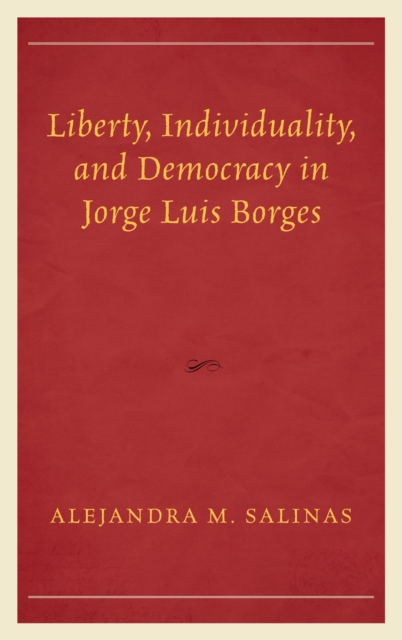
Liberty, individuality, and democracy in Jorge Luis Borges
This book seeks to fill a double lacuna in Borges scholarship. For one, this scholarship has been largely developed through the lens of literary and cultural studies, and not by political theorists who bring a distinct disciplinary perspective into the reading of literary works. Secondly, mainstream interpreters have overlooked or have not analyzed enough Borges's political sympathies. This book doesnot evaluate if these sympathies are truthful to political and historical facts or philosophical theories; rather, she shows in which aspects and around which topics Borges finds inspiration and gives literary form to the political. His texts abound with concepts and events such as liberty, individuality, war, and revolution, and they deal with topics such as the legitimacy of authority, the limits of reason, and the principle of representation, among others. This book also addresses Borges's democratic sensitivity and his critique of populism and militarism as related to salient national and global historical events that inspired his works. Above all, it calls attention to Borges's belief in the pre-eminence of individual liberty, his rejection of political oppression, and his warning against civic indifference brought about by an isolated individualism. This book may be of interest to students and professors of politics, philosophy and literature. It may also interest literary critics and readers who want to approach Borges's works with a political rather than a literary or a cultural lens.
eBook

Necrophilology
The problem that the general equivalent poses to Marx’s theory of value stems from two sources.¹ The first is the theory’s first moment, preceding and setting under way what Alfred Sohn-Rethel calls Marx’s “commodity abstraction,” and in specific from the requirement thatany commodity whatevermay pass from the field of relative valuation (of value that pertains to its use, here and now, to a concrete end) into the role of coin-of-the-realm in a circuit of exchange, of general equivalent, of money.² Whatever-commodity steps uncertainly into the abstract, general shape that awaits it, there to lose every particular relation to
Book Chapter