
Catalogue Search | MBRL


Are you sure you want to remove the book from the shelf?

{{itemTitle}}
811
result(s) for
"Botany Terminology."
Sort by:

The Kew plant glossary : an illustrated dictionary of plant terms
\"Kew's highly acclaimed plant dictionary clearly defines 4,905 entries used by botanists to describe plants in textbooks, scientific papers, floras and field guides. This second edition includes 400 new terms including a section of vegetation types, and more than 730 entries are illustrated with detailed line drawings as well as 32 plates of grouped terms. The Kew Plant Glossary provides an essential reference for students, teachers, researchers, conservationists, horticulturalists, agriculturalists and gardeners.\" --Cover.
Book

A Primer of Botanical Latin with Vocabulary
Latin is one of two acceptable languages for describing new plants, and taxonomists must be able to translate earlier texts in Latin. Providing a simple explanation of Latin grammar along with an in-depth vocabulary, this is an indispensable guide for systematic botanists worldwide. All relevant parts of speech are discussed, with accompanying examples as well as worked exercises for translating diagnoses and descriptions to and from Latin. Guidelines for forming specific epithets are also included. The authors cross-reference their grammar to Stearn's Botanical Latin and to articles in the International Code of Nomenclature for Algae, Fungi and Plants. The comprehensive vocabulary is enhanced with terms from recent glossaries for non-flowering plants – lichens, mosses, algae, fungi and ferns – making this an ideal resource for anyone looking to hone their understanding of Latin grammar and to translate botanical texts from the past 300 years.
eBook


Units, symbols, and terminology for plant physiology : a reference for presentation of research results in the plant sciences
This book represents a beginning toward a consensus on units, symbols, and terminology in the plant sciences. Written by 27 specialists and reviewed by several others, each discussion is condensed for easy reference, but still thorough enough to answer virtually any question concerning plant terminology. Principles are outlined and covered in readable text. Some chapters include formulas and definitions of specialized terms, while others include recommendations for suitable units. The appendices offer guidelines on presenting scientific data, such as principles of grammar, oral and poster presentations, and reporting on data from experiments that utilized growth chambers. Anyone involved in the plant sciences, particularly plant physiology, will find this an invaluable reference.
eBook

A Glossary of Latin and Italo-Romance Medico-Botanical Terms in Hebrew Characters on an Illustrated Manuscript Page (Ms. Oxford, Bodleian Opp. 688, fol. 117b)
This article studies fol. 117b of Ms. Oxford, Bodleian Opp. 688, cat. Neubauer
2123, which combines a small bilingual medico-botanical glossary
(Latin/Italo-Romance in Hebrew characters) with a drawing representing a hunting
scene. Although there is possibly no relationship between the drawing and the
glossary, both elements provide interesting insights into Jewish life and
culture in fifteenth-century Italy. We analyze the drawing, identifying it as an
allegory of the persecution of the Jews, as well as the glossary. The latter is
studied both in its relationship to Rogerio Frugardi's
Chirurgia (a Hebrew translation of which is featured in the
same codex) and in terms of the medico-botanical vocabulary itself. The nature
of the Italo-Romance words eventually suggests that the writer came from an area
in or near Latium or Abruzzo.
Journal Article
The Names of Plants
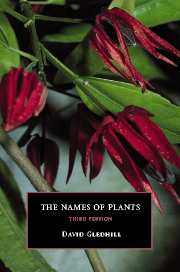
The Names of Plants is a handy two-part reference for the botanist and amateur gardener. The book begins by documenting the historical problems associated with an ever-increasing number of common names of plants and the resolution of these problems through the introduction of International Codes for both botanical and horticultural nomenclature. It also outlines the rules to be followed when plant breeders name a new species or cultivar of plant. The second part of the book comprises an alphabetical glossary of generic and specific plant names, and components of these, from which the reader may interpret the existing names of plants and construct new names. For the third edition, the book has been updated to include explanations of the International Codes for both Botanical Nomenclature (2000) and Nomenclature for Cultivated Plants (1995). The glossary has similarly been expanded to incorporate many more commemorative names.
eBook

‘Hemiepiphyte’: a confusing term and its history
Background and ScopeOver more than 120 years of scientific study since Schimper's seminal work, the recognized categories of structurally dependent plants have changed several times. Currently, ignoring parasitic mistletoes, it is usual to distinguish four functional groups: (1) true epiphytes; (2) primary hemiepiphytes; (3) secondary hemiepiphytes; and (4) climbing plants, i.e. lianas and vines. In this Viewpoint, it is argued that the term secondary hemiepiphytes (SHs) is misleading, that its definition is hard to impossible to apply in the field and, possibly causally related to this conceptual problem, that the use of this category in field studies is inconsistent, which now hampers interpretation and generalization.ConclusionsCategories will frequently fail to capture gradual biological variation, but terms and concepts should be as unambiguous as possible to facilitate productive communication. A detailed analysis of the conceptual problems associated with the term SH and its application in scientific studies clearly shows that this goal is not fulfilled in this case. Consequently, the use of SH should be abandoned. An alternative scheme to categorize structurally dependent flora is suggested.
Journal Article

On the language and physiology of dormancy and quiescence in plants
The language of dormancy is rich and poetic, as researchers spanning disciplines and decades have attempted to understand the spell that entranced ‘Sleeping Beauty’, and how she was gently awoken. The misleading use of ‘dormancy’, applied to annual axillary buds, for example, has confounded progress. Language is increasingly important as genetic and genomic approaches become more accessible to species of agricultural and ecological importance. Here we examine how terminology has been applied to different eco-physiological states in plants, and with pertinent reference to quiescent states described in other domains of life, in order to place plant quiescence and dormancy in a more complete context than previously described. The physiological consensus defines latency or quiescence as opportunistic avoidance states, where growth resumes in favourable conditions. In contrast, the dormant state in higher plants is entrained in the life history of the organism. Competence to resume growth requires quantitative and specific conditioning. This definition applies only to the embryo of seeds and specialized meristems in higher plants; however, mechanistic control of dormancy extends to mobile signals from peripheral tissues and organs, such as the endosperm of seed or subtending leaf of buds. The distinction between dormancy, quiescence, and stress-hardiness remains poorly delineated, most particularly in buds of winter perennials, which comprise multiple meristems of differing organogenic states. Studies in seeds have shown that dormancy is not a monogenic trait, and limited study has thus far failed to canalize dormancy as seen in seeds and buds. We argue that a common language, based on physiology, is central to enable further dissection of the quiescent and dormant states in plants. We direct the topic largely to woody species showing a single cycle of growth and reproduction per year, as these bear the majority of global timber, fruit, and nut production, as well being of great ecological value. However, for context and hypotheses, we draw on knowledge from annuals and other specialized plant conditions, from a perspective of the major physical, metabolic, and molecular cues that regulate cellular activity.
Journal Article

Trichomes in Asteraceae: Names Standardization and a Unified Classification
The family Asteraceae possesses a remarkable variety of trichomes which led to the use of the same name for different types of trichomes and different names for the same type of trichome. Light microscope observations of vegetative and reproductive organs of ca. 135 genera of Asteraceae were surveyed. Additional information on the trichomes of Asteraceae and other plant families was obtained from the literature. Some terms that are frequently misused, misunderstood, or employed as synonyms were clarified, the trichomes were classified and illustrated and the existing terminology was standardized. Seventeen trichome types and 25 subtypes were established: 1) Glandular trichomes: uniseriate (subtypes simple, bladder head); biseriate (subtypes simple, bladder head); multiseriate (subtypes simple, hollow-stalked, tack-shaped). 2) Non-glandular trichomes: unicellular; one-armed (subtypes simple, barnadesioid); filiform; flagelliform; conical; cylindrical; moniliform; two-armed (subtypes T-shaped, antler-shaped, L-shaped, Y-shaped); three- to more-armed (subtypes antler-shaped, stellate); scale; dendritic (subtypes ramose, bristly); multitiered (subtypes multi-two-armed, multistellate). 3) Twin trichomes: subtypes basic; asymmetric; divergent; crenate; radiate; one hair-celled. 4) Papillae. Synonymies and a key to trichomes are presented.
Journal Article

Back to the roots: standardizing root length density terminology
The number of studies investigating root length has increased, particularly in the context of root length measurements observed through windows such as minirhizotrons and rhizoboxes. However, there are currently two obstacles constraining their broader utility: (1) the absence of standardized terminology or units for root length data, and (2) the translation from two-dimensional (2D) to three-dimensional (3D) data. Here, we delineate the fundamental disparities between root length measurements obtained from observation windows and via volumetric soil sampling and propose the adoption of more precise terminology to distinguish 2D planar (pRLD) from 3D volumetric (vRLD) root length density measurements. This differentiation should be accompanied with the use of standardized units and should not endeavour to make blanket conversions between dimensions unless this is supported by specific calibration data.
Journal Article