
Catalogue Search | MBRL


Are you sure you want to remove the book from the shelf?

{{itemTitle}}
50
result(s) for
"Boys Comic books, strips, etc."
Sort by:

Barnaby. Volume 1. 1942-1943
Harold and the Purple Crayon cartoonist Crockett Johnson's Barnaby revolves around a precocious five-year-old named Barnaby Baxter and his fairly godfather Jackeen J. O'Malley. Yet O'Malley, a cigar-chomping, bumbling con-artist and fast-talker, is not your typical protector. His grasp of magic is usually specious at best, limited to occasional flashes, often aided and abetted by his fellow members in The Elves, Leprechauns, Gnomes, and Little Men's Chowder & Marching Society.
Book

Robin and the Making of American Adolescence
Holy adolescence, Batman! Robin and the Making of American Adolescence offers the first character history and analysis of the most famous superhero sidekick, Robin. Debuting just a few months after Batman himself, Robin has been an integral part of the Dark Knight’s history—and debuting just a few months prior to the word “teenager” first appearing in print, Robin has from the outset both reflected and reinforced particular images of American adolescence. Closely reading several characters who have “played” Robin over the past eighty years, Robin and the Making of American Adolescence reveals the Boy (and sometimes Girl!) Wonder as a complex figure through whom mainstream culture has addressed anxieties about adolescents in relation to sexuality, gender, and race. This book partners up comics studies and adolescent studies as a new Dynamic Duo, following Robin as he swings alongside the ever-changing American teenager and finally shining the Bat-signal on the latter half of “Batman and—.”
eBook

Skip
\"A colorful, unpredictable postapocalyptic world comes alive in Skip, when two unlikely friends, Bloom and Gloopy, find themselves tossed from dimension to dimension. Gloopy is running toward adventure, and away from their home and friends who don't understand their creative talent. Bloom is desperately trying to return home to their lake, and avoid the terrible violence of the city. Instead, both Bloom and Gloopy find what they need in each other, and bravely return home to challenge their fears and create beauty in their own worlds\"-- Publisher's description.
Book

Boys Love Manga and Beyond
Boys Love Manga and Beyondlooks at a range of literary, artistic and other cultural products that celebrate the beauty of adolescent boys and young men. In Japan, depiction of the \"beautiful boy\" has long been a romantic and sexualized trope for both sexes and commands a high degree of cultural visibility today across a range of genres from pop music to animation.
In recent decades, \"Boys Love\" (or simply BL) has emerged as a mainstream genre in manga, anime, and games for girls and young women. This genre was first developed in Japan in the early 1970s by a group of female artists who went on to establish themselves as major figures in Japan's manga industry. By the late 1970s many amateur women fans were getting involved in the BL phenomenon by creating and self-publishing homoerotic parodies of established male manga characters and popular media figures. The popularity of these fan-made products, sold and circulated at huge conventions, has led to an increase in the number of commercial titles available. Today, a wide range of products produced both by professionals and amateurs are brought together under the general rubric of \"boys love,\" and are rapidly gaining an audience throughout Asia and globally.
This collection provides the first comprehensive overview in English of the BL phenomenon in Japan, its history and various subgenres and introduces translations of some key Japanese scholarship not otherwise available. Some chapters detail the historical and cultural contexts that helped BL emerge as a significant part of girls' culture in Japan. Others offer important case studies of BL production, consumption, and circulation and explain why BL has become a controversial topic in contemporary Japan.
eBook
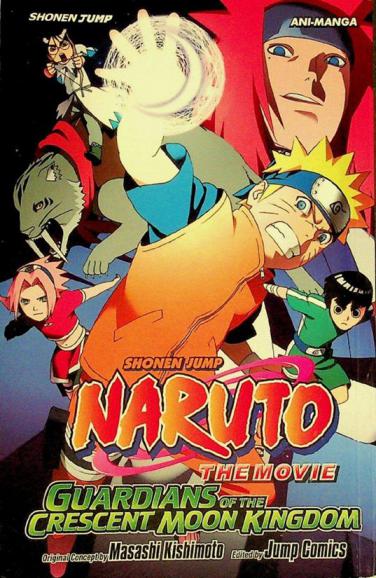
Naruto : the movie : Guardians of the Crescent Moon Kingdom
Naruto, Sakura, and Rock Lee escort Prince Michiru and his spoiled son Hikaru back to Crescent Moon Kingdom, where they find a villainous rebellion going on.
Book

Girls Who Love Girls and Boys Who Love Girlish Dresses
Joana Estrela, born in Penafiel in 1990, is a Portuguese illustrator and comics artist whose short but rich career path intersects significantly with the concerns of girlhood and the dynamics of the transnational creation and circulation of graphic narratives. In 2013, she self-published the zine, Os vestidos do Tiago, which was later re-published by the independent Luso-Brazilian publisher Sapata Press in 2018 and is now available in English with the title James's Dresses (2019). The zine is a short immersion into the fictional, though quite realistic, world of Tiago, a boy who loves wearing feminine dresses and is not scared of experimenting with them. Despite having a boy as protagonist, Os vestidos do Tiago can be looked at as Estrela's first attempt at representing girlhood, given the presence, in the publication, of crucial aesthetic references to the realm of childhood and femininity.
Journal Article
Black clover
\"Asta is a young boy who dreams of becoming the greatest mage in the kingdom. Only one problem--he can't use any magic! Luckily for Asta, he receives the incredibly rare five-leaf clover grimoire that gives him the power of anti-magic. Can someone who can't use magic really become the Wizard King? One thing's for sure -- Asta will never give up!\"--Back cover of Volume 1.
Book

The Loud house. #22, Powered up!
\"Power up with Lincoln Loud and his ten sisters, Lori, Leni, Luna, Luan, Lynn, Lucy, Lola, Lana, Lisa, and Lily, in the latest high-voltage volume!\"-- From publisher description.
CHILDBOOK

Christopher Koch: drawn to comics Paper in special conference issue: Australian Literature in a Global World. Ommundsen, Wenche and Simoes da Silva. Tony (eds).
In debates about appreciation and interpretation of literature, Christopher Koch is an outspoken, and often controversial, figure. In his now famed acceptance speech for the 1996 Miles Franklin award for his Vietnam War novel, 'Highways to a War', Koch berated the 'bullies' in the ranks of the literary community for ignoring Beauty in Literature, and for seeing authors as 'blind instruments of social forces'. He deplores what he terms the postmodern approach to critical analysis, and continues in this vein when he writes the foreword to 'Education and the Ideal' (2004), questioning why children are 'studying films, comic strips and hopelessly bad contemporary novels with social messages, rather than major works that have stood the test of time' (vii). It is somewhat surprising then, to study Koch's novels and uncover how frequently his work is informed by childhood influences and his love of comic books. The question raised is whether unwittingly Koch, as an author, is indeed an instrument of social forces.
Journal Article