
Catalogue Search | MBRL


Are you sure you want to remove the book from the shelf?

{{itemTitle}}
41
result(s) for
"Brazil History 16th century."
Sort by:


Go-betweens and the Colonization of Brazil
Doña Marina (La Malinche) ...Pocahontas ...Sacagawea-their names live on in historical memory because these women bridged the indigenous American and European worlds, opening the way for the cultural encounters, collisions, and fusions that shaped the social and even physical landscape of the modern Americas. But these famous individuals were only a few of the many thousands of people who, intentionally or otherwise, served as \"go-betweens\" as Europeans explored and colonized the New World.
In this innovative history, Alida Metcalf thoroughly investigates the many roles played by go-betweens in the colonization of sixteenth-century Brazil. She finds that many individuals created physical links among Europe, Africa, and Brazil-explorers, traders, settlers, and slaves circulated goods, plants, animals, and diseases. Intercultural liaisons produced mixed-race children. At the cultural level, Jesuit priests and African slaves infused native Brazilian traditions with their own religious practices, while translators became influential go-betweens, negotiating the terms of trade, interaction, and exchange. Most powerful of all, as Metcalf shows, were those go-betweens who interpreted or represented new lands and peoples through writings, maps, religion, and the oral tradition. Metcalf's convincing demonstration that colonization is always mediated by third parties has relevance far beyond the Brazilian case, even as it opens a revealing new window on the first century of Brazilian history.
eBook

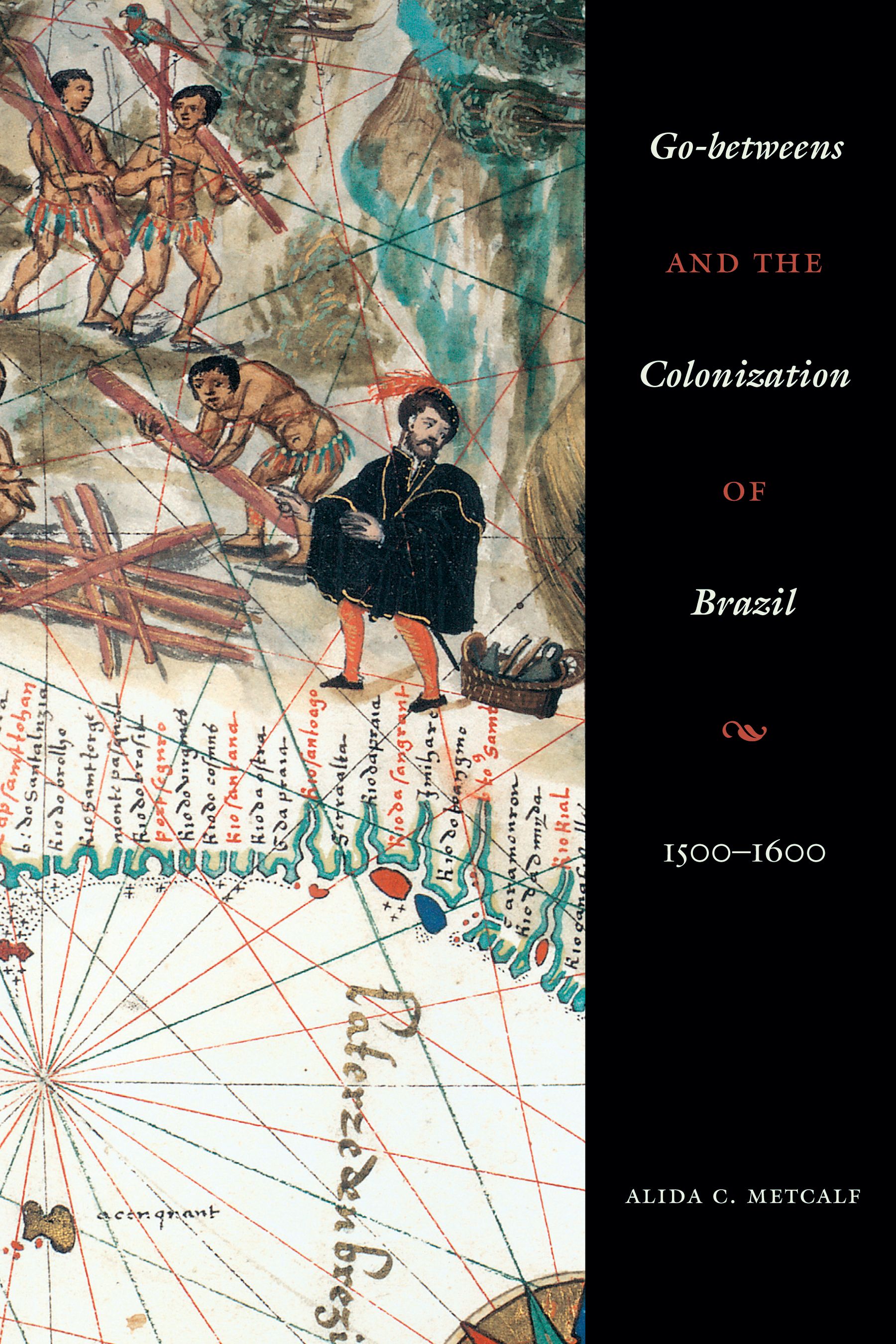
Go-betweens and the Colonization of Brazil
Doña Marina (La Malinche) ...Pocahontas ...Sacagawea—their names live on in historical memory because these women bridged the indigenous American and European worlds, opening the way for the cultural encounters, collisions, and fusions that shaped the social and even physical landscape of the modern Americas. But these famous individuals were only a few of the many thousands of people who, intentionally or otherwise, served as \"go-betweens\" as Europeans explored and colonized the New World. In this innovative history, Alida Metcalf thoroughly investigates the many roles played by go-betweens in the colonization of sixteenth-century Brazil. She finds that many individuals created physical links among Europe, Africa, and Brazil—explorers, traders, settlers, and slaves circulated goods, plants, animals, and diseases. Intercultural liaisons produced mixed-race children. At the cultural level, Jesuit priests and African slaves infused native Brazilian traditions with their own religious practices, while translators became influential go-betweens, negotiating the terms of trade, interaction, and exchange. Most powerful of all, as Metcalf shows, were those go-betweens who interpreted or represented new lands and peoples through writings, maps, religion, and the oral tradition. Metcalf's convincing demonstration that colonization is always mediated by third parties has relevance far beyond the Brazilian case, even as it opens a revealing new window on the first century of Brazilian history.
eBook

Between Empires: Brazilian Sugar in the Early Atlantic Economy,1550-1630
This study of the wholesale trade in Brazilian sugar challenges previous imperial and mercantilist perspectives and presents the Atlantic economy in its earliest phases as an integrated, inter-imperial system not subject to monopolies and effective imperial regulation.
eBook

Responsa in a Historical Context
A Winner of the 2024 Association for Jewish Studies' Jordan Schnitzer First Book Publication Award
This book contains a collection of eight annotated translations of responsa, alongside the original Hebrew texts, focusing on the post-expulsion Spanish-Portuguese communities of the sixteenth to seventeenth centuries. This collection will acquaint the reader with Jews who, following their expulsion, settled in the Ottoman Empire, in Palestine under the Mamluks, in Amsterdam and in Brazil. The period of the expulsion of the Jews from the Iberian Peninsula was a tragic time in Jewish history, but the revitalization of the post-expulsion Spanish-Portuguese Jewish communities in new locales is testimony to the human spirit and determination.
The volume includes eight chapters, each built around one responsum from one of the great halakhic authorities of the time. Topics include excommunication in Amsterdam, ʻ
agunot , inheritance rights of a converso son, obligatory contracts and breach of agreement, heresy and humanist scholarship, informing on someone to the Venetian Inquisition, and more
eBook

Pre-colonial Amerindian legacies in forest composition of southern Brazil
Past human societies have left persistent marks on forests worldwide. However, the degree to which pre-colonial Amerindian societies have affected forest structure is still not fully understood, especially in southern Brazil. This study investigated the influence of two distinct Amerindian groups (Southern-Jê and Guarani) over tree composition of forest fragments in the State of Santa Catarina. Vegetation data was obtained from the Santa Catarina Forest and Floristic Inventory (SCFFI): a statewide systematic vegetation sampling project. Archaeological data was collated from literature reviews as well as existing databases for archaeological sites occupied by Guarani and Southern-Jê groups. Using these sites of known Amerindian occupation, and corresponding environmental variables, ecological niche models were developed for each Amerindian group, predicting potential archaeological sites occupied by these groups across southern Brazil. Maps of these potential occupation sites of pre-colonial Amerindian groups were compared with 417 corresponding floristic inventory plots. Redundancy analysis (RDA) was used to identify floristic composition patterns linked to areas with a high probability of Southern-Jê or Guarani presence. Southern-Jê and Guarani pre-colonial occupations overlapped near main rivers; however, Southern-Jê groups generally occupied elevated areas whereas Guarani occupied mostly coastal areas. We observed differences in forest composition associated with the predicted occurrence of these pre-colonial Amerindian groups. Based on these results, we argue there is a relationship between tree species distribution and pre-colonial human occupation by these two Amerindian groups.
Journal Article

Stable isotope evidence for dietary diversification in the pre-Columbian Amazon
Archaeological research is radically transforming the view that the Amazon basin and surrounding areas witnessed limited societal development before European contact. Nevertheless, uncertainty remains on the nature of the subsistence systems and the role that aquatic resources, terrestrial mammalian game, and plants had in supporting population growth, geographic dispersal, cultural adaptations and political complexity during the later stages of the pre-Columbian era. This is exacerbated by the general paucity of archaeological human remains enabling individual dietary reconstructions. Here we use stable carbon and nitrogen isotope analysis of bone collagen to reconstruct the diets of human individuals from São Luís Island (Brazilian Amazon coast) dated between
ca
. 1800 and 1000 cal BP and associated with distinct ceramic traditions. We expanded our analysis to include previously published data from Maracá and Marajó Island, in the eastern Amazon. Quantitative estimates of the caloric contributions from food groups and their relative nutrients using a Bayesian Mixing Model revealed distinct subsistence strategies, consisting predominantly of plants and terrestrial mammals and variably complemented with aquatic resources. This study offers novel quantitative information on the extent distinct food categories of polyculture agroforestry systems fulfilled the caloric and protein requirements of Late Holocene pre-Columbian populations in the Amazon basin.
Journal Article

A Smart Campus Framework: Challenges and Opportunities for Education Based on the Sustainable Development Goals
Although technology improvements boosted the digital transition of universities, which built a path for smart campuses, the smartization process is more than simply promoting digitalization. This research aims to identify the essential elements and the most significant deficiencies in the smart campus dimensions and its variables from the user’s viewpoint to offer a list of priorities for decision-makers. Through an importance-performance analysis (IPA) performed using IBP SPSS 26, we tested an integrative smart campus framework in a Brazilian university, previously validated with Latin American experts. This research confirmed that eight dimensions are important for a smart campus evaluation and provided a list of priorities for academic managers. The results indicated the main gaps among importance and performance. This research concluded that the smartization process could not rely on technology attributes only. Universities should meet the modern society’s present and emerging needs and the labor market in a sustainable, social, and technological manner. Smart campuses in developing countries may prioritize different components than developed countries, such as infrastructure. We propose that more studies should apply the framework in more universities.
Journal Article
Understanding the Chronology and Occupation Dynamics of Oversized Pit Houses in the Southern Brazilian Highlands
A long held view about the occupation of southern proto-Jê pit house villages of the southern Brazilian highlands is that these sites represent cycles of long-term abandonment and reoccupation. However, this assumption is based on an insufficient number of radiocarbon dates for individual pit houses. To address this problem, we conducted a programme of comprehensive AMS radiocarbon dating and Bayesian modelling at the deeply stratified oversized pit House 1, Baggio I site (Cal. A.D. 1395-1650), Campo Belo do Sul, Santa Catarina state, Brazil. The stratigraphy of House 1 revealed an unparalleled sequence of twelve well preserved floors evidencing a major change in occupation dynamics including five completely burnt collapsed roofs. The results of the radiocarbon dating allowed us to understand for the first time the occupation dynamics of an oversized pit house in the southern Brazilian highlands. The Bayesian model demonstrates that House 1 was occupied for over two centuries with no evidence of major periods of abandonment, calling into question previous models of long-term abandonment. In addition, the House 1 sequence allowed us to tie transformations in ceramic style and lithic technology to an absolute chronology. Finally, we can provide new evidence that the emergence of oversized domestic structures is a relatively recent phenomenon among the southern proto-Jê. As monumental pit houses start to be built, small pit houses continue to be inhabited, evidencing emerging disparities in domestic architecture after AD 1000. Our research shows the importance of programmes of intensive dating of individual structures to understand occupation dynamics and site permanence, and challenges long held assumptions that the southern Brazilian highlands were home to marginal cultures in the context of lowland South America.
Journal Article