
Catalogue Search | MBRL


Are you sure you want to remove the book from the shelf?

{{itemTitle}}
12
result(s) for
"Brevskrivning."
Sort by:

Women's letters from ancient Egypt, 300 BC-AD 800
\"More than three hundred letters written in Greek and Egyptian by women in Egypt in the millennium from Alexander the Great to the Arab conquest survive on papyrus and pottery. These letters were written by women from various walks of life and shed light on critical social aspects of life in Egypt after the pharaohs. Roger S. Bagnall and Raffaella Cribiore collect the best preserved of these letters in translation and set them in their paleographic, linguistic, social, and economic contexts. As a result, Women's Letters from Ancient Egypt, 300 B.C.-A.D. 800, provides a sense that these women's habits, interests, and means of expression were a product more of their social and economic standing than of specifically gender-related concerns or behavior.\"--Jacket.
Book

Reading the Letters of Pliny the Younger
This is the first general introduction to Pliny's Letters published in any language, combining close readings with broader context and adopting a fresh and innovative approach to reading the letters as an artistically structured collection. Chapter 1 traces Pliny's autobiographical narrative throughout the Letters; Chapter 2 undertakes detailed study of Book 6 as an artistic entity; while Chapter 3 sets Pliny's letters within a Roman epistolographical tradition dominated by Cicero and Seneca. Chapters 4 to 7 study thematic letter cycles within the collection, including those on Pliny's famous country villas and his relationships with Pliny the Elder and Tacitus. The final chapter focuses on the 'grand design' which unifies and structures the collection. Four detailed appendices give invaluable historical and scholarly context, including a helpful timeline for Pliny's life and career, detailed bibliographical help on over 30 popular topics in Pliny's letters and a summary of the main characters mentioned in the Letters.
eBook

Letters, Postcards, Email
In this original study, Milne moves between close readings of letters, postcards and emails, and investigations of the material, technological infrastructures of these forms, to answer the question: How does presence function as an aesthetic and rhetorical strategy within networked communication practices? As her work reveals, the relation between old and new communication systems is more complex than allowed in much contemporary media theory.
Although the correspondents of letters, postcards and emails are not, usually, present to one another as they write and read their exchanges, this does not necessarily inhibit affective communication. Indeed, this study demonstrates how physical absence may, in some instances, provide correspondents with intense intimacy and a spiritual, almost telepathic, sense of the other’s presence. While corresponding by letter, postcard or email, readers construe an imaginary, incorporeal body for their correspondents that, in turn, reworks their interlocutor’s self-presentation. In this regard the fantasy of presence reveals a key paradox of cultural communication, namely that material signifiers can be used to produce the experience of incorporeal presence.
Esther Milne is Lecturer, Department of Media and Communications, Faculty of Life and Social Sciences, Swinburne University, Melbourne, Australia.
List of Figures Acknowledgments Introduction 1: \"The Conscious Presence of a Central Intellect\": British Postal History 2: \"The simple transcripts of natural feeling\": Signifiers of Presence in Epistolary Practice 3: \"The ghosts of all my impertinent letters\": Presence in Crisis 4: \"The Self-conscious air of the reproduced\": Postcard History 5: \"A photo of the ship that I am now on\": Signifiers of Presence, Intimacy and Privacy in Postcard Correspondence 6: A Brief History of Electronic Mail 7: \"In my sickness\": Constructing Presence on the Cybermind Discussion Group Conclusion Notes Bibliography Index
eBook

Postal Culture
The nationalization of the postal service in Italy transformed post-unification letter writing as a cultural medium. Both a harbinger of progress and an expanded, more efficient means of circulating information, the national postal service served as a bridge between the private world of personal communication and the public arena of information exchange and production of public opinion. As a growing number of people read and wrote letters, they became part of a larger community that regarded the letter not only as an important channel in the process of information exchange, but also as a necessary instrument in the education and modernization of the nation.
In Postal Culture , Gabriella Romani examines the role of the letter in Italian literature, cultural production, communication, and politics. She argues that the reading and writing of letters, along with epistolary fiction, epistolary manuals, and correspondence published in newspapers, fostered a sense of community and national identity and thus became a force for social change.
eBook

The Gift of Correspondence in Classical Rome
Amanda Wilcox offers an innovative approach to two major collections of Roman letters—Cicero’s
Ad Familiares and Seneca’s
Moral Epistles —informed by modern cross-cultural theories of gift-giving. By viewing letters and the practice of correspondence as a species of gift exchange, Wilcox provides a nuanced analysis of neglected and misunderstood aspects of Roman epistolary rhetoric and the social dynamics of friendship in Cicero’s correspondence. Turning to Seneca, she shows that he both inherited and reacted against Cicero’s euphemistic rhetoric and social practices, and she analyzes how Seneca transformed the rhetoric of his own letters from an instrument of social negotiation into an idiom for ethical philosophy and self-reflection. Though Cicero and Seneca are often viewed as a study in contrasts, Wilcox extensively compares their letters, underscoring Cicero’s significant influence on Seneca as a prose stylist, philosopher, and public figure.
eBook

Lost Letters of Medieval Life
Everyday life in early thirteenth-century England is revealed in vivid detail in this riveting collection of correspondence of people from all classes, from peasants and shopkeepers to bishops and earls. The documents presented here include letters between masters and servants, husbands and wives, neighbors and enemies, and cover a wide range of topics: politics and war, going to fairs and going to law, attending tournaments and stocking a game park, borrowing cash and doing favors for friends, investigating adultery and building a windmill.
While letters by celebrated people have long been known, the correspondence of ordinary people has not survived and has generally been assumed never to have existed in the first place. Martha Carlin and David Crouch, however, have discovered numerous examples of such correspondence hiding in plain sight. The letters can be found in manuscripts called formularies-the collections of form letters and other model documents that for centuries were used to teach the arts of letter-writing and keeping accounts.
The writing-masters and their students who produced these books compiled examples of all the kinds of correspondence that people of means, members of the clergy, and those who handled their affairs might expect to encounter in their business and personal lives. Tucked among the sample letters from popes to bishops and from kings to sheriffs are examples of a much more casual, ephemeral kind of correspondence. These are the low-level letters that evidently were widely exchanged, but were often discarded because they were not considered to be of lasting importance. Two manuscripts, one in the British Library and the other in the Bodleian Library, are especially rich in such documents, and it is from these collections that Carlin and Crouch have drawn the documents in this volume. They are presented here in their first printed edition, both in the original Latin and in English translation, each document splendidly contextualized in an accompanying essay.
eBook
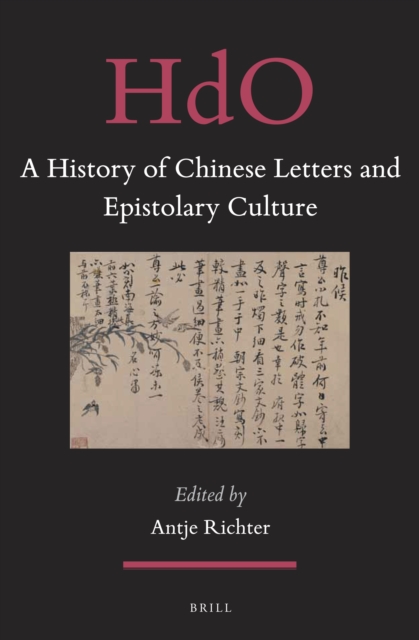
A History of Chinese Letters and Epistolary Culture
Dedicated to the study of Chinese epistolary literature and culture from the early empire to the twentieth century, the twenty-five essays of A History of Chinese Letters and Epistolary Culture discuss a wealth of epistolary topics and provide numerous translations.
eBook

Paul and the Ancient Letter Form
This volume seeks to advance the discusison of Paul's relationship to Greek epistolary traditions by evaluating the nature of ancient letters as well as the individual letter components. These features are evaluated alongside Paul's letters to better understand Paul's use and adaptations of these traditions in order to meet his communicative needs.
eBook
Letter Writing in Late Modern Europe
Letter-writing instruction grew in importance as a learning tool in the Late Modern period because of its practical application to real-life situations. The vernacular had become the language of the educated, and the rising middle classes needed literacy skills to prepare for their vocations. The British Empire was growing and changing. Industrial centers were forming and trade to foreign ports increased, both of which demanded language competence. Letter writing reinforced grammar and composition skills in order for students to be successful. This study will investigate how schoolmasters used letter-writing assignments to improve literacy, teach grammar rules, and develop writing strategies, paying special attention to the earliest stages of this process, in the seventeenth and eighteenth centuries.
eBook
