
Catalogue Search | MBRL


Are you sure you want to remove the book from the shelf?

{{itemTitle}}
1,568
result(s) for
"Bribery Prevention."
Sort by:

Bribery and corruption in weak institutional environments : connecting the dots from a comparative perspective
\"Drawing on 20 years of research and observations, Li explains how bribery and corruption are carried out in countries with weak institutional environments, and how these activities become globalized. By distinguishing rule-based, relation-based and clan-based governance, this book offers a novel explanation to the age-old puzzle of why some countries thrive despite corruption. It also sheds lights on the symbiotic roles corruption and anticorruption campaigns play in maintaining dictatorships. Applying cost-benefit analysis to different governance environments, Li argues that as non-rule-based economies expand, the transition from relying on private relationships to relying on public rules is inevitable. However, by highlighting the globalization of corruption by non-rule-based countries, this book warns against the potential threats and consequences of bribery by powerful dictatorial governments. This book will appeal to scholars, analysts and graduate students studying corruption, as well as policymakers, business professionals and executives seeking insights into the characteristics of bribery and corruption within different institutional settings\"-- Provided by publisher.
Book
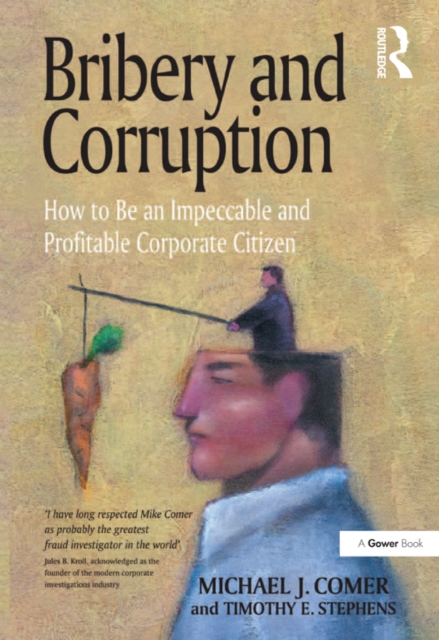
Bribery and corruption
Politicians and regulators do not run businesses. Bribery and Corruption is for managers who do. It will help you transform uncertainties and problems created via legislation and regulations (such as The UK Bribery Act, The Proceeds of Crime Act, The Foreign Corrupt Practices Act, Sarbanes-Oxley) into opportunities to: ¢ Maintain entrepreneurial, profitable, and enjoyable working environments while easily surpassing compliance standards ¢ Control incoming, internal, outgoing, competitive corruption and fraud ¢ Take decisions in grey areas, confidently Bribery and Corruption frames control and compliance in an entirely different way: not as a brake on your company’s forward motion but as essential protective equipment enabling you to go faster and further in safety. Written by the world’s leading practitioners in the fields of fraud prevention, detection and investigation with massive practical experience in both commercial and governmental sectors, Bribery and Corruption exposes the misconceptions, myths and corruption of the word bribery and suggests effective solutions that go well beyond simple compliance. It commits to assertive managerial rather than timorous legal solutions to anti-bribery and other laws. It explains how processes can be tested - using automated fraud detection software - to expose current cases of fraud and corruption or to provide assurance that controls are functioning optimally. It tackles the usually ignored problems of stratospheric, political, academic and media corruption, which often motivate commercial bribery. It exposes the dangers of employee to employee corruption; skulduggery by blue collar workers and lots more. Over the last 25 years, Mike Comer, occasionally writing with Tim Stephens, has been responsible for some of the most readable and influential books on fraud. Bribery and Corruption is another tour de force, complete, authoritative and yet a great pleasure to read.
Mike Comer, a member of MENSA, is Managing Director of Cobasco Group Limited, an elite community of fraud and compliance practitioners. He has served as Visiting Professor at Cranfield Institute of Technology, and is Honorary Visiting Fellow, Scarman Centre, University of Leicester. He is past President of the European Chapter of Association of Certified Fraud Examiners and ex-Chairman of American Society of Industrial Security's committee on fraud. Mike has written six books each translated into Spanish, Portuguese, German, Thai and Chinese. Corporate Fraud III (Gower, 1997) is a best seller. Investigating Corporate Fraud (Gower, 2003) was hailed a 'masterpiece' and 'a survival guide for businesses' by Professional Security magazine. Timothy Stephens, who died in April 2012, was a director of Cobasco Group, in charge of research and intelligence. Tim was responsible for the production of Inside Fraud Bulletin contributing a number of groundbreaking articles, including reviews of the Partners Against Crime Initiative, Data Protection Legislation and the Anti-Terrorism Crime and Security Act.
eBook


Private Remedies for Corruption
Despite significant developments in anti-corruption law and policy over the last 20 years, corruption still remains a deep and pressing problem.The profoundly negative consequences of corruption in a global world make the need for effective mechanisms to combat it particularly urgent.
eBook

Foreign corrupt practices act compliance guidebook
Foreign Corrupt Practices Act Compliance Guidebook shows readers how the Foreign Corrupt Practices Act (FCPA) has grown to critical importance to any U.S. company that does business in a global environment, as well as foreign companies that supply or have agency agreements with U.S. companies. It provides an overview of the business risks and guidance on spotting potential red flags regarding FCPA violation. Business professionals are provided with practical guidance on managing FCPA requirements as part of an overall compliance program.
eBook

Indicatoren van corruptie en omkoping, Handboek voor medewerkers van de Belastingdienst
Het doel van dit handboek is de bevordering van het bewustzijn van medewerkers van de Belastingdienst met betrekking tot omkoping en andere vormen van corruptie. Het boek vormt een leidraad voor het herkennen van indicatoren van mogelijke omkoping of corruptie die zij bij de heffing en controle van belastingen kunnen tegenkomen.
eBook

Public procurement: Spotting the bribe
From major public works projects such as constructing power stations and roads to building public universities and equipping them with telecommunications and rest rooms, government contracts are a magnet for international business and generate enormous financial flows. In OECD countries, public procurement is estimated to account for 15% of GDP, and more in many non-OECD countries. While all this generates enormous valuable economic activity, it also makes procurement vulnerable to bribery on a global scale. What should governments do? Here are several areas for action: 1. Make sure the appropriate procurement and anti-corruption laws are in place. 2. Develop networks of experts with judicial and technical skills to improve prevention and detection within procurement administrations. 3. Cultivate awareness and application of adequate procurement rules and controls. The OECD's anti-bribery instruments will evolve to continue leading the fight against bribery in public procurement, but their effectiveness ultimately depends on the people on the ground.
Journal Article

Anti-corruption, transparency and accountability in health: concepts, frameworks, and approaches
Background: As called for by the Sustainable Development Goals, governments, development partners and civil society are working on anti-corruption, transparency and accountability approaches to control corruption and advance Universal Health Coverage.
Objectives: The objective of this review is to summarize concepts, frameworks, and approaches used to identify corruption risks and consequences of corruption on health systems and outcomes. We also inventory interventions to fight corruption and increase transparency and accountability.
Methods: We performed a critical review based on a systematic search of literature in PubMed and Web of Science and reviewed background papers and presentations from two international technical meetings on the topic of anti-corruption and health. We identified concepts, frameworks and approaches and summarized updated evidence of types and causes corruption in the health sector.
Results: Corruption, or the abuse of power for private gain, in health systems includes bribes and kickbacks, embezzlement, fraud, political influence/nepotism and informal payments, among other behaviors. Drivers of corruption include individual and systems level factors such as financial pressures, poorly managed conflicts of interest, and weak regulatory and enforcement systems. We identify six typologies and frameworks that model relationships influencing the scope and seriousness of corruption, and show how anti-corruption strategies such as transparency, accountability, and civic participation can affect corruption risk. Little research exists on the effectiveness of anti-corruption measures; however, interventions such as community monitoring and insurance fraud control programs show promise.
Conclusions: Corruption undermines the capacity of health systems to contribute to better health, economic growth and development. Interventions and resources on prevention and control of corruption are essential components of health system strengthening for Universal Health Coverage.
Journal Article