
Catalogue Search | MBRL


Are you sure you want to remove the book from the shelf?

{{itemTitle}}
901
result(s) for
"Brodsky, Joseph (1940-1996)"
Sort by:

The Man Who Brought Brodsky into English
Brodsky's poetic career in the West was launched when Joseph
Brodsky: Selected Poems was published in 1973. Its translator
was a scholar and war hero, George L. Kline. This is the story of
that friendship and collaboration, from its beginnings in 1960s
Leningrad and concluding with the Nobel poet's death in 1996.
Kline translated more of Brodsky's poems than any other single
person, with the exception of Brodsky himself. The Bryn Mawr
philosophy professor and Slavic scholar was a modest and retiring
man, but on occasion he could be as forthright and adamant as
Brodsky himself. \"Akhmatova discovered Brodsky for Russia, but I
discovered him for the West,\" he claimed.
Kline's interviews with author Cynthia L. Haven before his death
in 2014 include a description of his first encounter with Brodsky,
the KGB interrogations triggered by their friendship, Brodsky's
emigration, and the camaraderie and conflict over translation. When
Kline called Brodsky in London to congratulate him for the Nobel,
the grateful poet responded, \"And congratulations to you, too,
George!\"
eBook
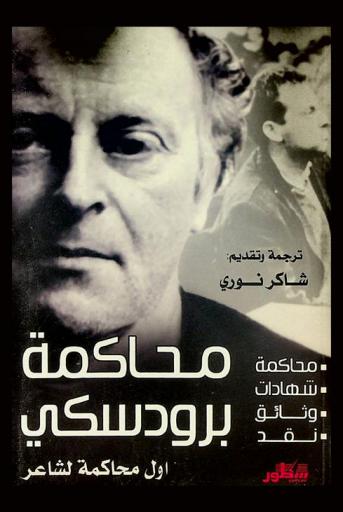
محاكمة برودسكي : أول محاكمة لشاعر محاكمة.شهادات.وثائق.نقد
هذا الكتاب : محاكمة سريالية تراجيكوميدية، إن من يركض وراء نشر كتبه لا يمكن أن يكتب وينتج، نحن جئنا إلى هنا لا لكي نعيش بل لكي نكمل ما تبقى لنا من أيام العمر، عندما نفقد قدرتنا على كتابة الشعر، يعني ذلك أن الحياة أوشكت على الانتهاء. -برودسكي لم تكن محاكمة الشاعر جوزيف برودسكي من نسج الخيال بل هي حقيقة واقعة موجودة في الوثائق والأرشيف إذ تجسد أول محاكمة لشاعر، العلاقة المأساوية بين السلطة والإبداع، وهذه القضية ما زالت تتفاعل في مجتمعنا العربي ولم تجد بعد الحلول اللازمة رغم سقوط الإمبراطوريات والدكتاتوريات والأنظمة الشمولية هنا وهناك. لقد تعرض الشاعر إلى المنع من الكتابة لأنه لم يكن منتميا إلى اتحاد الكتاب والأدباء السوفيات آنذاك، فالإبداع الأدبي كان عليه أن يمر بسلسلة من القنوات الحزبية قبل أن يرى النور وألا يعتبر منشورا سريا يحاسب عليه صاحبه، وهذا ما حصل مع الشاعر برودسكي يعود الفضل في تدوين وحفظ جلسات محاكمة الشاعر برودسكي في عام 1964 الصحافية الشجاعة فريدا فيغدوروفا التي لولاها لذهبت وقائعها أدراج الرياح، لذلك أصبحت وثيقة مهمة وفريدة من نوعها، في تاريخ الأدب، علق عليها ايفيم ايتكند، عضو اتحاد الكتاب والأدباء، وصديق برودسكي وأحد الذين شهدوا محاكمته، وقد وصفها الكثيرون بأنها رائعة سريالية تراجيكوميدية، انبثقت من لجتها البيروسترويكا التي غيرت وجه روسيا نحو الديمقراطية. وقد صدمت سلطات بلده أن حاز مواطنها الشاعر على جائزة نوبل للآداب من مقر إقامته في الولايات المتحدة، الذي اعتبر أكثر من شاعر، فهو مفكر، خرج على تقاليد الأدب المألوف ليذهب بتجربته إلى أقصى مداها في عالم كتابة الشعر.
BOOK

Brodsky through the Eyes of his Contemporaries, vol. 2
Joseph Brodsky (1940-1996) is the only Russian poet who has been taken seriously by Russian leaders: Khrushchev sent him to the Gulag (1964), Brezhnev exiled him (1972), Gorbachev paid him a visit in the Library of Congress (1992), and Chernomyrdin demanded that his body be returned to Russia (1996). He is the most important poet Russia has produced in the second part of the twentieth century. Nobody after Pushkin has done as much as Brodsky for Russian poetry, introducing many features of English and American poetics, a new linguistic substratum to Russian poetry, new genres, and a new mentality. He replaced the hot-blooded, hysterical note of Russian poetry with a rational approach to the most profound problems of our time. His tragic perception of the world combines with skilfully camouflaged irony, self-deprecation, and technical virtuosity. Professor Emeritus of Russian Literature Valentina Polukhina, who knew Brodsky well over a long period, has been studying and writing about him for at least 30 years. Her second volume of interviews draws on eye-witness accounts of his friends, publishers, editors, translators, and fellow poets. It is a series of important discussions on the style, ideas, and personality of one of the most brilliant and paradoxical poets of our time. Subtle, incisive, and rigorous in its critical evaluation, each discussion significantly advances our understanding of Brodsky's complex poetic world.All discussions are linked by core questions that are carefully and sometimes provocatively formulated. This collection of 40 interviews illuminates a peculiarly intriguing contemporary phenomenon and affords a fascinating insight into the American literary scene.
eBook

Joseph Brodsky and the Soviet Muse
MacFadyen focuses on Brodsky's poetic beginnings. Revising the typical, simplistic representation of the young Brodsky and his peers in Western criticism, he demonstrates that Brodsky and his acquaintances absorbed an amazingly wide range of texts, both old and new, and that they read contemporary American, French, German, and Polish literature. Through numerous interviews with Brodsky's contemporaries and vast archival research, MacFadyen offers a vital new slant on Brodsky's early verse, providing the first published translations of these poems and examining Brodsky's work in relation to a broad international spectrum of influences to reveal the art and craft of his poetry.
eBook

Brodsky Abroad
Expelled from the Soviet Union in 1972 and honored with the Nobel Prize fifteen years later, poet Joseph Brodsky in many ways fit the grand tradition of exiled writer. But Brodsky’s years of exile did not render him immobile: though he never returned to his beloved Leningrad, he was free to travel the world and write about it. In
Brodsky Abroad , Sanna Turoma discusses Brodsky’s poems and essays about Mexico, Brazil, Turkey, and Venice. Challenging traditional conceptions behind Brodsky’s status as a leading émigré poet and major descendant of Russian and Euro-American modernism, she relocates the analysis of his travel texts in the diverse context of contemporary travel and its critique. Turoma views Brodsky’s travel writing as a response not only to his exile but also to the postmodern and postcolonial landscape that initially shaped the writing of these texts.
In his Latin American encounters, Brodsky exhibits disdain for third-world politics and invokes the elegiac genre to reject Mexico’s postcolonial reality and to ironically embrace the romanticism of an earlier Russian and European imperial age. In an essay on Istanbul he assumes Russia’s ambiguous position between East and West as his own to negotiate a distinct, and controversial, interpretation of Orientalism. And, Venice, the emblematic tourist city, becomes the site for a reinvention of his lyric self as more fluid, hybrid, and cosmopolitan.
Brodsky Abroad reveals the poet’s previously uncharted trajectory from alienated dissident to celebrated man of letters and offers new perspectives on the geopolitical, philosophical, and linguistic premises of his poetic imagination.
eBook

Joseph Brodsky
The work of Joseph Brodsky (1940-1996), one of Russia's great modern poets, has been the subject of much study and debate. His life, too, is the stuff of legend, from his survival of the siege of Leningrad in early childhood to his expulsion from the Soviet Union and his achievements as a Nobel Prize winner and America's poet laureate.
In this penetrating biography, Brodsky's life and work are illuminated by his great friend, the late poet and literary scholar Lev Loseff. Drawing on a wide range of source materials, some previously unpublished, and extensive interviews with writers and critics, Loseff carefully reconstructs Brodsky's personal history while offering deft and sensitive commentary on the philosophical, religious, and mythological sources that influenced the poet's work. Published to great acclaim in Russia and now available in English for the first time, this is literary biography of the first order, and sets the groundwork for any books on Brodsky that might follow.
eBook

Joseph Brodsky and the Baroque
MacFadyen shows that the works of John Donne, the existential philosophy of Kierkegaard and Sestov, and the cities of St Petersburg and Venice inspired in Brodsky a fundamentally Baroque evolution. He provides a compelling and comprehensive examination of Brodsky's poetry and prose in a fascinating overview of some problems of post-soviet aesthetics. The book concludes with a reassessment of Brodsky's final role, that of cross-cultural, bilingual essayist.
eBook


English Rhythms in Russian Verse
Readers of poetry make aesthetic judgements about verse. It is quite common to hear intuitive statements about poets' rhythms. It is said, for example, that Joseph Brodsky, the Russian poet and 1987 Nobel Prize laureate, \"sounds English\" when he writes in Russian.
Yet, it is far from clear what this statement means from a linguistic point of view. What is English about Brodsky's Russian poetry? And in what way are his \"English\" rhythms different from the verse of his Russian predecessors?
The book provides an analysis of Brodsky's experiment bringing evidence from an unusually wide variety of disciplines and theories rarely combined in a single study, including the generative approach to meter; the Russian quantitative approach, analysis of readers' intuitions about poetic rhythm, analysis of the poet's source readings, as well as acoustic phonetics, statistics, and archival research. The distinct analytic approaches applied in this book to the same phenomenon complement one another each providing insight alternate approaches do not, and showing that only a combination of theories and methods allows us to fully appreciate what Brodsky's \"English accent\" really was, and what any poetic innovation means.
eBook