
Catalogue Search | MBRL


Are you sure you want to remove the book from the shelf?

{{itemTitle}}
31,973
result(s) for
"Brothers."
Sort by:

Ant plays bear
Ant and his brother play a game, discuss growing up, hear a scary noise, and learn to be friends.
Book


Little One Step
\"As three duckling brothers cross forest and field to return to their mother, the older ones encourage the youngest by teaching him a game that earns him the name of Little One Step.\"--Title page verso.
Book

Princely Brothers and Sisters
InPrincely Brothers and Sisters, Jonathan R. Lyon takes a fresh look at sibling networks and the role they played in shaping the practice of politics in the Middle Ages. Focusing on nine of the most prominent aristocratic families in the German kingdom during the Staufen period (1138-1250), Lyon finds that noblemen-and to a lesser extent, noblewomen-relied on the cooperation and support of their siblings as they sought to maintain or expand their power and influence within a competitive political environment. Consequently, sibling relationships proved crucial at key moments in shaping the political and territorial interests of many lords of the kingdom.
Family historians have largely overlooked brothers and sisters in the political life of medieval societies. As Lyon points out, however, siblings are the contemporaries whose lives normally overlap the longest. More so than parents and children, husbands and wives, or lords and vassals, brothers and sisters have the potential to develop relationships that span entire lifetimes. The longevity of some sibling bonds therefore created opportunities for noble brothers and sisters to collaborate in especially potent ways. As Lyon shows, cohesive networks of brothers and sisters proved remarkably effective at counterbalancing the authority of the Staufen kings and emperors. Well written and impeccably researched,Princely Brothers and Sistersis an important book not only for medieval German historians but also for the field of family history.
eBook

The Great Brain
The exploits of the Great Brain of Adenville, Utah are described by his younger brother, frequently the victim of the Great Brain's schemes for gaining prestige or money.
Book
Brothers and Sisters
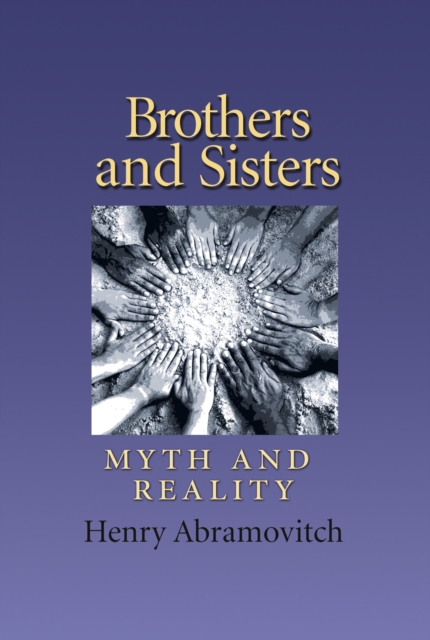
Growing up, we typically spend more time with our brothers and sisters than we do with our parents. In an age of divorce, mobility, and alienation, the sibling bond is often the only one that really lasts.Given that brothers and sisters are such a fundamental aspect of human existence, it is remarkable that they have received so little in-depth attention in the field of psychology.Henry Abramovitch's Brothers and Sisters explores the tension between the myth and reality of brothers and sisters in a variety of cultures and through the poignant brother-sister stories in the Bible. Abramovitch looks at the developmental sequence in the sibling relationship as brothers or sisters struggle to find their place with each other, concluding with a very personal account of his own relationship with his brother and sister.
eBook


Experiences of adult siblings of those with developmental coordination disorder
This qualitative study explored the childhood experiences of growing up with a sibling with Developmental Coordination Disorder (DCD) to offer an 'outsider's' view of this condition. Ten individuals who had grown up with a sibling with DCD were interviewed about their experiences. Data were analysed using Thematic Analysis. Analysis described three main themes: i)'witnessing the challenges for their sibling with DCD' ii) 'experiencing the impact on the family'; iii) 'a vacuum of knowledge'. Not all experiences were negative and transcending these themes was the notion 'resolution and finding benefit' highlighting access to support, being more empathic and resilient, becoming a role model for others and finding success. Participants play witness to their sibling's experiences which can often be negative sometimes impacted by a vacuum of knowledge but they also describe how a diagnosis of DCD comes with some benefits which are discussed in the context of 'posttraumatic growth'.
Journal Article