
Catalogue Search | MBRL


Are you sure you want to remove the book from the shelf?

{{itemTitle}}
96
result(s) for
"Brown, Dan (1964- )"
Sort by:
The Da Vinci Code in the Academy
As millions of readers worldwide react to Dan Browns The Da Vinci Code, so do many scholars. The novel has become a proxy debate for two compelling scholarly and social issues of our time: the feminist/post-feminist challenge to patriarchal authority; and the textual construction of meaning and value. Presenting the feminine as both dominant and sacred brings attention to every text which argues for dominance or divinity. Traditional scholars are being challenged to defend their discipline.
eBook
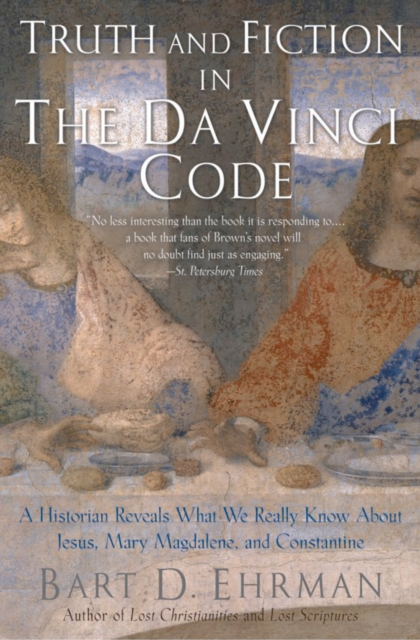
Truth and fiction in The Da Vinci code : a historian reveals what we really know about Jesus, Mary Magdalene, and Constantine
This book is the most authoritative, arguably the definitive appraisal of some of the claims that are directly made or are imbedded in the incredibly successful work of popular fiction by Dan Brown, The Da Vinci Code; it is not an essentially partisan Christian rebuttal of The Da Vinci Code (as are virtually all the books currently available) but a truly historical assessment by a noted early Christian scholar. Brown's novel is unusual in that the author makes the statement up front that the historical information in the book is all factually accurate, and many readers presumably have taken the author at his word. Some of these \"facts\" are surprising and provocative, such as that Jesus was married to Mary Magdalene, that this union produced an offspring whose holy lineage has been preserved down to today, that Emperor Constantine suppressed secret Gospels that attest to these stories, etc. Ehrman discusses the historical truth behind these claims from a scholar's perspective. His focus is on the historical Jesus, the historical Mary, the development of the early Christian church, the writings of the early Christian Gospels, and the role played by Constantine in the formation of what has come down to us as the beliefs and scriptures of the Christian religion. Ehrman writes: \"I should stress that I am not objecting to Dan Brown's inventing claims about early Christian documents as part of his fictional narrative; the problem is that he indicates that his accounting of early Christian documents is historically accurate, and readers who don't know the history of early Christianity will naturally take him at his word. But there is more fiction than fact, not just in the plot of The Da Vinci Code, but also in its discussion of the early documentary record about Jesus.\"
eBook

Rethinking Film Adaptation Through Directors’ Discourse and Auteur Theory: Approaching Dan Brown’s The Da Vinci Code
This article examines the apropos of Dan Brown’s novel - adaptation, The Da Vinci Code, to the director’s discourses around the film adaptation of a literary work. Ron Howard’s stance as an auteur is assessed to gauge him as an illustrator of American filmmaking in terms of auteur discourses and formulate that his work disavows significant portions of the Catholic conspiracies, sidestepping the subject of authenticity, which is at the forefront of contemporary literature adaptation discourses. Despite appearing to be more ‘authentic,’ the film falls short of the fidelity to source material that was an avowedly auteurist vision and is shown to have issues with authorship. This paper proposes the contemporary auteur influence, examining how the concept of directors’ discourse functions in the Hollywood film industry and the director’s stature as an auteur and the works’ creative style in literary, screen adaptation and movie translation.
Journal Article
Is The Da Vinci Code True?1
The guild of historical novelists, if there is such a thing, might debate his professional ethics; I am not sure, however, that they differ much from Shakespeare's or Alexandre Dumas's. [...]the plot draws much of its \"truthiness\" from the perennial suspicion of Roman Catholics among Protestant, English-speaking Europeans and Americans. According to Baigent and colleagues, the Orthodox and later Catholic Churches have engaged in a 2,000-year cover-up of the fact that Jesus did not die on the cross, that he and his wife Mary Magdalene absconded from Judea and in the course of time bequeathed their hidden heritage to the Merovingian kings of France, the Knights Templar, assorted authors of medieval romance, the Freemasons, and so on-basically, everyone was in on it, but no one knew about it. [...]it is not surprising that as young men surpass their mothers in strength and status, they feel a certain ambivalent guilt rooted in the early mother-son relationship.14 And it is not surprising that young women, no longer the equals of their male peers in size, social prestige, and power, imagine that once things were different. [...]the book appears aimed more at teenage than adult readers, perhaps like the old Encyclopedia Brown detective series by the late Donald J. Sobol. 4.
Journal Article

Characters’ Politeness Strategies in Giving Command: Should Translators Keep Them?
Politeness strategies have been studied from various angles. In literary works, they can be used as a device to frame characterisation. However, in recent times only a few studies have investigated the association of politeness strategies with characterisation as seen from the translation perspective. This article discusses the result of an investigation on how far the translation of politeness markers in giving commands has contributed to the framing of certain characterisation in literary works. A Pragmatic approach is used in this qualitative research to analyse the translation of politeness markers from English to Indonesian. Objective data were collected through purposive sampling from Dan Brown’s novel Deception Point and its two Indonesian versions to obtain information as to which techniques produce better translation quality in both translations. Then, affective data were collected through Focus Group Discussions. The results show that the translation of politeness markers contributed to the characterisation. It was found that established equivalence, variation, and explicitation techniques employed to the translation of politeness markers contributed to the maintenance of characterisation and the translation quality. Meanwhile, addition, reduction, and literal translation techniques altered the characterisations and therefore, decreased the translation quality. This implies that translators should consider politeness and characterisation in translating commands.
Journal Article

Religious Studies and Popular Fiction: What Does Dan Brown Have to Do With the Ivory Tower?
In this article the authors discuss the problems and prospects of engaging popular fiction in the academy, particularly in religious studies. Utilizing Dan Brown as the example par excellence, the authors argue that while Brown's novels, particularly The Lost Symbol, appeal to a culture of consumption, they nonetheless afford scholars a valuable opportunity to dialogue with audiences unfamiliar with the academic study of religion. When approached responsibly with the distinctive theories and methods of the discipline, popular fiction has the potential to serve as a productive pedagogical tool to promote religious studies as an intellectually stimulating and culturally relevant enterprise. Rather than ignore or inveigh against popular fiction because of its tendency toward misinformation, sensationalism, and superficiality, scholars of religion should harness the public enthusiasm that these works engender and redirect it toward constructive scholarly ends.
Journal Article
Priory Of Sion
Ed Bradley decided to find out for himself whether or not the Priory of Sion, which is central to Dan Brown's 'The Da Vinci Code' was a real organization or not.
Streaming Video

The Last Supper and the \da Vinci Code\ frenzy
THE MASTER PAINTER is said to have planted a clue leading to the first secret: the wedding of the famous repentant sinner to Jesus and their subsequent bloodline, which is supposed to have carried on through the Merovingian kings. The truth about this enormous deception is said to have been passed from generation to generation, since the days of the Crusades, within a tight circle of initiates gathered in a secret society: the Priory of Sion. [Dan Brown] portrays Leonardo as one of the Priory's great dignitaries. The final thesis offered by the novel is that the Saint Sulpice church in Paris is a Priory temple.
Journal Article

Editorial: Country Club Literature and the Thriller
Hoppenstand relates an event when a noted author, who delivered a lecture about his life as writer in Michigan State University, made a derogatory remark about Dan Brown's thriller The Da Vinci Code. He comments that the author's revelation entails that he was jealous of The Da Vinci Code's monumental commercial success; jealous that Dan Brown reaches an astonishingly wide readership; jealous that The Da Vinci Code has had more booklength studies written about it than has any other work of fiction published since World War II; and jealous that it has had more media attention on television and in newspapers than has any novel ever published.
Journal Article

Summer of Adaptations
Not only did a sizeable pre-existing audience wait anxiously for the film-it's been almost impossible to travel by plane the past few years without seeing a copy of Dan Brown's book tucked under someone's arm-but Sony Pictures and Imagine Entertainment, dreading any early tepid internet reception, eschewed the test screening process in favor of launching the film's first public screening at the Cannes Film Festival.
Journal Article