
Catalogue Search | MBRL


Are you sure you want to remove the book from the shelf?

{{itemTitle}}
6
result(s) for
"Brown Berets"
Sort by:

The Politics of Patronage
Founded in 1968, the Mexican American Legal Defense and Educational Fund (MALDEF) is the Latino equivalent to the NAACP: a source of legal defense for the Latina/o community in cases centered on education, state immigration laws, redistricting, employment discrimination, and immigrant rights. Unlike the NAACP, however, MALDEF was founded by Mexican American activists in conjunction with the larger philanthropic structure of the Ford Foundation—a relationship that has opened it up to controversy and criticism.In the first book to examine this little-known but highly influential organization, Benjamin Márquez explores MALDEF’s history and shows how it has thrived and served as a voice for the Latina/o community throughout its six decades of operation. But he also looks closely at large-scale investments of the Ford Foundation, Rockefeller Foundation, and others, considering how their ties to MALDEF have influenced Mexican American and Latinx politics. Its story crafted from copious research into MALDEF and its benefactors, this book brings to light the influence of outside funding on the articulation of minority identities and the problems that come with creating change through institutional means.
eBook

The Struggle for Freedom, Justice, and Equality Transcends Racial and National Boundaries
This article examines the 1967–1971 political prisoner solidarity movement for Black Panther Party co-founder Huey P. Newton as a case study of multiracial radical alliances in the San Francisco Bay Area. In contrast to the predominant trope of “unlikely allies,” I argue that the activists examined in this article who formed alliances with Newton and the Panthers were predisposed to collaborative activism through their common anti-imperialist orientation, expressed as anti-racism, anti-capitalism, and anti–U.S. military interventionism. In addition, I show that earlier alliances laid the foundation for alliances with later movements and organizations, creating what I term “genealogies of alliance” within the Free Huey Movement that demonstrate a persistent desire for collaborative activism throughout this era. This article prompts a reconsideration of Sixties radicalism; in contrast to scholarly and popular interpretations that focus on activists’ sectarianism and divisiveness, the Free Huey Movement illuminates how activists theorized and endeavored to work toward the collective liberation of all people.
Journal Article

Mi Raza Primero, My People First
¡Mi Raza Primero! is the first book to examine the Chicano movement's development in one locale—in this case Los Angeles, home of the largest population of people of Mexican descent outside of Mexico City. Ernesto Chávez focuses on four organizations that constituted the heart of the movement: The Brown Berets, the Chicano Moratorium Committee, La Raza Unida Party, and the Centro de Acción Social Autónomo, commonly known as CASA. Chávez examines and chronicles the ideas and tactics of the insurgency's leaders and their followers who, while differing in their goals and tactics, nonetheless came together as Chicanos and reformers. Deftly combining personal recollection and interviews of movement participants with an array of archival, newspaper, and secondary sources, Chávez provides an absorbing account of the events that constituted the Los Angeles-based Chicano movement. At the same time he offers insights into the emergence and the fate of the movement elsewhere. He presents a critical analysis of the concept of Chicano nationalism, an idea shared by all leaders of the insurgency, and places it within a larger global and comparative framework. Examining such variables as gender, class, age, and power relationships, this book offers a sophisticated consideration of how ethnic nationalism and identity functioned in the United States during the 1960s and 1970s.
eBook
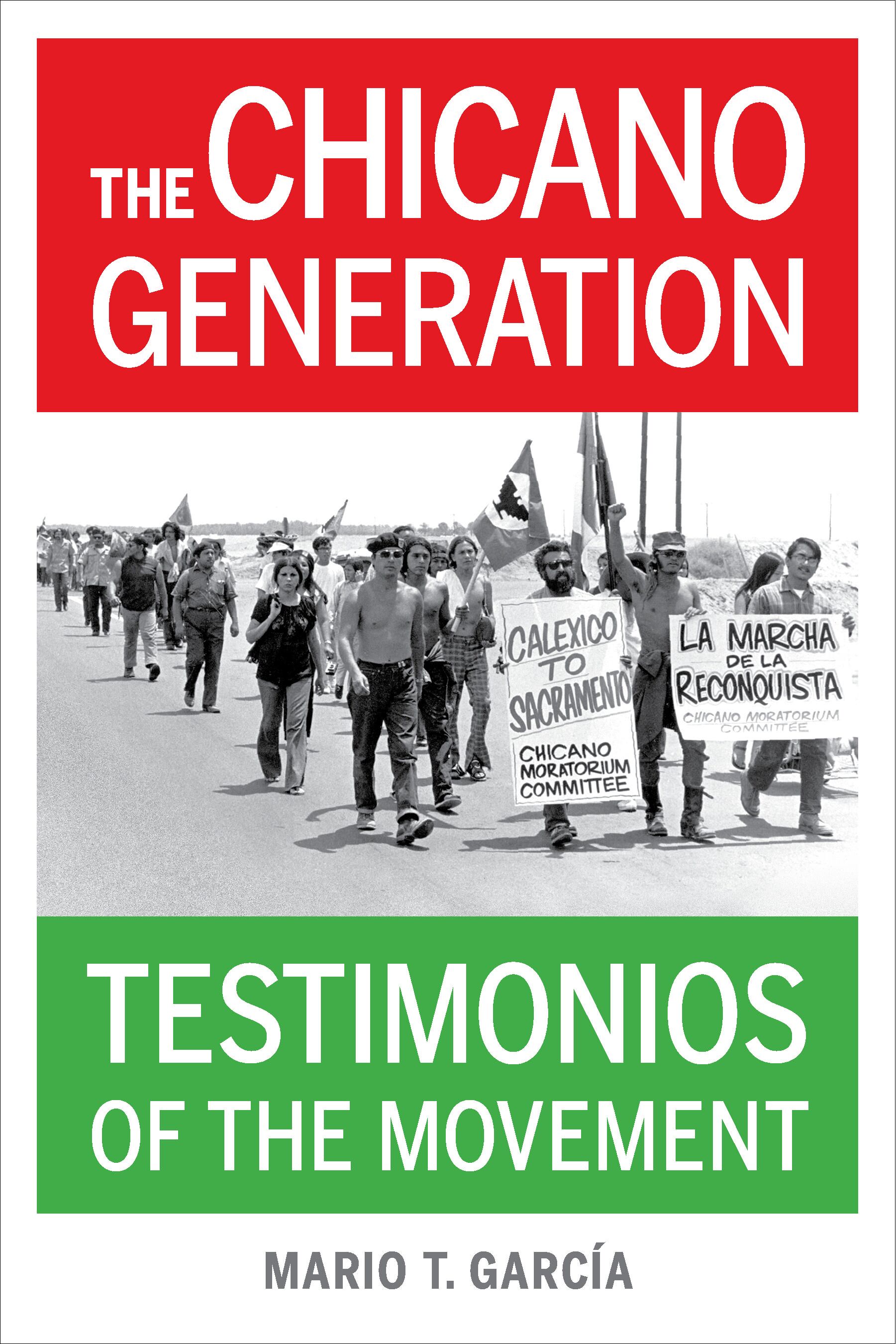
The Chicano generation
In The Chicano Generation, veteran Chicano civil rights scholar Mario T. García provides a rare look inside the struggles of the 1960s and 1970s as they unfolded in Los Angeles. Based on in-depth interviews conducted with three key activists, this book illuminates the lives of Raul Ruiz, Gloria Arellanes, and Rosalio Muñoz—their family histories and widely divergent backgrounds; the events surrounding their growing consciousness as Chicanos; the sexism encountered by Arellanes; and the aftermath of their political histories. In his substantial introduction, García situates the Chicano movement in Los Angeles and contextualizes activism within the largest civil rights and empowerment struggle by Mexican Americans in US history—a struggle that featured César Chávez and the farm workers, the student movement highlighted by the 1968 LA school blowouts, the Chicano antiwar movement, the organization of La Raza Unida Party, the Chicana feminist movement, the organizing of undocumented workers, and the Chicano Renaissance. Weaving this revolution against a backdrop of historic Mexican American activism from the 1930s to the 1960s and the contemporary black power and black civil rights movements, García gives readers the best representations of the Chicano generation in Los Angeles.
eBook