
Catalogue Search | MBRL


Are you sure you want to remove the book from the shelf?

{{itemTitle}}
2,169
result(s) for
"Browning, Elizabeth Barrett"
Sort by:

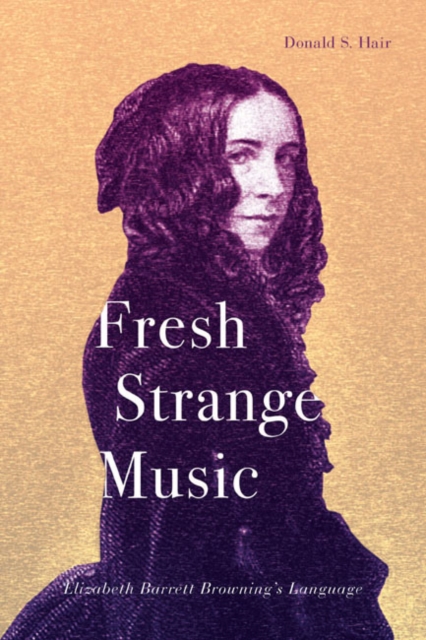
Fresh Strange Music
Elizabeth Barrett Browning evokes several figures as muses for her poetry, and one recurring type is the music master. While her writing has always been recognized as highly experimental, the influence and use of music in her work have not been fully examined. Fresh Strange Music defines the exact nature of Browning's experiments and innovations in rhythm, which she called the \"animal life\" of poetry, and in sound repetition, which she labelled her \"rhymatology.\" Donald Hair approaches Elizabeth Barrett Browning's art with a focus on the power that shapes it - the technical music of her poetry and the recurring beat at the beginning of units of equal time that requires a different system of scansion than conventional metres and syllable counting. Music for Barrett Browning, Hair explains, has momentous implications. In her early poetry, it is the promoter of kindly and loving relations in families and in society. Later in her career, she makes it the basis of nation-building, in her support for the unification of Italy and, more problematically, in her championing of French emperor Napoleon III. Fresh Strange Music traces the development of Barrett Browning's poetics through all her works - from the early An Essay on Mind to Last Poems - showcasing her as a major poet, independently minded, and highly innovative in her rhythms and rhymes.
eBook


The Lady on the Sofa: Revisiting Elizabeth Barrett Browning’s Illness
If there is one poet who has been widely represented under a legendary light, it is Elizabeth Barrett Browning (1806–1861), mostly through the figure of a secluded invalid. Barrett Browning’s illness and death have been romanticised ever since her own time, with multiple rumours and theories mostly focusing on the fact that her illness was ‘miraculously dispelled’ by ‘love’ and only reappeared gradually to take the poet’s life. This article proposes yet another and quite different diagnosis for Barrett Browning’s illness, theorising on the possibility that Barrett Browning’s ailment was a pulmonary congenital malformation, which remained misdiagnosed due to the lack of medical technology at the time. Several of the diagnoses given to Barrett Browning by her medical practitioners, contemporary and posthumous biographers and other scholars are presented and compared, alongside my own hypothesis. In addition, Barrett Browning’s arguable morphine dependency is reassessed in order to explore its impact on her illness, with the possibility that it exacerbated or even caused some of her symptoms. This reassessment also explores the role that morphine played in Barrett Browning’s death, suggesting an accidental overdose possibly overlooked by Robert Browning.
Journal Article


Religious Imaginaries
Religious Imaginariesexplores liturgical practice as formative for how three Victorian women poets imagined the world and their place in it and, consequently, for how they developed their creative and critical religious poetics. In doing so, this new study rethinks several assumptions in the field: that Victorian women's faith commitments tend to limit creativity; that the contours of church experiences matter little for understanding religious poetry; and that gender is more significant than liturgy in shaping women's religious poetry.Exploring the import of bodily experience for spiritual, emotional, and cognitive forms of knowing, Karen Dieleman explains and clarifies the deep orientations of different strands of nineteenth-century Christianity, such as Congregationalism's high regard for verbal proclamation, Anglicanism and Anglo-Catholicism's valuation of manifestation, and revivalist Roman Catholicism's recuperation of an affective aesthetic. Looking specifically at Elizabeth Barrett Browning, Christina Rossetti, and Adelaide Procter as astute participants in their chosen strands of Christianity, Dieleman reveals the subtle textures of these women's religious poetry: the different voices, genres, and aesthetics they create in response to their worship experiences. Part recuperation, part reinterpretation, Dieleman's readings highlight each poet's innovative religious poetics.Dieleman devotes two chapters to each of the three poets: the first chapter in each pair delineates the poet's denominational practices and commitments; the second reads the corresponding poetry.Religious Imaginarieshas appeal for scholars of Victorian literary criticism and scholars of Victorian religion, supporting its theoretical paradigm by digging deeply into primary sources associated with the actual churches in which the poets worshipped, detailing not only the liturgical practices but also the architectural environments that influenced the worshipper's formation. By going far beyond descriptions of various doctrinal positions, this research significantly deepens our critical understanding of Victorian Christianity and the culture it influenced.
eBook
Elizabeth Barrett Browning and Shakespeare
For most of the twentieth century the exuberant fluency of Elizabeth Barrett Browning’s art was not regarded as worthy of serious attention. Even the evidence for the swiftness of her wit, thought and composition remains more impressionistic and anecdotal than firmly proven. Through close attention to original manuscript material, Josie Billington argues that Barrett Browning’s fast, fine and excitedly vigorous and agile imaginative intelligence is Shakespearean, both in its power, and in the creative drive and dynamic to which it gives rise. Billington contends that for Barrett Browning, as for Shakespeare, writing was demonstrably a creative event not a second-order record of experience, and that Barrett Browning’s characteristic habits of composition, and her creative procedure, resemble in significant ways those of the poet she valued most highly. A fascinating study of both writers’ analogous creative dispositions, minds and modes.
eBook

Women's Poetry and Religion in Victorian England
Victorian women poets lived in a time when religion was a vital aspect of their identities. Cynthia Scheinberg examines Anglo-Jewish (Grace Aguilar and Amy Levy) and Christian (Elizabeth Barrett Browning and Christina Rossetti) women poets, and argues that there are important connections between the discourses of nineteenth-century poetry, gender and religious identity. Further, Scheinberg argues that Jewish and Christian women poets had a special interest in Jewish discourse; calling on images from Judaism and the Hebrew Scriptures, their poetry created complex arguments about the relationships between Jewish and female artistic identity. She suggests that Jewish and Christian women used poetry as a site for creative and original theological interpretation, and that they entered into dialogue through their poetry about their own and each other's religious and artistic identities. This book's interdisciplinary methodology calls on poetics, religious studies, feminist literary criticism, and little read Anglo-Jewish primary sources.
eBook

The dramatic imagination of Robert Browning : a literary life
An English poet who was deeply responsive to European culture and affairs, Robert Browning has sometimes been dismissed by modern readers for his obscurity or roughness of language. Now Richard S. Kennedy and Donald S. Hair, two distinguished scholars of Browning's work, trace the arc of his development as an artist and thinker from his earliest poems to the last in a long and remarkably productive career. Through a fresh reading of not only his poetry but also the letters of both Robert and Elizabeth Barrett Browning, the authors garner details that situate the two in historical context, provide a vivid sense of Robert's personality, and also correct biases against Elizabeth's influence.
eBook

‘Solving the problem of reality’ in Virginia Woolf’s Flush
Flush’s main character, Elizabeth Barrett Browning’s spaniel, can be seen as the epitome of Victorianism, an embodiment of its tradition of anthropomorphism and a displaced portrait of his mistress, but it is also the pretext for a modernist reconstruction of Victorian society, towards a new literary (re)presentation of the sensorial world. No longer neglected by critics and scholars, Flush has been widely analysed as encapsulating the social issues of the mid-nineteenth century in terms of class and gender, adopting the point of view of a dog to expose the confinement and submission women had to face—in the Victorian period, but also in Woolf’s own time. The Edwardian perspective allows Woolf to use Flush as the conveyor of modernity—not merely because writing the biography of a dog questions the established societal and literary codes, but also because the de-familiarization of the world through animal eyes aims at ‘solving the problem of reality’. The reader becomes the witness of a reconfiguration of perception as primeval instincts are inscribed within Flush’s body, smell takes over eyesight and the novel depicts a world distorted by synaesthesia. Despite the human qualities Flush is endowed with, a reversal still occurs which highlights the human beings’ otherness and reduces their/our language to hieroglyphic, undecipherable signs, unable to grasp reality. The animal’s perspective ushers in a tentative description of ‘the world seen without a self’, a world that escapes the screen of the human eye/I and where the unobserved and uncanny nature of things can be unveiled.
Journal Article