
Catalogue Search | MBRL


Are you sure you want to remove the book from the shelf?

{{itemTitle}}
32
result(s) for
"Buchenwald (Concentration camp)"
Sort by:

The order of terror
During the twelve years from 1933 until 1945, the concentration camp operated as a terror society. In this pioneering book, the renowned German sociologist Wolfgang Sofsky looks at the concentration camp from the inside as a laboratory of cruelty and a system of absolute power built on extreme violence, starvation, \"terror labor,\" and the business-like extermination of human beings.
Based on historical documents and the reports of survivors, the book details how the resistance of prisoners was broken down. Arbitrary terror and routine violence destroyed personal identity and social solidarity, disrupted the very ideas of time and space, perverted human work into torture, and unleashed innumerable atrocities. As a result, daily life was reduced to a permanent struggle for survival, even as the meaning of self-preservation was extinguished. Sofsky takes us from the searing, unforgettable image of the Muselmann--Auschwitz jargon for the \"walking dead\"--to chronicles of epidemics, terror punishments, selections, and torture.
The society of the camp was dominated by the S.S. and a system of graduated and forced collaboration which turned selected victims into accomplices of terror. Sofsky shows that the S.S. was not a rigid bureaucracy, but a system with ample room for autonomy. The S.S. demanded individual initiative of its members. Consequently, although they were not required to torment or murder prisoners, officers and guards often exploited their freedom to do so--in passing or on a whim, with cause, or without.
The order of terror described by Sofsky culminated in the organized murder of millions of European Jews and Gypsies in the death-factories of Auschwitz and Treblinka. By the end of this book, Sofsky shows that the German concentration camp system cannot be seen as a temporary lapse into barbarism. Instead, it must be conceived as a product of modern civilization, where institutionalized, state-run human cruelty became possible with or without the mobilizing feelings of hatred.
eBook
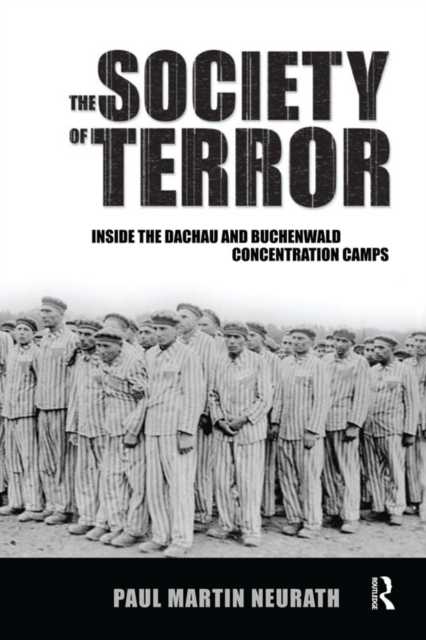
The Society of Terror
During 1938 and 1939, Paul Neurath was a Jewish political prisoner in the concentration camps at Dachau and Buchenwald. He owed his survival to a temporary Nazi policy allowing release of prisoners who were willing to go into exile and the help of friends on the outside who helped him obtain a visa. He fled to Sweden before coming to the United States in 1941. In 1943, he completed The Society of Terror, based on his experiences in Dachau and Buchenwald. He embarked on a long career teaching sociology and statistics at universities in the United States and later in Vienna until his death in September 2001. After liberation, the horrific images of the extermination camps abounded from Dachau, Buchenwald, and other places. Neurath's chillingly factual discussion of his experience as an inmate and his astute observations of the conditions and the social structures in Dachau and Buchenwald captivate the reader, not only because of their authenticity, but also because of the work's proximity to the events and the absence of influence of later interpretations. His account is unique also because of the exceptional links Neurath establishes between personal experience and theoretical reflection, the persistent oscillation between the distanced and sober view of the scientist and that of the prisoner.
eBook

On the Defensive
On the Defensive considers how our ethical responses to the Nazi camps have unintentionally repressed and denied the experiences of their victims. Through detailed readings of survivor narratives, particularly the works of political deportees Jorge Semprun and Charlotte Delbo, Sharon Marquart examines how well-intentioned people – including victims, their family members, and readers of witness literature – respond to such testimony in ways that are understood as ethical by their communities but serve instead to ignore victims’ experiences.
As Marquart shows, collective disasters such as the Holocaust expose the limitations of our ethical theories. To cope with this instability we withdraw and defend ourselves through inattentive and formulaic responses that turn a blind eye to the plight of victims. Challenging contemporary theorizations of community, ethics, testimony, and trauma, On the Defensive is a far-reaching reflection on the ways in which communal understandings of our duties and responsibilities to others can facilitate the denial of an atrocity’s horrors.
eBook

A Jewish Communist in Weimar Germany
This biography of Werner Scholem (1895-1940), former Zionist activist and later chief organiser of the German Communist Party, sheds new light on German-Jewish relations in the Weimar Republic, focussing on a revolutionary's lifelong struggle against Anti-Semitism.
eBook

Ludwik Fleck: On Medical Experiments on Human Beings
Ludwik Fleck's article, \"On medical experiments on human beings\" was published in 1948 in the main Polish medical journal; it was destined for general practitioners. Fleck was prisoner in the concentration camp Buchenwald, where he witnessed Nazi murderous \"experiments\" on the camp's imamates; he testified about these experiments in the Nuremberg Trial of Nazi doctors. This article, and Tadeusz Kielanowski's comment on Fleck text, stress, however, that an exclusive focus on the – hopefully rare – criminal activities of doctors may be misleading. It is important to prevent the numerous ethical transgressions of'normal' medical science and routine clinical practice.
Journal Article

The Old Guard
Brutally and unflinchingly honest in its depiction of the effects of concentration camp life on the human psyche, Mieczysław Lurczyński's The Old Guard is one of the earliest works of Holocaust literature and one of the few works written by a non-Jew who was also a survivor of the camps. Begun during his imprisonment on fragments and scraps of paper and completed immediately after the war, in 1945, the play is based on Lurczyński's experiences in Buchenwald and its subcamp in Eschenhausen, SS-kommando Hecht. The action takes place in the Block Elder's room at Hecht, where the prisoners who hold privileged positions in the camp—old-timers from Auschwitz, Majdanek, and other camps—play cards, drink moonshine, and steal from one another. The play's hero, based on the pre-war Polish actor Fryderyk Jarosy, who was also interned at Hecht, attempts to uphold the values of Western civilization in this depraved environment, an impossible task that ultimately leads to his death at the hands of the Camp Elder. As Lurczysnki writes in his preface, the play contains no great atrocities: \"The focus, rather, is on internal experiences and on depicting pained, sick, desparate, and resigned psyches, on depicting the methods by which people were turned into beasts, and beasts into freaks of nature.\" Available for the first time in English, The Old Guard is an important and compelling work of Holocaust literature that stands on a par with the work of Tadeusz Borowski and Primo Levi.
eBook

The Buchenwald Child
At the notorious Buchenwald concentration camp, communist prisoners organized resistance against the SS and even planned an uprising. They helped rescue a three-year-old Jewish boy, Stefan Jerzy Zweig, from certain death in the gas chambers. After the war, his story became a focus for the German Democratic Republic's celebration of its resistance to the Nazis. Now Bill Niven tells the true story of Stefan Zweig: what actually happened to him in Buchenwald, how he was protected, and at what price. He explores the (mis)representation of Zweig's rescue in East Germany and what this reveals about that country's understanding of its Nazi past. Finally he looks at the telling of the Zweig rescue story since German unification: a story told in the GDR to praise communists has become a story used to condemn them. Bill Niven is Professor of Contemporary German History at the Nottingham Trent University, UK.
eBook
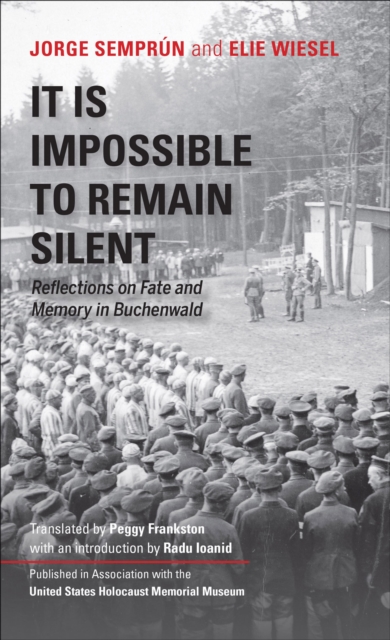
It Is Impossible to Remain Silent
On March 1, 1995, at the time of the fiftieth anniversary of the liberation of the Nazi concentration camps, ARTE (a French-German state-funded television network) proposed an encounter between two highly-regarded figures of our time: Elie Wiesel and Jorge Semprún. These two men, whose destinies were unparalleled, had probably crossed paths-without ever meeting-in the Nazi concentration camp Buchenwald in 1945. This short book is the entire transcription of their recorded conversation. During World War II, Buchenwald was the center of a major network of sub-camps and an important source of forced labor. Most of the internees were German political prisoners, but the camp also held a total of 10,000 Jews, Roma, Sinti, Jehovah's Witnesses, and German military deserters.
In these pages, Wiesel and Semprún poignantly discuss the human condition under catastrophic circumstances. They review the categories of inmate at Buchenwald and agree on the tragic reason for the fate of the victims of Nazism-as well as why this fate was largely ignored for so long after the end of the war. Both men offer riveting testimony and pay vibrant homage to the Jewish victims of the Holocaust. Today, seventy-five years after the liberation of the Nazi camps, this book could not be more timely for its confrontation with ultra-nationalism and antisemitism.
eBook
The Buchenwald Child
The dramatic story of a Jewish child's rescue at Buchenwald and its use as propaganda in both East and united Germany.At the notorious Buchenwald concentration camp, communist prisoners organized resistance against the SS and even planned an uprising. They helped rescue a three-year-old Jewish boy, Stefan Jerzy Zweig, from certain death in the gas chambers. After the war, his story became a focus for the German Democratic Republic's celebration of its resistance to the Nazis. Now Bill Niven tells the true story of Stefan Zweig: what actually happened to him in Buchenwald, how he was protected, and at what price. He explores the (mis)representation of Zweig's rescue in East Germany and what this reveals about that country's understanding of its Nazi past. Finally he looks at the telling of the Zweig rescue story since German unification: a story told in the GDR to praise communists has become a story used to condemn them. Bill Niven is Professor of Contemporary German History at the Nottingham Trent University, UK.
eBook

RePlacing Memory: the reorientation of Buchenwald
This article examines the reconfiguration of memory at the former Buchenwald concentration camp following the reunification of Germany. Buchenwald's complex history and its function as a national memorial of communist East Germany made the reorientation process a highly controversial issue. At the centre of the controversy was the distinction between heroes, victims and perpetrators. The reorientation of Buchenwald cast the successive chapters of Buchenwald's history - as a Nazi concentration camp, as a Soviet detention camp and as an East German memorial shrine - in the mould of three geographically separated spheres of memory.
Journal Article