
Catalogue Search | MBRL


Are you sure you want to remove the book from the shelf?

{{itemTitle}}
15,330
result(s) for
"Building Environmental aspects."
Sort by:


Life cycle assessment in the built environment
Life cycle assessment enables the identification of a broad range of potential environmental impacts occurring across the entire life of a product, from its design through to its eventual disposal or reuse. The need for life cycle assessment to inform environmental design within the built environment is critical, due to the complex range of materials and processes required to construct and manage our buildings and infrastructure systems.
After outlining the framework for life cycle assessment, this book uses a range of case studies to demonstrate the innovative input-output-based hybrid approach for compiling a life cycle inventory. This approach enables a comprehensive analysis of a broad range of resource requirements and environmental outputs so that the potential environmental impacts of a building or infrastructure system can be ascertained. These case studies cover a range of elements that are part of the built environment, including a residential building, a commercial office building and a wind turbine, as well as individual building components such as a residential-scale photovoltaic system.
Comprehensively introducing and demonstrating the uses and benefits of life cycle assessment for built environment projects, this book will show you how to assess the environmental performance of your clients' projects, to compare design options across their entire life and to identify opportunities for improving environmental performance.
eBook

Understanding green building materials
Architects, Designers, And Contractors are increasingly familiar with the policies, procedures, and guidelines for achieving sustainable, or \"green\" building standards. But what about the green building materials themselves? What are they, what are the options, and how shuld you decide what to specify? --
Book

Net zero energy design
Conveniently organized and packed with robust technical content and clear explanations of key principles Written by an architect who is the director of sustainability at a global architecture firm, Net Zero Energy Design is a practical guide for architects and related construction professionals who want to design and build net zero energy commercial architecture. It offers no-nonsense strategies, step-by-step technical analysis, and valuable examples, in addition to developed case studies. With a focus on application in a variety of building types and scales, the book also develops a broad-based understanding of all the integrated principles involved in achieving net zero energy. This book is an indispensable resource for anyone venturing into net zero energy design, construction, and operation, and it also serves as an excellent resource on a variety of sustainable design topics. Important features include: Organization based upon the commercial building delivery process Robust technical content for use in actual project applications Analysis examples that demonstrate key technical principles Plenty of design data for use as a valuable design resource Abundant and sophisticated information graphics and color illustrations and photographs A distinct design focus on the content that inspires adoption of principles into projects
eBook


Ecology, Economy, Equity
In the first book to seriously examine the future of libraries in a climate reality-based context, Henk convincingly argues that building a carbon-neutral future for libraries is not only essential but eminently practical.
eBook

Basics climate-friendly planning and building
The construction sector currently accounts for a high proportion of CO2 emissions and gray energy use. This will have to change fundamentally if we are to prevent catastrophic climate change and make urban planning and construction fit for the future. In addition to a paradigm shift in how architects work, we need to rethink how they are trained in higher education. Based on a lifecycle approach and an awareness of resource consumption, this volume in the 'Basics' series explains a wide range of climate-friendly concepts in an easy-to-understand way, inspiring readers to take a closer look at solutions and new approaches in their daily practice. The key factors involved in the various planning stages of buildings are presented and placed in the context of the overall planning.
Book
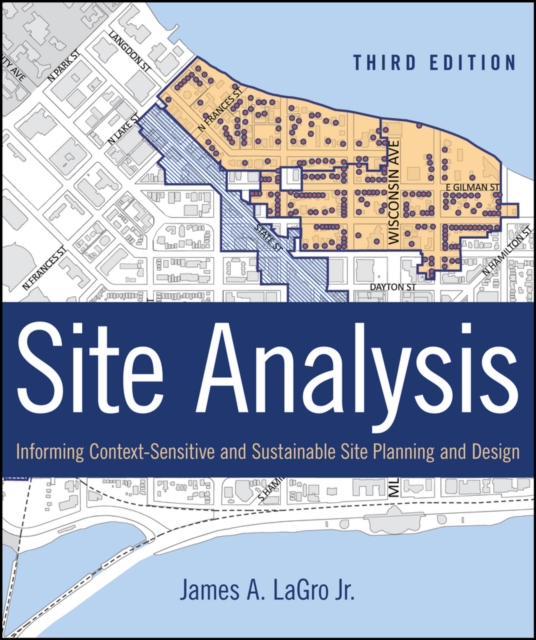
Site analysis : informing context-sensitive and sustainable site planning and design
The process-oriented guide to context-sensitive site selection, planning, and design
Sustainable design is responsive to context. And each site has a unique set of physical, biological, cultural, and legal attributes that presents different opportunities and constraints for alternative uses of the site. Site analysis systematically evaluates these on-site and off-site factors to inform the design of places—including neighborhoods and communities—that are attractive, walkable, and climate-resilient.
This Third Edition of Site Analysis is fully updated to cover the latest topics in low-impact, location-efficient design and development.
This complete, user-friendly guide:
* Blends theory andpractice from the fields of landscape architecture, urban planning, architecture, geography, and urban design
* Addresses important sustainability topics, including LEED-ND, Sustainable Sites, STAR community index, and climate adaptation
* Details the objectives and visualization methods used in each phase of the site planning and design process
* Explains the influence of codes, ordinances, and site plan approval processes on the design of the built environment
* Includes more than 200 illustrations and eight case studies of projects completed by leading planning and design firms
Site Analysis, Third Edition is the ideal guide for students taking courses in site analysis, site planning, and environmental design. New material includes review questions at the end of each chapter for students as well as early-career professionals preparing for the ARE, LARE, or AICP exams.
eBook

Low impact building : housing using renewable materials
\"Low Impact Building: Housing using Renewable Materials is about changing the way we build houses to reduce their 'carbon' footprint and to minimise environmental damage. One of the ways this can be done is by reducing the energy and environmental impact of the materials and resources used to construct buildings by choosing alternative products and systems. In particular, we need to recognise the potential for using natural and renewable construction materials as a way to reduce both carbon emissions but also build in a more benign and healthy way. This book is an account of some attempts to introduce this into mainstream house construction and the problems and obstacles that need to be overcome to gain wider acceptance of genuinely environmental construction methods.\"-- From publisher description.
Book
Low impact building
This guide to the designs, technologies and materials that really make green buildings work will help architects, specifiers and clients make informed choices, based on reliable technical information.
Low Impact Building: Housing using Renewable Materials is about changing the way we build houses to reduce their 'carbon' footprint and to minimise environmental damage. One of the ways this can be done is by reducing the energy and environmental impact of the materials and resources used to construct buildings by choosing alternative products and systems. In particular, we need to recognise the potential for using natural and renewable construction materials as a way to reduce both carbon emissions but also build in a more benign and healthy way. This book is an account of some attempts to introduce this into mainstream house construction and the problems and obstacles that need to be overcome to gain wider acceptance of genuinely environmental construction methods.
The book explores the nature of renewable materials in depth: where do they come from, what are they made of and how do they get into the construction supply chain? The difference between artisan and self-build materials like earth and straw, and more highly processed and manufactured products such as wood fibre insulation boards is explored.
The author then gives an account of the Renewable House Programme in the UK explaining how it came about and how it was funded and managed by Government agencies. He analyses 12 case studies of projects from the Programme, setting out the design and methods of construction, buildability, environmental assessment tools used in the design, performance in terms of energy, air tightness, carbon footprint and post-occupancy issues.
The policy context of energy and sustainability in the UK, Europe and the rest of the world is subjected to a critical examination to show how this affects the use of natural and renewable materials in the market for insulation and other construction materials. The debate over energy usage and embodied energy is discussed, as this is central to the reason why even many environmentally progressive people ignore the case for natural and renewable materials.
The book offers a discussion of building physics and science, considering energy performance, moisture, durability, health and similar issues. A critical evaluation of assessment, accreditation and labelling of materials and green buildings is central to this as well as a review of some of the key research in the field.
eBook