
Catalogue Search | MBRL


Are you sure you want to remove the book from the shelf?

{{itemTitle}}
574
result(s) for
"Bulgarian language"
Sort by:

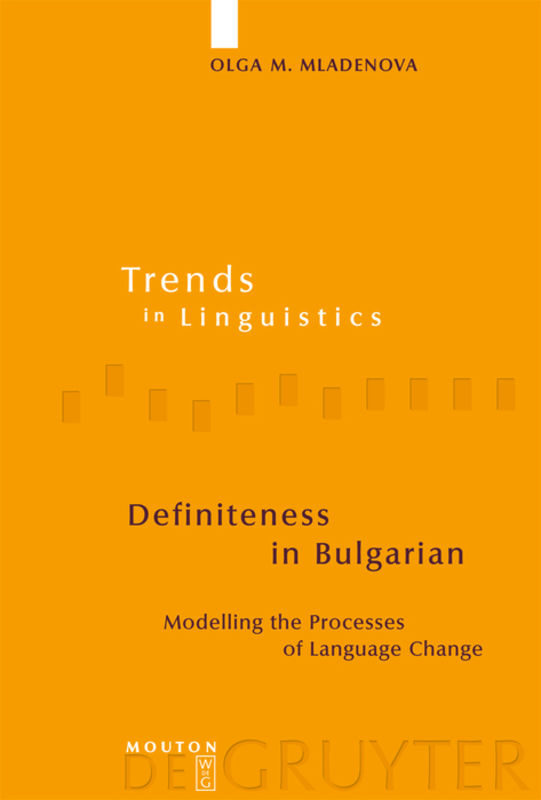
Definiteness in Bulgarian
In its evolution from a synthetic to an analytic language, Bulgarian acquired a grammaticalized category of definiteness. The book presents the first attempt to explore in detail how this happened by comparing the earliest Modern Bulgarian texts with contemporary dialect and standard Bulgarian data. The basic units of analysis are the various types of nominal structures headed by nouns or pronouns. The analysis requires the strict terminological disentanglement of form from content and the adoption of a default inheritance model of definiteness that allow the exhaustive classification and tagging of nominal structures encountered in the texts. Tagging makes it possible to apply quantitative analysis to nominal structure and to assess the types available in the early texts from a current native-speaker perspective.
Based on an S-curve model of language change, the study establishes that overt markers of definiteness were first made available to identifiability-based definites, then to inclusiveness-based definites, quantitative generics and unique referents. The overt markers of indefiniteness followed suit, separating indefinites from non-specifics and typifying generics. This progression of definiteness was directed by variables such as person, animacy, gender, number and noun-class, and started in contexts in which definiteness closely interacted with possessivity. Such an analysis leads to the realization that the two-dimensional S-curve model does not account for all language change and that there is a need for a three-dimensional model. It also demonstrates that, contrary to previous assumptions, there is continuity between the early Slavic marker of definiteness (long-form adjectives) and the Modern Bulgarian article. This discovery, in conjunction with geolinguistic arguments, sheds new light on the role that relations inside the Balkan Sprachbund played in the grammaticalization of Bulgarian definiteness.
eBook
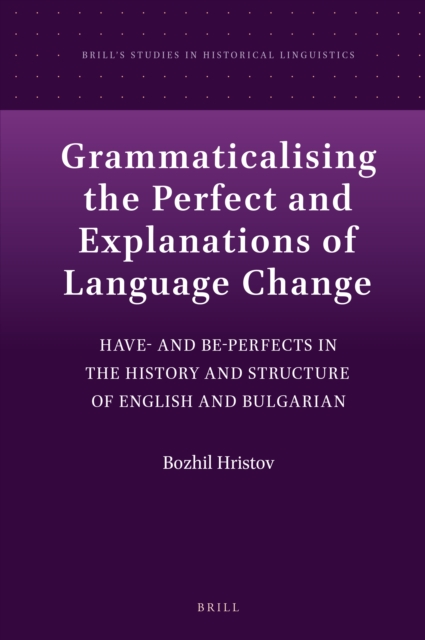
Grammaticalising the perfect and explanations of language change : have- and be-perfects in the history and structure of English and Bulgarian
In this book, Bozhil Hristov investigates the verbal systems of two distantly related Indo-European languages, highlighting similarities as well as crucial differences between them and seeking a unified approach.
eBook


Degrees of explicitness : information structure and the packaging of Bulgarian subjects and objects
This book explores factors relevant in the choices speakers and writers make in regard to explicitness of reference to the subjects and objects in their utterances. Bulgarian is a particularly felicitous target language for this type of study, since it possesses a rich inventory of available packaging techniques, ranging from zero reference, to various stressed and unstressed single forms, to actual doubled (\"reduplicated\") constructions. The study systematically addresses the need to avoid referential and grammatical ambiguity, and the crucial influence of emphasis. Another, and perhaps most interesting central factor is the status of what the communication is about, which is assessed on two different levels. The book makes use of data from both published Bulgarian fiction and naturally occurring oral conversations. The fundamental similarities between these modes of communication with respect to noun phrase selection is demonstrated, but explanations are also proposed for the observable differences.
eBook
Verbal Aspect in Old Church Slavonic
In Verbal Aspect in Old Church Slavonic Jaap Kamphuis demonstrates that the aspect system of Old Church Slavonic can best be described if one divides the verbs into three main categories: perfective, imperfective and anaspectual. This differs from the traditional division into perfective and imperfective verbs only. To support the categorization, the study contains a corpus-based quantitative and qualitative analysis of the available Old Church Slavonic data. This analysis contributes to a better understanding of the development of aspect in Slavic. Kamphuis shows that aspect in Old Church Slavonic functions more like verbal aspect in the Western groups of Slavic languages (e.g. Czech) than verbal aspect in the Eastern group (e.g. Russian).
eBook