
Catalogue Search | MBRL


Are you sure you want to remove the book from the shelf?

{{itemTitle}}
12,096
result(s) for
"Bush fires"
Sort by:

Australia's Megafires
The Australian wildfires of 2019-20 (Black Summer) were devastating and unprecedented. These megafires burnt more than 10 million hectares, mostly of forests in southern and eastern Australia. Many of the fires were uncontrollable. These megafires affected many of Australia's most important conservation areas and severely impacted threatened species and ecological communities. They were a consequence of climate change - and offered a glimpse of how this is likely to continue to affect our future.Australia's Megafires includes contributions by more than 200 researchers and managers with direct involvement in the management and conservation of the biodiversity affected by the Black Summer wildfires. It provides a comprehensive review of the impacts of these fires on all components of biodiversity, and on Indigenous cultural values.These fires also triggered an extraordinary and highly collaborative response by governments, NGOs, Indigenous groups, scientists, landholders and others, seeking to recover the fire-affected species and environments - to restore Country. This book documents that response. It draws lessons that should be heeded to sustain that recovery and to be better prepared for the inevitable future comparable catastrophes. Such lessons are of global relevance, for wildfires increasingly threaten biodiversity and livelihoods across the globe.FEATURES:Documents the major impacts on wildlife, ecological communities, sites of biodiversity significance and Indigenous cultural values.Explores the extraordinary collaborative response to attempt to recover impacted species and environments.Provides perspectives from people involved in the fire management and recovery.Identifies necessary learnings to reduce the chance of future such catastrophes, to be better prepared and better enable recovery.Includes responses and recommendations that will be broadly applicable to comparable environmental catastrophes around the world.
eBook

Five Suns
A climate defined by wet and dry seasons, a mostly mountainous
terrain, a biota prone to disturbances, a human geography
characterized by a diversity of peoples all of whom rely on burning
in one form or another: Mexico has ideal circumstances for fire,
and those fires provide a unique perspective on its complex
history. Narrating Mexico's evolution of fire through five eras,
historian Stephen J. Pyne describes the pre-human, pre-Hispanic,
colonial, industrializing (1880-1980), and contemporary (1980-2015)
fire biography of this diverse and dynamic country. Creatively
deploying the Aztec New Fire Ceremony and the \"five suns\" that it
birthed, Pyne addresses the question, \"Why does fire appear in
Mexico the way it does?\" Five Suns tells the saga through a pyric
prism. Mexico has become one of the top ten \"firepowers\" in the
world today through its fire suppression capabilities, fire
research, and industrial combustion, but also by those continuing
customary practices that have become increasingly significant to a
world that suffers too much combustion and too little fire.
Five Suns completes a North American fire-history trilogy
written by Pyne over the past 40 years, complementing his histories
of Canada and the United States.
eBook
Economist video. Will LA rebuild after the fires?
As the fires continue to burn in Los Angeles, our reporter on the ground, Aryn Braun, explores whether residents will be able to rebuild their homes.
Streaming Video
Wildland Fire Behaviour - Dynamics, Principles and Processes
Wildland fires have an irreplaceable role in sustaining many of our forests, shrublands and grasslands. They can be used as controlled burns or occur as free-burning wildfires, and can sometimes be dangerous and destructive to fauna, human communities and natural resources. Through scientific understanding of their behaviour, we can develop the tools to reliably use and manage fires across landscapes in ways that are compatible with the constraints of modern society while benefiting the ecosystems. This book examines what is known and unknown about wildfire behaviours. The authors introduce fire as a dynamical system along with traditional steady-state concepts. They then break down the system into its primary physical components, describe how they depend upon environmental factors, and explore system dynamics by constructing and exercising a nonlinear model. The limits of modelling and knowledge are discussed throughout but emphasised by review of large fire behaviours. Advancing knowledge of fire behaviours will require a multidisciplinary approach and rely on quality measurements from experimental research, as covered in the final chapters.
eBook

Introduction to the Australian Fire Danger Rating System
BackgroundFire danger rating systems are used daily across Australia to support fire management operations and communications to the general public regarding potential fire danger.AimsIn this paper, we introduce the Australian Fire Danger Rating System (AFDRS), providing a short historical account of fire danger rating in Australia as well as the requirements for an improved forecast system.MethodsThe AFDRS combines nationally consistent, spatially explicit fuel information with forecast weather and advanced fire behaviour models and knowledge to produce locally relevant ratings of fire behaviour potential.Key resultsA well-defined framework is essential for categorising and defining fire danger based on operational response, the potential for impact and observable characteristics of fire incidents. The AFDRS is modular, supporting continuous and incremental improvements and allowing upgrades to components in response to new science.ConclusionsThe AFDRS provides a new method to estimate fire danger based on the best available fire behaviour models, leading to potentially significant improvements in the way fire danger is calculated, forecast and interpreted.ImplicationsThe Australian Fire Danger Rating System was implemented in 2022, the most significant change to fire danger forecasting in Australia in more than 50 years.
Journal Article

First Nations Wildfire Evacuations
Based on the experiences of evacuees from seven First Nations communities, this book offers guidance to Indigenous communities and external agencies on how to successfully plan for and carry out wildfire evacuations.
eBook
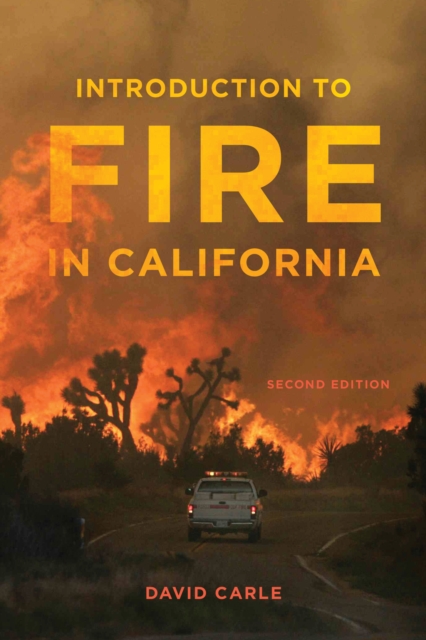
Introduction to fire in California
An up-to-date, essential guide to California's long relationship with fire, for the climate-change generation. What is fire? How are wildfires ignited? How do California's weather and topography influence fire? How did Indigenous people use fire on the land we now call California? David Carle's clearly written, dramatically illustrated first edition of Introduction to Fire in California helped Californians, including the millions who live near naturally flammable wildlands, better understand their own place in the state's landscape. In this revised edition, Carle covers the basics of fire ecology; looks at the effects of fire on people, wildlife, soil, water, and air; discusses fire-fighting organizations and land-management agencies; and explains how to prepare for an emergency and what to do when one occurs. This second edition brings the wildfire story up to the year 2020, with information about recent extreme and deadly fire events and the evidence that climate change is swiftly changing the wildfire story in California. This update reflects current debates about California's future as a climate-crisis leader facing massive, annual natural disasters; the future of California development and housing; and the critically necessary alternatives to traditional energy options. Features:A larger, more reader-friendly page formatMore than 110 color illustrations and mapsAn overview of major wildfires in California's historyAn updated and expanded discussion of the effect of climate change on fires in natural landscapesTips on what to do before, during, and after firesDiscussion of utility companies and massive power shutoffs
eBook

British Columbia in Flames
Like many British Columbians in 2017, Claudia Cornwall found herself glued to the news about the disastrous wildfires across the province. Her worry was personal: her cabin at Sheridan Lake had been in the family for sixty years and was now in danger of destruction. Cornwall, a long-time writer, was stricken not just by her own experience, but by the many moving stories she came across about the fires—so she began collecting them. She met with people from the communities of Sheridan Lake, Ashcroft, Cache Creek, 16 Mile House, Lac La Hache, Quesnel, Williams Lake, Hanceville-Riske Creek and Clinton. She hoped to be a conduit for the voices she heard—for those who fought the fires raging around them, those who were evacuated and displaced, and those who could do nothing but watch as their homes burned. She conducted over fifty hours of interviews with ranchers, cottagers, Indigenous residents, RCMP officers, evacuees, store and resort owners, search and rescue volunteers, firefighters and local government officials. Presented in British Columbia in Flames are stories that illustrate the importance of community. During the 2017 wildfires, people looked after strangers who had no place to go. They shared information. They helped each other rescue and shelter animals. They kept stores open day and night to supply gas, food and comfort to evacuees. This memoir, at once journalistic and deeply personal, highlights the strength with which BC communities can and will come together to face a terrifying force of nature.
eBook
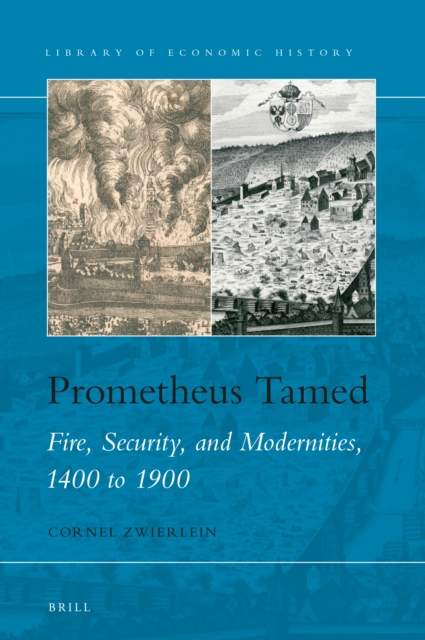
Prometheus tamed : fire, security, and modernities, 1400 to 1900
Large city fires were a huge threat in premodern Central European every-day life; only quite late, institutional forms of fire insurances emerged as a post-disaster instrument of damage recovery. During the nineteenth century, insurance agencies spread through the World forming a plurality of modernities, safe or unsafe.
eBook