
Catalogue Search | MBRL


Are you sure you want to remove the book from the shelf?

{{itemTitle}}
633
result(s) for
"Business logistics Data processing."
Sort by:

A real-time in-memory discovery service : leveraging hierarchical packaging information in a unique identifier network to retrieve track and trace information
The research presented in this book discusses how to efficiently retrieve track and trace information for an item of interest that took a certain path through a complex network of manufacturers, wholesalers, retailers, and consumers. To this end, a super-ordinate system called \"Discovery Service\" is designed that has to handle large amounts of data, high insert-rates, and a high number of queries that are submitted to the discovery service. An example that is used throughout this book is the European pharmaceutical supply chain, which faces the challenge that more and more counterfeit medicinal products are being introduced. Between October and December 2008, more than 34 million fake drug pills were detected at customs control at the borders of the European Union. These fake drugs can put lives in danger as they were supposed to fight cancer, take effect as painkiller or antibiotics, among others. The concepts described in this book can be adopted for supply chain management use cases other than track and trace, such as recall, supply chain optimization, or supply chain analytics.
Book
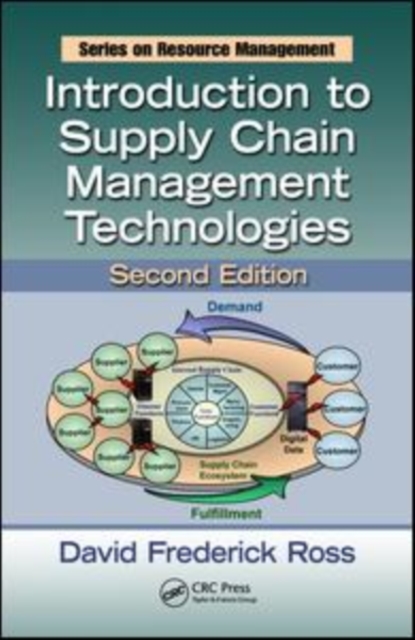
Introduction to Supply Chain Management Technologies
The second edition of this popular resource reflects new technology in supply chain management (SCM). Providing a comprehensive review of business computing, it features new chapters on the fundamentals of computing and their enabling power as well as the basics of contemporary ERP/supply chain business solutions. This book remains a critical resource on the enabling power of today's technologies and their impact on SCM. Focusing on the impact of the Internet on strategic elements of SCM, the author highlights integrative software tools that allow for new levels of collaboration, flexibility, and performance.
eBook

Supply chain analytics and modelling : quantitative tools and applications
\"An incredible volume of data is generated at a very high speed within the supply chain and it is necessary to understand, use and effectively apply the knowledge learned from analyzing data using intelligent business models. However, practitioners and students in the field of supply chain management face a number of challenges when dealing with business models and mathematical modelling. Supply Chain Analytics and Modelling presents a range of business analytics models used within the supply chain to help readers develop knowledge on a variety of topics to overcome common issues. Supply Chain Analytics and Modelling covers areas including supply chain planning, single and multi-objective optimization, demand forecasting, product allocations, end-to-end supply chain simulation, vehicle routing and scheduling models. Learning is supported by case studies of specialist software packages for each example. Readers will also be provided with a critical view on how supply chain management performance measurement systems have been developed and supported by reliable and accurate data available in the supply chain. Online resources including lecturer slides are available\"-- Provided by publisher.
Book

Managing construction logistics
Every major industry except construction uses logistics to improve its bottom line…
Poor logistics is costing the construction industry at least £3 billion a year according to a report – ‘Improving Construction Logistics’ – published by the Strategic Forum for Construction. Additional costs arise as a result of operatives waiting for materials, and skilled craftsmen being used for unskilled jobs. Inadequate management of logistics also has an adverse effect on quality, causes delays to projects, and adds to the health and safety risks on site. This practical book highlights the benefits of good logistics as well as the use of consolidation centres on projects. It shows how reduction in transport movements, less money tied up in stock, less waste, and the more efficient use of skilled craftsmen will reduce the cost of projects, reduce construction time, improve quality, reduce risks to health and safety, improve environmental performance and generally improve the image of the industry. The authors offer practical ways of achieving these benefits through integrated project teams and supply chains and the increased adoption of information technology including electronic communications, bar coding, and electronic tagging for tracing products. They also show how specific roles for each part of the industry can help to improve logistics.
• Practical, clear and accessible
• First book to address logistics in construction
• Written by the industry-recognized logistics experts
• Tackles issues of key concern: efficient use of labour; sustainability; waste and supply chain management
eBook


Scheduling in supply chains using mixed integer programming
A unified, systematic approach to applying mixed integer programming solutions to integrated scheduling in customer-driven supply chains Supply chain management is a rapidly developing field, and the recent improvements in modeling, preprocessing, solution algorithms, and mixed integer programming (MIP) software have made it possible to solve large-scale MIP models of scheduling problems, especially integrated scheduling in supply chains. Featuring a unified and systematic presentation, Scheduling in Supply Chains Using Mixed Integer Programming provides state-of-the-art MIP modeling and solutions approaches, equipping readers with the knowledge and tools to model and solve real-world supply chain scheduling problems in make-to-order manufacturing. Drawing upon the author's own research, the book explores MIP approaches and examples-which are modeled on actual supply chain scheduling problems in high-tech industries-in three comprehensive sections: Short-Term Scheduling in Supply Chains presents various MIP models and provides heuristic algorithms for scheduling flexible flow shops and surface mount technology lines, balancing and scheduling of Flexible Assembly Lines, and loading and scheduling of Flexible Assembly Systems Medium-Term Scheduling in Supply Chains outlines MIP models and MIP-based heuristic algorithms for supplier selection and order allocation, customer order acceptance and due date setting, material supply scheduling, and medium-term scheduling and rescheduling of customer orders in a make-to-order discrete manufacturing environment Coordinated Scheduling in Supply Chains explores coordinated scheduling of manufacturing and supply of parts as well as the assembly of products in supply chains with a single producer and single or multiple suppliers; MIP models for a single- or multiple-objective decision making are also provided Two main decision-making approaches are discussed and compared throughout. The integrated (simultaneous) approach, in which all required decisions are made simultaneously using complex, monolithic MIP models; and the hierarchical (sequential) approach, in which the required decisions are made successively using hierarchies of simpler and smaller-sized MIP models. Throughout the book, the author provides insight on the presented modeling tools using AMPL® modeling language and CPLEX solver. Scheduling in Supply Chains Using Mixed Integer Programming is a comprehensive resource for practitioners and researchers working in supply chain planning, scheduling, and management. The book is also appropriate for graduate- and PhD-level courses on supply chains for students majoring in management science, industrial engineering, operations research, applied mathematics, and computer science.
eBook

Using BPEL Processes in WebSphere Business Integration Server Foundation Business Process Integration and Supply Chain Solutions
This IBM Redbooks publication examines business process
integration using Business Process Choreographer to build solutions
that help to streamline the supply chain process. We provide a
sample scenario that integrates business processes to streamline a
supply chain showing how suppliers and customers can use global
repositories to synchronize data.The sample scenario discussed in this publication was initially
implemented using WebSphere Application Server Enterprise Process
Choreographer to aggregate and transform supplier product data.
Data is then published to a global repository using the WebSphere
Web Services Gateway, and also loaded to a catalog that uses a
WebSphere Commerce portal.We take this existing scenario and detail how to migrate the
business processes to run on WebSphere Business Integration Server
Foundation V5.1. As part of this migration effort we describe how
to use WebSphere Studio Application Developer Integration Edition
V5.1 as the development environment for process migration. The
migrated sample uses Business Process Execution Language (BPEL)
processes.Please note that the additional material referenced in the text is not available from IBM.
eBook

Artificial Intelligence for Big Data
Create smart systems to extract intelligent insights for decision making. You will learn about widely used Artificial Intelligence techniques for carrying out solutions in a production-ready environment. You'll explore advanced topics such as clustering, symbolic and sub-symbolic information representation, and many more.
eBook