
Catalogue Search | MBRL


Are you sure you want to remove the book from the shelf?

{{itemTitle}}
20,026
result(s) for
"Business networking"
Sort by:

Flat world navigation : collaboration and networking in the global digital economy
\"The future of a company lies in its ability to make authentic connections in a global, \"flattened world\" economy, spanning departments, cultures, and countries. Flat World Navigation explains how network-building, collaboration, and authentic communication are essential to navigating this new business landscape. Exploring the essential skills, tools, techniques, and technologies involved in making and maintaining business relationships, author Kim Chandler McDonald integrates practical tips and advice with interviews with leading figures who are successful flat world navigators\"-- Provided by publisher.
Book

Business networking orientation, green operations practices and firm performance
PurposeThe authors apply social network theory and natural resource–based view to empirically examine a model of the relationships among business networking (BN) orientation, green operations practices and performance. A firm must achieve appropriate internal green operations practices to capitalize on its external BN orientation and thus be able to establish a competitive advantage and superior performance.Design/methodology/approachUsing survey data from 132 ISO 14001–certified manufacturing firms in Malaysia, all of which participate in environmental programs and sustainability activities, the authors explore the effects of two BN orientation facets (customer-oriented and supplier-oriented) on green operations practices (green purchasing, eco-design and regulatory practices) and their subsequent influence on environmental and economic performance.FindingsStructural equation modeling outcomes confirm only one BN orientation facet positively affects green operations practices, nor do the advantages affect economic performance directly. The results illustrate how environmental outcomes mediate the links between green operations practices and economic performance.Originality/valueDrawing on social network theory and natural resource–based view, authors propose internal green operations practices as a channel through which external BN orientation induces firm performance. Internal green operations practices determine a firm's ability to exploit its external BN orientation to achieve operational competencies and lead to superior performance. Rather than focusing on the social connections generated by external BN orientation itself, the authors recommend that firms address the core competencies contributing to their green operations practices and engage in network building.
Journal Article

The social organism : a radical understanding of social media to transform your business and life
\"From visionary tech entrepreneur Oliver Luckett and MIT Media Lab's Michael J. Casey, a groundbreaking, must-read theory of social media-- how it works, how it's changing human life, and how we can master it for good and for profit ... Luckett and Casey offer a revolutionary theory: social networks-- to an astonishing degree --mimic the rules and functions of biological life. In sharing and replicating packets of information known as memes, the world's social media users are facilitating an evolutionary process just like the transfer of genetic information in living things. Memes are the basic building blocks of our culture, our social DNA. To master social media-- and to make online content that impacts the world --you must start with the social organism\"-- Provided by publisher.
Book

Digital Relationships
Why do so many organizations fail to mobilize the social networks of employees to respond to disruptions, innovate, and change? In Digital Relationships, Jason Davis argues that individual and organizational interests about networking can come out of alignment such that the network ties that individuals form are organizationally sub-optimal for achieving their most ambitious goals. Developing a new perspective about networks and organizations, he explains through network agency theory how network problems emerge, the role of digital technology adoption by organizations in amplifying misalignment, and the capacity of managers and function of the executive to resolve agency problems and mitigate their impact. Drawing on over a decade of qualitative research in US, Asian, and European \"big tech\" companies and new analytical and computational modeling, this book offers new interpretations and solutions to the pathologies that emerge from organizationally detrimental networking behaviors and in the face of managerial interventions.
eBook

Social media risk and governance : managing enterprise risk
\"In a recent survey, 71 percent of executives polled said their company was concerned about the possible risks posed by social media, but 59 percent do not perform a social media risk assessment. This book is a comprehensive, practical guide to the components and considerations that make up a social media governance strategy, spanning both external communications channels such as Facebook, Twitter and LinkedIn, as well as enterprise social networks within an organization. Phil Mennie, PwC's Global Social Media Risk and Governance leader, addresses key issues such as policy evaluation and planning, information security and fraud risks, how to respond to a crisis and how to archive data. The book empowers professional users of social networks to collaborate with their compliance and risk management counterparts, and to harness the power of social media safely and successfully for their organization\"-- Provided by publisher.
Book

Sustaining Competitive Advantage Via Business Intelligence, Knowledge Management, and System Dynamics
The first chapter in this book examines the relationships between absorptive capacity and effective knowledge management through the analysis of quantitative data drawn from managers and employees in residential aged care organizations in Western Australia. The author, Michael Preece, defines absorptive capacity as the ability of an organization to use prior knowledge to recognize the value of new knowledge from external sources, assimilate this new knowledge, and apply it to the benefit of the organization. He provides valuable training in how service organizations go about transforming new knowledge into effective actionable business plans. The second chapter by Mohammad Shamsuddoha provides an application of system dynamics modelling in firms in the poultry industry in Bangladesh. This chapter offers deep knowledge of the \"fifth discipline\" and beyond. Shamsuddoha uses Vensim, a simulation-based software package, to build a simulation model with appropriate equations, formulae, and connectivity to replicate the real-life operation and outcome in a simulation environment. He also provides the in-depth knowledge necessary to learn to truly understand the fifth discipline.
eBook

The Econometrics of Networks
Showcasing fresh methodological and empirical research on the econometrics of networks, and comprising both theoretical, empirical and policy papers, the authors in this volume bring together a wide range of perspectives to facilitate a dialogue between academics and practitioners for better understanding this groundbreaking field.
eBook
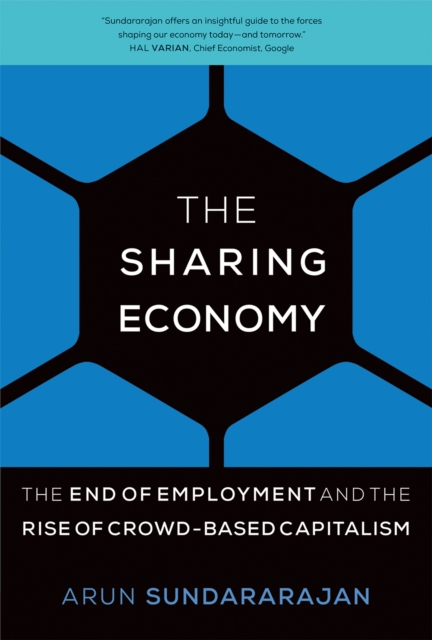
The Sharing Economy
Sharing isn't new. Giving someone a ride, having a guest in your spare room, running errands for someone, participating in a supper club -- these are not revolutionary concepts. What is new, in the \"sharing economy,\" is that you are not helping a friend for free; you are providing these services to a stranger for money. In this book, Arun Sundararajan, an expert on the sharing economy, explains the transition to what he describes as \"crowd-based capitalism\" -- a new way of organizing economic activity that may supplant the traditional corporate-centered model. As peer-to-peer commercial exchange blurs the lines between the personal and the professional, how will the economy, government regulation, what it means to have a job, and our social fabric be affected?Drawing on extensive research and numerous real-world examples -- including Airbnb, Lyft, Uber, Etsy, TaskRabbit, France's BlaBlaCar, China's Didi Kuaidi, and India's Ola, Sundararajan explains the basics of crowd-based capitalism. He describes the intriguing mix of \"gift\" and \"market\" in its transactions, demystifies emerging blockchain technologies, and clarifies the dizzying array of emerging on-demand platforms. He considers how this new paradigm changes economic growth and the future of work. Will we live in a world of empowered entrepreneurs who enjoy professional flexibility and independence? Or will we become disenfranchised digital laborers scurrying between platforms in search of the next wedge of piecework? Sundararajan highlights the important policy choices and suggests possible new directions for self-regulatory organizations, labor law, and funding our social safety net.
eBook

Organizational Culture, Business-to-Business Relationships, and Interfirm Networks
Provides in-depth understanding about business-to-business (B2B) and organizational relationships. This title includes descriptions on how B2B networks form, function and develop and is for readers who want to delve into how B2B relationships actually work and, frequently, do not work.
eBook

LinkedIn for dummies
Brand yourself like a pro on LinkedIn LinkedIn multiplies what you know by the power of who you know to deliver the number one social platform for business professionals and new job seekers. LinkedIn For Dummies shows LinkedIn newcomers the best ways to discover new opportunities, enhance their personal brand, network with other professionals.
eBook