
Catalogue Search | MBRL


Are you sure you want to remove the book from the shelf?

{{itemTitle}}
51
result(s) for
"Byzantine Empire -- Politics and government"
Sort by:
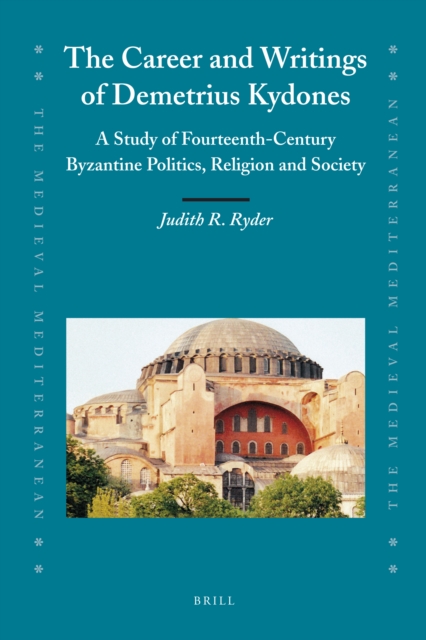
The Career and Writings of Demetrius Kydones
Demetrius Kydones was a leading political and intellectual figure in fourteenth-century Byzantium, know especially for his translations of Aquinas and pro-western attitudes. This book examines Kydones' career and writings in order to see what light they shed on Byzantine political and cultural developments in the period.
eBook


The Emperor Theophilos and the East, 829-842
Modern historiography has become accustomed to portraying the emperor Theophilos of Byzantium (829-842) in a favourable light, taking at face value the legendary account that makes of him a righteous and learned ruler, and excusing as ill fortune his apparent military failures against the Muslims. The present book considers events of the period that are crucial to our understanding of the reign and argues for a more balanced assessment of it. The focus lies on the impact of Oriental politics on the reign of Theophilos, the last iconoclast emperor. After introductory chapters, setting out the context in which he came to power, separate sections are devoted to the influence of Armenians at the court, the enrolment of Persian rebels against the caliphate in the Byzantine army, the continuous warfare with the Arabs and the cultural exchange with Baghdad, the Khazar problem, and the attitude of the Christian Melkites towards the iconoclast emperor. The final chapter reassesses the image of the emperor as a good ruler, building on the conclusions of the previous sections. The book reinterprets major events of the period and their chronology, and sets in a new light the role played by figures like Thomas the Slav, Manuel the Armenian or the Persian Theophobos, whose identity is established from a better understanding of the sources.
eBook

The empire that would not die : the paradox of eastern Roman survival, 640-740
\"In the middle of the sixth century the eastern Roman (Byzantine) empire was the largest state in western Eurasia. A century later it was a fraction of the size, its eastern provinces torn away by the early Islamic conquests in the middle of the seventh century. It had lost three-quarters of its lands and probably more of its tax revenues. How did it survive beyond the year 700 CE? Surrounded on all sides by challenges, most particularly from the dynamism and strength of the Islamic Caliphate, it should not have done: massively outnumbered and out-resourced, its territory repeatedly and continuously laid waste, its towns turned to fortresses, its population decimated by warfare and plague, even the capital, Constantinople, the largest city in the western world, besieged and threatened. Yet it did survive. By bringing together evidence for beliefs, identities and attitudes, administrative structures and the search for resources, the organization of its armies and the system of crisis management in its tax system, this book seeks to locate and describe the mechanisms of survival. The author places all these developments into their environmental context, looking at how the Byzantine state benefited from small-scale climatic changes--of which it was, of course, largely unaware--and how, together with other elements, these created the conditions that permitted the eastern Roman empire not just to survive, but indeed to recover sufficiently to mount its own major challenge to the Islamic world in subsequent centuries.\"--Provided by publisher.
Book

Court ceremonies and rituals of power in Byzantium and the medieval Mediterranean : comparative perspectives
Comparative approaches to political rituals and ceremonies in Byzantium and other court cultures of the Mediterranean basin form the subject of this collective volume, which examines related topics from the viewpoint of transformation, succession, appropriation, and representation in art and literature.
eBook

The Byzantine Republic : people and power in New Rome
\"Although Byzantium is known to history as the Eastern Roman Empire, scholars have long claimed that this Greek Christian theocracy bore little resemblance to Rome. This book reconnects Byzantium to its Roman roots, arguing that from the fifth to the twelfth centuries CE the Eastern Roman Empire was essentially a republic, with power exercised on behalf of the people and sometimes by them too. Kaldellis recovers for the historical record a less autocratic, more populist Byzantium whose Greek-speaking citizens considered themselves as fully Roman as their Latin-speaking 'ancestors.' He shows that the idea of Byzantium as a rigid imperial theocracy is a misleading construct of Western historians since the Enlightenment. With court proclamations often draped in Christian rhetoric, the notion of divine kingship emerged as a way to disguise the inherent vulnerability of each regime. The legitimacy of the emperors was not predicated on an absolute right to the throne but on the popularity of individual emperors, whose grip on power was tenuous despite the stability of the imperial institution itself. Kaldellis examines the overlooked Byzantine concept of the polity, along with the complex relationship of emperors to the law and the ways they bolstered their popular acceptance and avoided challenges. The rebellions that periodically rocked the empire were not aberrations, he shows, but an essential part of the functioning of the republican monarchy\"-- Provided by publisher.
Book

Byzantium's Balkan Frontier
Byzantium's Balkan Frontier is the first narrative history in English of the northern Balkans in the tenth to twelfth centuries. Where previous histories have been concerned principally with the medieval history of distinct and autonomous Balkan nations, this study regards Byzantine political authority as a unifying factor in the various lands which formed the empire's frontier in the north and west. It takes as its central concern Byzantine relations with all Slavic and non-Slavic peoples - including the Serbs, Croats, Bulgarians and Hungarians - in and beyond the Balkan Peninsula, and explores in detail imperial responses, first to the migrations of nomadic peoples, and subsequently to the expansion of Latin Christendom. It also examines the changing conception of the frontier in Byzantine thought and literature through the middle Byzantine period.
eBook

The Byzantine Dark Ages
\"The Byzantine Dark Ages explores current debates about the sudden transformation of the Byzantine Empire in the wake of environmental, social and political changes. Those studying the Byzantine Empire, the successor to the Roman Empire in the eastern Mediterranean, have long recognized that the mid-7th century CE ushered in sweeping variations in the way of life of many inhabitants of the Mediterranean world, with evidence of the decline of the size and economic prosperity of cities, a sharp fall in expressions of literary culture, the collapse in trade networks, and economic and political instability. Michael J. Decker looks at the material evidence for the 7th to 9th centuries, lays out the current academic discourse about its interpretation, and suggests new ways of thinking about this crucial era. Important to readers interested in understanding how and why complex societies and imperial systems undergo and adapt to stresses, this clearly written, accessible work will also challenge students of archaeology and history to think in new ways when comprehending the construction of the past\"-- Provided by publisher.
Book

The Latin Renovatio of Byzantium
This book offers a new perspective on the Latin take-over of Byzantine territories after the crusader sack of Constantinople in 1204, arguing that the new rulers very consciously aimed at continuing the Eastern Empire, drawing many Byzantines to their side.
eBook