
Catalogue Search | MBRL


Are you sure you want to remove the book from the shelf?

{{itemTitle}}
28
result(s) for
"Byzantine Empire -- Social life and customs"
Sort by:

Becoming Byzantine : children and childhood in Byzantium
Eight articles from a 2006 conference are included in this volume which covers issues related to childhood during the Byzantine Empire. Topics covered include law, procreation, death, patterns of breastfeeding, & material culture.
Book

Court ceremonies and rituals of power in Byzantium and the medieval Mediterranean : comparative perspectives
Comparative approaches to political rituals and ceremonies in Byzantium and other court cultures of the Mediterranean basin form the subject of this collective volume, which examines related topics from the viewpoint of transformation, succession, appropriation, and representation in art and literature.
eBook

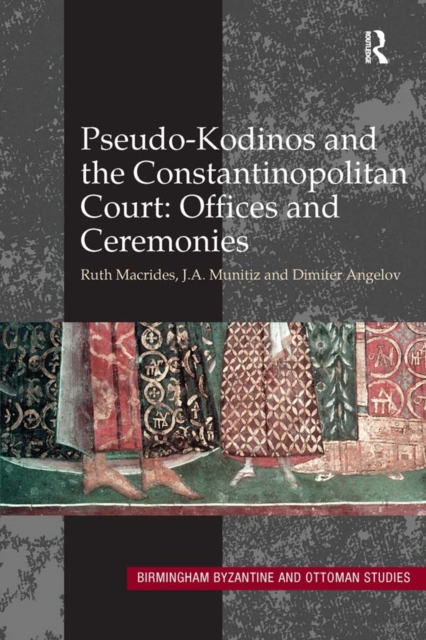
Pseudo-Kodinos and the Constantinopolitan Court: Offices and Ceremonies
The work known as Pseudo-Kodinos, the fourteenth-century text which is one of two surviving ceremonial books from the Byzantine empire, is presented here for the first time in English translation. With facing page Greek text and the first in-depth analysis in the form of commentary and individual studies on the hierarchy, the ceremonies, court attire, the Blachernai palace, lighting, music, gestures and postures, this volume makes an important new contribution to the study of the Byzantine court, and to the history and culture of Byzantium more broadly. The unique traits of this ceremony book include the combination of hierarchical lists of court officials with protocols of ceremonies; a detailed description of the clothing used at court, in particular, hats and staffs; an account of the functions of the court title holders, a description of the ceremonies of the year which take place both inside the palace and outside; the service of the megas domestikos in the army, protocols for the coronation of the emperor, the promotions of despot, sebastokrator and caesar, of the patriarch; a description of the mourning attire of the emperor; protocol for the reception of a foreign bride in Constantinople all these are analysed here. Developments in ceremonial since the tenth-century Book of Ceremonies are discussed, as is the space in which ceremonial was performed, along with a new interpretation of the ’other palace’, the Blachernai. The text reveals the anonymous authors’ interest in the past, in the origins of practices and items of clothing, but it is argued that Pseudo-Kodinos presents descriptions of actual practice at the Byzantine court, rather than prescriptions.
Ruth Macrides is Reader in Byzantine Studies in the Centre for Byzantine, Ottoman and Modern Greek Studies, University of Birmingham, UK; J.A. Munitiz, SJ, is Honorary Senior Research Fellow in Byzantine, Ottoman and Modern Greek Studies, Institute of Archaeology and Antiquity, University of Birmingham, UK; Dimiter Angelov is Professor of Byzantine History in the Centre for Byzantine, Ottoman and Modern Greek Studies, University of Birmingham, UK.
eBook

Arguing it Out : Discussion in Twelfth-Century Byzantium
\"The social and cultural history of Byzantium seems at first sight unsuited to the kind of thick description at which Natalie Zemon Davis excels. Yet recent scholarship that aims to locate Byzantine culture and society within new global and transnational approaches to history demands a more nuanced understanding. In these lectures she will explore the question of what kind of thick description can be provided. She will focus on the long twelfth century, a time of intense creativity as well as of rising tensions, and one for which literary approaches are currently a lively area in current scholarship. She will argue for their integration within a broader approach to Byzantine social and cultural history focusing on discourse, and drawing on the many kinds of dialogue texts (secular and religious) that were a key feature of Byzantine textual production\"--From publisher's website.
Book

Byzantine Gender
Why were virtuous Byzantine women described as manly? Why were boys' bodies thought to be closer in constitution to those of women than adult men? Did Byzantines think eunuchs were men?
This lively and personal book explains some key aspects of how people of the Medieval Roman Empire (Byzantine Empire) conceived of men and women, masculinity and femininity, and proper behaviour for men and women. By laying bare fundamental ideas about how gender was defined and performed, Byzantine Gender enables readers to understand Byzantine society more fully. And by providing background information about Byzantine gender, it makes it easier to approach and appreciate the fascinating otherness of Byzantine culture.
eBook

Knowing bodies, passionate souls : sense perceptions in Byzantium
\"Byzantine culture was notably attuned to a cosmos of multiple dominions: material, bodily, intellectual, physical, spiritual, human, divine. Despite a prevailing discourse to the contrary, the Byzantine world found its bridges between domains most often in sensory modes of awareness. These different domains were concretely perceptible and were encountered daily amidst the mundane no less than the exalted. Icons, incense, music, sacred architecture, ritual activity; saints, imperial families, persons at prayer; hymnography, ascetical or mystical literature: in all of its cultural expressions, the Byzantines excelled in highlighting the intersections between human and divine realms through sensory engagement (whether positive or negative). Byzantinists have been slow to look at the operations of the senses in Byzantium, especially those of seeing, its relation to the other senses, and phenomenological approaches in general. More recently, work on smell and hearing has followed that on seeing, and yet the areas of taste and touch--the most universal and most necessary of the senses--are still largely uncharted. Nor has much been done to explore how Byzantines viewed the senses, or how they envisaged the sensory interactions with their world. A map of the connections between sense-perceptions and other processes (of perception, memory, visualization) in the Byzantine brain has still to be sketched out. How did the Byzantines describe, narrate, or represent the senses at work? It is hoped to further studies of how individual senses in Byzantium operated in the context of all the senses, and their place in Byzantine thought about perception and cognition. Recent work on dreaming, on memory, and on the emotions has made advances possible, and collaborative experiments between Byzantinists and neurological scientists open further approaches. The happy coincidence of this symposium with the upcoming Garden and Landscape Studies Symposium, 'Sound and Scent in the Garden, ' and a forthcoming exhibition at the Walters Art Museum on the five senses enables cross-cultural comparisons that include gardens in Islamic Spain, Hebrew hymnography, Syriac wine-poetry, Mediterranean ordure, and Romanesque and Gothic precious objects that were not just looked at but also touched, smelled, and heard. Architects, musicologists, art historians, archaeologists, philologists can all contribute approaches to the revelation of the Byzantine sensorium\"--Publisher's website.
Book

Rome and Byzantium in the Visigothic Kingdom
This volume interrogates the assumption that Visigothic practices and institutions were mere imitations of the Byzantine empire. Contributors rethink these practices not as uncritical and derivative adoptions of Byzantine customs, but as dynamic processes in dialogue with not only the Byzantine empire but also with the contemporary Iberian context, as well as the Roman past. The goal of the volume is to approach Visigothic customs not as an uncritical adoption and imitatio of contemporary Roman models (an 'acculturation' model), but as unique interpretations of a common pool of symbols, practices, and institutions that formed the legacy of Rome. The contributors argue that it is necessary to reconsider the idea of imitatio imperii as a process that involved specific actors taking strategic decisions in historically contingent circumstances.
eBook

Fountains and water culture in Byzantium
\"This book restores the fountains of Roman Byzantium, Byzantine Constantinople and Ottoman Istanbul, reviving the sounds, shapes, smells and sights of past water cultures. Constantinople, the capital of the Byzantine and Ottoman Empires, is surrounded on three sides by sea, and has no major river to deliver clean, potable water. However, the cultures that thrived in this remarkable waterscape through millennia have developed and sustained diverse water cultures and a water delivery system that has supported countless fountains, some of which survive today. Scholars address the delivery system that conveyed and stored water, and the fountains, large and small, from which it gushed. Papers consider spring water, rainwater and seawater; water suitable for drinking, bathing and baptism; and fountains real, imagined and symbolic. Experts in the history of art and culture, archaeology and theology, and poetry and prose, offer reflections on water and fountains across two millennia in one location. The first study of water culture and fountains in Byzantium. Presents Byzantine material in a longer chronology, across several disciplines, embracing late Roman material as well as Ottoman material. Includes work from established names in the field as well as new voices\"--Publisher's website.
Book

Homosexuality in Greece and Rome
The most important primary texts on homosexuality in ancient Greece and Rome are translated into modern, explicit English and collected together for the first time in this comprehensive sourcebook. Covering an extensive period—from the earliest Greek texts in the late seventh century b.c.e. to Greco-Roman texts of the third and fourth centuries c.e.—the volume includes well-known writings by Plato, Sappho, Aeschines, Catullus, and Juvenal, as well as less well known but highly relevant and intriguing texts such as graffiti, comic fragments, magical papyri, medical treatises, and selected artistic evidence. These fluently translated texts, together with Thomas K. Hubbard's valuable introductions, clearly show that there was in fact no more consensus about homosexuality in ancient Greece and Rome than there is today. The material is organized by period and by genre, allowing readers to consider chronological developments in both Greece and Rome. Individual texts each are presented with a short introduction contextualizing them by date and, where necessary, discussing their place within a larger work. Chapter introductions discuss questions of genre and the ideological significance of the texts, while Hubbard's general introduction to the volume addresses issues such as sexual orientation in antiquity, moral judgments, class and ideology, and lesbianism. With its broad, unexpurgated, and thoroughly informed presentation, this unique anthology gives an essential perspective on homosexuality in classical antiquity.
eBook