
Catalogue Search | MBRL


Are you sure you want to remove the book from the shelf?

{{itemTitle}}
522
result(s) for
"C.I.S"
Sort by:

Conventions of agency independence
It is often said that the legal touchstone of agency independence is whether agency heads are removable at will or only for cause. Yet this condition is neither necessary nor sufficient for operational independence. Many important agencies whose heads lack for-cause tenure protection are conventionally treated as independent, while other agencies whose heads enjoy for-cause tenure protection are by all accounts thoroughly dependent upon organized interest groups, the White House, or legislators and legislative committees. This Article argues that the crucial role is played by what Commonwealth lawyers call 'conventions.' Agencies that lack for-cause tenure yet enjoy operative independence are protected by unwritten conventions that constrain political actors from attempting to remove their members or to direct their exercise of discretion. Such conventions reflect norms within relevant legal and political communities that impose sanctions for violations of agency independence or create beliefs or internalized moral strictures protecting independence. Conversely, where agencies enjoy statutory independence yet lack operative independence, the interaction among relevant political actors has failed to generate protective conventions. The lens of convention helps resolve several puzzles about the behavior of Presidents, legislators, judges, and others with respect to agency independence - including the Supreme Court's puzzling treatment of SEC independence in Free Enterprise Fund v. PCAOB. By acknowledging the conventional character of agency independence, U.S. courts can incorporate ideas from the courts of Commonwealth legal systems that harmonize conventions with written rules of law. This Article's principal suggestion is that U.S. courts should adopt the leading Commonwealth approach, according to which judges may indirectly 'recognize' conventions and incorporate them into their interpretation of written law, but not directly enforce conventions as freestanding obligations.
Journal Article

New regional geographies of the world as practised by leading advanced producer service firms in 2010
This paper reports a new type of world regionalisation based upon the location strategies of leading advanced producer service firms. To generate these 'global practice' regions, a principal components analysis of the office networks of 175 service firms across 138 cities is used to identify 10 common location strategies. These are interpreted as fuzzy (overlapping) and porous regional formations each consisting of two parts: a home-region and a global-outreach. The results indicate five overlapping pairs of regions: (i) intensive and extensive globalisations based upon the USA plus London (USAL); (ii) Americas and Latin America regions; (iii) Pacific Asia and China regions; (iv) Europe and Scandinavia regions; and (v) Australasian and Canadian 'Commonwealth' regions. All regions have worldwide global-outreaches but they differ significantly in their respective sizes and importance. Discussion of these findings elaborates upon two key points: first, globalisation is not a 'blanket' process creating a homogeneous world, and second, the resulting fuzzy and porous regionalisation counters the traditional 'territorialist' regional geographies that can provide a framework for global conflict with a more complex geography of multiple global integrations.
Journal Article

Russia and Syria: explaining alignment with a regime in crisis
This article explores explanations of Russia's unyielding alignment with the Syrian regime of Bashar al-Assad since the Syrian crisis erupted in the spring of 2011. Russia has provided a diplomatic shield for Damascus in the UN Security Council and has continued to supply it with modern arms. Putin's resistance to any scenario of western-led intervention in Syria, on the model of the Libya campaign, in itself does not explain Russian policy. For this we need to analyse underlying Russian motives. The article argues that identity or solidarity between the Soviet Union/Russia and Syria has exerted little real influence, besides leaving some strategic nostalgia among Russian security policy-makers. Russian material interests in Syria are also overstated, although Russia still hopes to entrench itself in the regional politics of the Middle East. Of more significance is the potential impact of the Syria crisis on the domestic political order of the Russian state. First, the nexus between regional spillover from Syria, Islamist networks and insurgency in the North Caucasus is a cause of concern—although the risk of 'blowback' to Russia is exaggerated. Second, Moscow rejects calls for the departure of Assad as another case of the western community imposing standards of political legitimacy on a 'sovereign state' to enforce regime change, with future implications for Russia or other authoritarian members of the Commonwealth of Independent States. Russia may try to enshrine its influence in the Middle East through a peace process for Syria, but if Syria descends further into chaos western states may be able to achieve no more in practice than emergency coordination with Russia.
Journal Article

Role of human capital and foreign direct investment in promoting economic growth
Purpose - The purpose of this paper is to validate the Endogenous Growth Model by examining the impacts of Human Capital (HK) and Foreign Direct Investment (FDI) on economic growth in ten countries from Commonwealth of Independent States (CIS). Design/methodology/approach - For empirical investigation, a linear regression model based on growth theory and panel data set covering the time-period from 1993 to 2011 are used. Fixed and random effects models are applied. On the basis of the Hausman test, the fixed effects model has been preferred over the random effects model. Findings - The results support the hypothesis of the study by confirming that HK development is critical for economic growth. Similarly, FDI has been found to have a facilitating role in promoting growth in the former Soviet Republics now comprising Central Asian independent economies. This is despite of the fact that there are country-specific differences across CIS. Practical implications - The findings suggest that investment climate in the host countries must be enriched through suitable policies. Improved domestic conditions not only enhance the performance of multinational corporations but also allow host economies to reap greater benefits of FDI inflows. Moreover, the findings demonstrate that investment in both education and health are indispensable. Therefore, improved levels of education and health should be the primary objective running concurrently with other factors in order to stimulate economic growth. Originality/value - The choice of CIS has been made because very little research has been found for the region particularly in the area of economic growth despite strong evidence of commonality in terms of landlocked geographical layout and economic and political structures of these economies. The region has gained importance gradually after independence of these states; and it has started to attract foreign funds in the shape of FDI only recently. Thus, there is a need to evaluate the future prospects pertaining to the importance of FDI and HK on growth performance of these economies and will insistently contribute to the literature.
Journal Article

What Really Happened in Kyrgyzstan?
This article is an analysis of the causes of Kyrgyzstan's \"Tulip Revolution\" of March 2005, and its implications for post-revolutionary politics. The mass mobilization was the result of community support for local elites after disputed parliamentary elections. The government was overthrown when an improvised alliance of opposition leaders and business elites unified uncoordinated protests around the country. Unlike Georgia and Ukraine's revolutions, civil society networks, students, and urban residents played a minimal role. Localism and informal ties were decisive, and have persisted in shaping politics since the revolution. The advent of \"hyper-democracy\" has endangered the government's efforts to ensure stability, reduce corruption, and grow the economy.
Journal Article

The New Commonwealth Model of Constitutionalism Notwithstanding: On Judicial Review and Constitution-Making
Scholars traditionally deduce the nature of judicial review (whether weak or strong) in a given country from the text of constitutional provisions (e.g., notwithstanding clause, incompatibility framework). They generally contrast the strong-form judicial review exercised under the U.S. model with weak-forms of judicial review exercised under the new Commonwealth model of constitutionalism. This article argues, however, that the strength of judicial review is mainly dictated by the method used for constitution-making. As such, it challenges conventional accounts of how models of constitutionalism come about and which systems should be classified as belonging to the new Commonwealth model of constitutionalism. This article further asserts that the process of constitution-making has practical implications for a country's present and future constitutional development. It explores how the various theories ascribed to a country's process of constitution-making lead to different resolutions of such fundamental issues as: (1) the implications of using \"notwithstanding\" language to overcome constitutional enactments; (2) the effectiveness of legislative self-entrenchment provisions; (3) the legitimacy of using referenda to decide constitutional matters; and (4) the \"unconstitutional constitutional amendment\" doctrine. The article shows that the process used for adoption and amendment of a constitution defines the nature of constitutionalism in a given country more than any text included in the constitution itself.
Journal Article

The Commonwealth of Independent States: an example of failed regionalism?
The Commonwealth of Independent States (CIS) was designed to manage the collapse of the Soviet Union and foster post-Soviet cooperation in political, economic, and security spheres. Over a decade into its existence, most analysts would rate it a failure: many post-Soviet states do not participate in CIS ventures, the institutional machinery of the CIS is weak, and Russia, the most dominant post-Soviet state, has tended to favour bi-lateral relationships over multi-lateral institutions. Why is this the case? This article looks at the CIS through the prism of theories of regionalism, demonstrating that the CIS was handicapped on many fronts, including emergent multi-polarity in the post-Soviet space and domestic-level political considerations in many post-Soviet states.
Journal Article
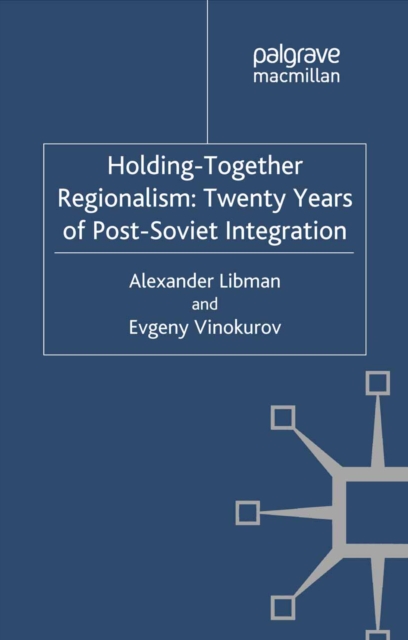
Holding-together regionalism : twenty years of post-Soviet integration
01
02
Libman and Vinokurov discuss the evolution of post-Soviet regional integration as a prominent case of 'holding-together regionalism' - integration of countries originally belonging to a single political entity. They provide a detailed account of the economic, political and social aspects of the interaction of post-Soviet countries, studying both formal regionalism and informal linkages between companies and individuals. The book pays particular attention to the political economy of this process, assessing both the reasons for the ineffectiveness of post-Soviet regionalism until recently and the driving forces of its persistence. It investigates migration flows, mutual trade and investments, as well as interaction in key sectors of infrastructure, such as telecommunications, transportation, agriculture and power utilities.
02
02
An in-depth analysis of one of the most important and complex issues of the post-Soviet era, namely the (re-)integration of this highly interconnected region. The book considers the evolution of 'holding-together' groups since the collapse of the Soviet Union in 1991, looking at intergovernmental interaction and informal economic and social ties.
31
02
Considers the evolution of the post-Soviet states and examines regional integration, looking at both intergovernmental interaction and informal economic and social linkages
04
02
PART I: BASIC CONCEPTS Searching for Holding-Together Regionalism The Dynamics of Holding-Together Regionalism PART II: POST-SOVIET INTEGRATION Institutional Integration: 20 years of Post-Soviet History Economic Actors and Regionalization Convergence and Divergence of Economic and Social Development The Political Economy of Post-Soviet Integration Sub-National Actors in Post-Soviet Integration PART III: KEY AREAS Holding Together of Falling Apart: Results of the Gravity Equation of CIS Trade Cross-Border Investment: General Trends through the 2000s Financial Markets and the Banking Sector Trans-Eurasian Transport Corridors Towards a CIS Common Electric Power Market CIS Telecommunications Sector: the Rise of the Multinationals Agriculture in the CIS: Departing from the Soviet Past Labour Migration PART IV: AN INTERTWINED REGION The Foreign Policies of Russia and Kazakhstan: Post-Soviet Regionalism and Power Balance Post-Soviet Space, Central Asia and Eurasia Issues for the Next Decade Conclusion
19
02
Up-to-date discussion of the political economy of post-Soviet integration, the reasons for its slow start and its revival in the past decade Original data on informal integration in the post-Soviet space including migration flows, mutual investments and social ties
13
02
Alexander Libman is Assistant Professor at the Frankfurt School of Finance & Management, Germany, Senior Research Fellow at the Russian Academy of Sciences and Affiliated Researcher at the East China Normal University. His principal publications have appeared in the Journal of Common Market Studies , Journal of Comparative Economics and Review of International Political Economy . Evgeny Vinokurov is Director of the Centre for Integration Studies at the Eurasian Development Bank. He has written and edited a number of monographs and papers on economic and political integration, including A Theory of Enclaves (2007) and The CIS, the EU and Russia: Challenges of Integration (2007).
eBook

Social capital and self-reported general and mental health in nine Former Soviet Union countries
Social capital has been proposed as a potentially important contributor to health, yet most of the existing research tends to ignore the challenge of assessing causality in this relationship. We deal with this issue by employing various instrumental variable estimation techniques. We apply the analysis to a set of nine former Soviet countries, using a unique multi-country household survey specifically designed for this region. Our results confirm that there appears to be a causal association running from several dimensions of individual social capital to general and mental health. Individual trust appears to be more strongly related to general health, while social isolation- to mental health. In addition, social support and trust seem to be more important determinants of health than the social capital dimensions that facilitate solidarity and collective action. Our findings are remarkably robust to a range of different specifications, including the use of instrumental variables. Certain interaction effects are also found: for instance, untrusting people who live in communities with higher aggregate level of trust are even less likely to experience good health than untrusting people living in the reference communities.
Journal Article

The Evolution of the Regulation of Labour in the USSR, the CIS and the Baltic States, 1985-2009
This article is a first systematic study of employment protection legislation in the 15 successor states of the USSR over the last two and a half decades. The analysis is based on new and unique data assembled using OECD methodology. We find that the dynamics of employment protection in the region resemble an inverted U-shaped pattern with the peak of labour market rigidity occurring in the mid-1990s in CIS countries and a decade later in the Baltic states. By now, the former Soviet states as a group are similar to the EU-15 and OECD countries in terms of the overall employment protection legislation index, although they differ in terms of contributions to the overall employment protection legislation of its three major components, namely, regulation of permanent contracts, temporary contracts and collective dismissals.
Journal Article