
Catalogue Search | MBRL


Are you sure you want to remove the book from the shelf?

{{itemTitle}}
2,486
result(s) for
"CARICATURES"
Sort by:


The Cartoons That Shook the World
On September 30, 2005, the Danish newspaperJyllands-Postenpublished twelve cartoons of the Prophet Muhammad. Five months later, thousands of Muslims inundated the newspaper with outpourings of anger and grief by phone, email, and fax; from Asia to Europe Muslims took to the streets in protest. This book is the first comprehensive investigation of the conflict that aroused impassioned debates around the world on freedom of expression, blasphemy, and the nature of modern Islam.
Jytte Klausen interviewed politicians in the Middle East, Muslim leaders in Europe, the Danish editors and cartoonists, and the Danish imam who started the controversy. Following the winding trail of protests across the world, she deconstructs the arguments and motives that drove the escalation of the increasingly globalized conflict. She concludes that the Muslim reaction to the cartoons was not-as was commonly assumed-a spontaneous emotional reaction arising out of the clash of Western and Islamic civilizations. Rather it was orchestrated, first by those with vested interests in elections in Denmark and Egypt, and later by Islamic extremists seeking to destabilize governments in Pakistan, Lebanon, Libya, and Nigeria. Klausen shows how the cartoon crisis was, therefore, ultimately a political conflict rather than a colossal cultural misunderstanding.
eBook

Cartoons and caricatures of Mark Twain in context : reformer and social critic, 1869-1910
The first book-length treatment of Mark Twain’s public persona as depicted in newspaper and magazine illustrations
Cartoons and Caricatures of Mark Twain in Context: Reformer and Social Critic, 1869–1910 examines the production, reception, and history of Twain’s reputation as a social and political satirist. Myrick and Scharnhorst trace the evolution of Twain’s depiction throughout his life, career, and even death and across more than seventy illustrations—from portrayals of the famous author as a court jester adorned with cap and bells, to a regally haloed king with a royal train—offering a new perspective on his influence and reputation. Although he was among the most photographed figures of the nineteenth century, Myrick and Scharnhorst focus on a medium that Twain, an expert ofself-promotion and brand management, could not control. As a result, Myrick and Scharnhorst have compiled an innovative and incisive visual reception history.
Cartoons and Caricatures of Mark Twain in Context illustrates the popular and often critical response to many famous and infamous episodes in his career, such as the storm of controversy that surrounded the publication of his anti-imperialist writings at the turn of the twentieth century. Routinely depicted with hair like a fright wig, a beak-like nose, and a cigar in hand, no matter the context or the costume, Twain was instantly recognizable. Yet it was not merely the familiarity of his image that made him a regular feature in visual commentary, but also his willingness to speak out against corruption and to insert himself into controversies of his day.
eBook


Graphic medicine manifesto
This inaugural volume in the Graphic Medicine series establishes the principles of graphic medicine and begins to map the field. The volume combines scholarly essays by members of the editorial team with previously unpublished visual narratives by Ian Williams and MK Czerwiec, and it includes arresting visual work from a wide range of graphic medicine practitioners. The book’s first section, featuring essays by Scott Smith and Susan Squier, argues that as a new area of scholarship, research on graphic medicine has the potential to challenge the conventional boundaries of academic disciplines, raise questions about their foundations, and reinvigorate literary scholarship—and the notion of the literary text—for a broader audience. The second section, incorporating essays by Michael Green and Kimberly Myers, demonstrates that graphic medicine narratives can engage members of the health professions with literary and visual representations and symbolic practices that offer patients, family members, physicians, and other caregivers new ways to experience and work with the complex challenges of the medical experience. The final section, by Ian Williams and MK Czerwiec, focuses on the practice of creating graphic narratives, iconography, drawing as a social practice, and the nature of comics as visual rhetoric. A conclusion (in comics form) testifies to the diverse and growing graphic medicine community. Two valuable bibliographies guide readers to comics and scholarly works relevant to the field.
eBook

Sketches from an unquiet country : Canadian graphic satire, 1840-1940
\"Canadian readers have enjoyed their own graphic satire since colonial times and Canadian artists have thrived as they took aim at the central issues and figures of their age. Graphic satire, a combination of humorous drawing and text that usually involves caricature, is a way of taking an ethical stand about contemporary politics and society. First appearing in short-lived illustrated weeklies in Montreal, Quebec City, and Toronto in the 1840s, usually as unsigned copies of engravings from European magazines, the genre spread quickly as skilled local illustrators, engravers, painters, and sculptors joined the teams of publishers and writers who sought to shape public opinion and public policy. A detailed account of of Canadian graphic satire, Sketches from an Unquiet Country looks at a century bookended by the aftermath of the 1837-38 Rebellions and Canada's entry into the Second World War. As fully fledged artist-commentators, Canadian cartoonists were sometimes gently ironic, but they were just as often caustic and violent in the pursuit of a point of view. This volume shows a country where conflicts crop up between linguistic and religious communities, a country often resistant to social and political change for women, and open to the cross-currents of anti-Semitism, xenophobia, and fascism that flared across Europe and North America in the early twentieth century. Drawing on new scholarship by researchers working in art history, material culture, and communications studies, Sketches from an Unquiet Country follows the fortunes of some of the artists and satiric themes that were prevalent in the centres of Canadian publishing.\"-- Provided by publisher.
Book
Caricature and National Character
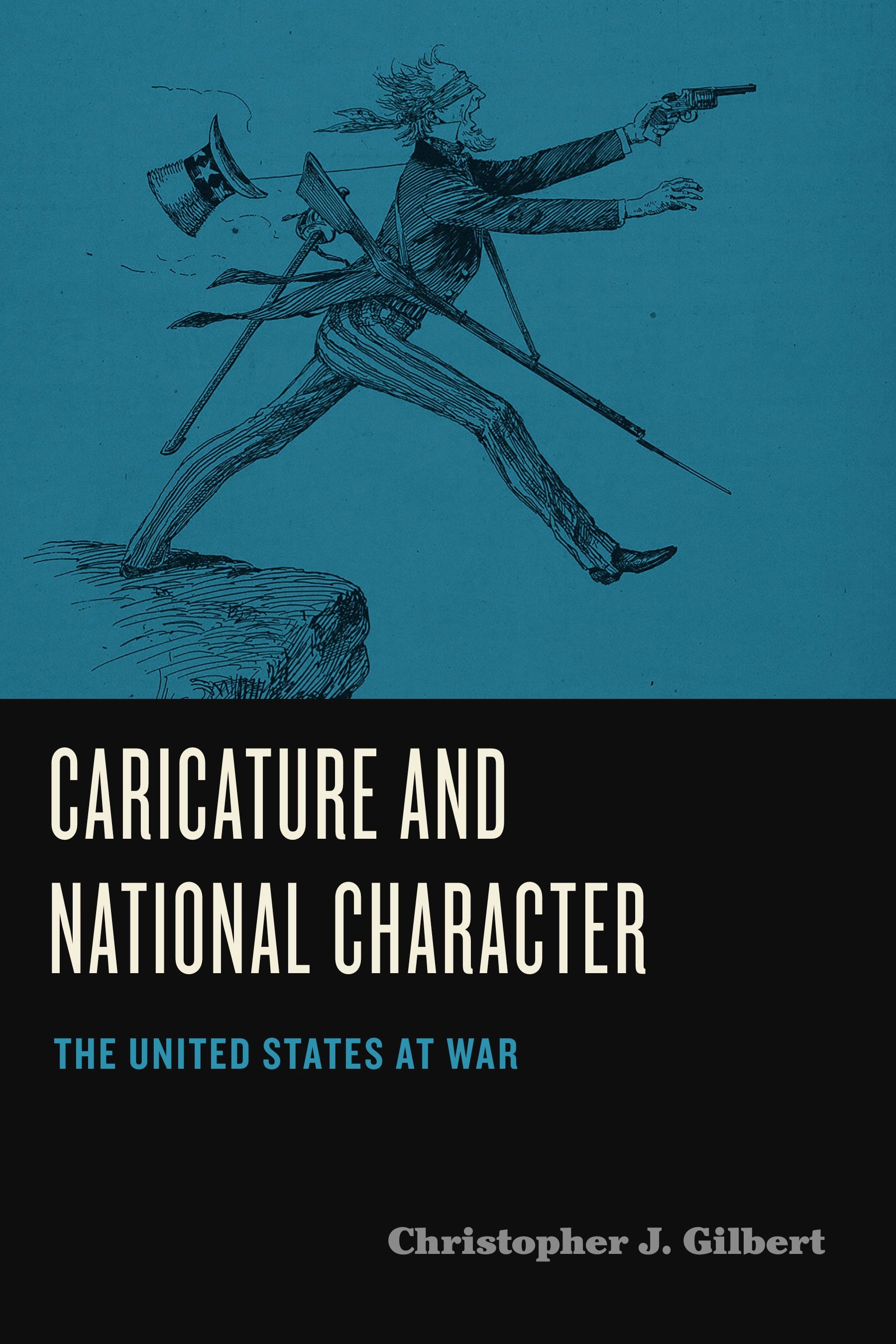
According to the popular maxim, a nation at war reveals its true character. In this incisive work, Chris Gilbert examines the long history of US war politics through the lens of political cartoons to provide new, unique insights into American cultural identity.
Tracing the comic representation of American values from the First World War to the War on Terror, Gilbert explores the power of humor in caricature to expose both the folly in jingoistic virtues and the sometimes-strange fortune in nationalistic vices. He examines the artwork of four exemplary American cartoonists—James Montgomery Flagg, Dr. Seuss, Ollie Harrington, and Ann Telnaes—to craft a trenchant image of Americanism. These examinations animate the rhetorical, and indeed comic, force of icons like Uncle Sam, national symbols like the American Eagle, political stooges like President Donald J. Trump, and more, as well as the power of political cartoons to comment on issues of race, class, and gender on the home front. Throughout, Gilbert portrays a US culture rooted in and riven by ideas of manifest destiny, patriotism, and democracy for all, yet plagued by ugly forms of nationalism, misogyny, racism, and violence.
Rich with examples of hilarious and masterfully drawn caricatures from a diverse range of creators, this unflinching look at the evolution of our conflicted national character illustrates how American cartoonists use farce, mockery, and wit to put national character in the comic looking glass.
eBook


Serials to Graphic Novels
\"A valuable and comprehensive survey of an enormous subject.\"--Paul Goldman, author ofReading Victorian Illustration, 1855-1875: Spoils of the Lumber Room \"A marvelous overview of how and why illustrations became an integral part of Victorian fiction. Golden documents a remarkable continuity from early nineteenth-century caricatures to realistic portrait-based illustrations to current graphic rewritings of familiar classics.\"--Martha Vicinus, author ofIntimate Friends: Women Who Loved Women, 1778-1928 \"A capacious and synthetic work that draws on a wide variety of scholarship, a very impressive command of the history of book illustration, a huge array of visual and verbal texts, and (most important) a commitment to the genreas a genre in the history of literary and artistic form.\"--Peter Betjemann, author ofTalking Shop: The Language of Craft in an Age of Consumption
The Victorian illustrated book came into being, flourished, and evolved during the nineteenth century. Catherine Golden offers a new framework for viewing the arc of this vibrant form and surveys the fluidity in styles of illustration in serial instalments, British and American periodicals, adult and children's literature, and--more recently--graphic novels.
Golden examines widely recognized illustrated texts, such asThe Pickwick Papers, Oliver Twist, Alice in Wonderland, andPeter Rabbit, and finds new expressions of this traditional genre in present-day graphic novel adaptations of the works of Austen, Dickens, and Trollope, as well as Neo-Victorian graphic novels likeThe League of Extraordinary Gentlemen. She explores the various factors that contributed to the early popularity of the illustrated book--the growth of commodity culture, a rise in literacy, new printing technologies--and how these ultimately created a mass market for new fiction.
While existing scholarship on Victorian illustrators largely centers on the Household Edition of Dickens or the realist artists of the \"Sixties,\" notably Fred Barnard and John Tenniel, this volume examines the lifetime of the Victorian illustrated book. It also discusses how a particular canon has been refashioned and repurposed for new generations of readers. Catherine J. Golden, professor of English at Skidmore College, is author of several books, includingPosting It: The Victorian Revolution in Letter Writing.\"A valuable and comprehensive survey of an enormous subject.\"--Paul Goldman, author ofReading Victorian Illustration, 1855-1875: Spoils of the Lumber Room \"A marvelous overview of how and why illustrations became an integral part of Victorian fiction. Golden documents a remarkable continuity from early nineteenth-century caricatures to realistic portrait-based illustrations to current graphic rewritings of familiar classics.\"--Martha Vicinus, author ofIntimate Friends: Women Who Loved Women, 1778-1928 \"A capacious and synthetic work that draws on a wide variety of scholarship, a very impressive command of the history of book illustration, a huge array of visual and verbal texts, and (most important) a commitment to the genreas a genre in the history of literary and artistic form.\"--Peter Betjemann, author ofTalking Shop: The Language of Craft in an Age of Consumption
The Victorian illustrated book came into being, flourished, and evolved during the nineteenth century. Catherine Golden offers a new framework for viewing the arc of this vibrant form and surveys the fluidity in styles of illustration in serial instalments, British and American periodicals, adult and children's literature, and--more recently--graphic novels.
Golden examines widely recognized illustrated texts, such asThe Pickwick Papers, Oliver Twist, Alice in Wonderland, andPeter Rabbit, and finds new expressions of this traditional genre in present-day graphic novel adaptations of the works of Austen, Dickens, and Trollope, as well as Neo-Victorian graphic novels likeThe League of Extraordinary Gentlemen. She explores the various factors that contributed to the early popularity of the illustrated book--the growth of commodity culture, a rise in literacy, new printing technologies--and how these ultimately created a mass market for new fiction.
While existing scholarship on Victorian illustrators largely centers on the Household Edition of Dickens or the realist artists of the \"Sixties,\" notably Fred Barnard and John Tenniel, this volume examines the lifetime of the Victorian illustrated book. It also discusses how a particular canon has been refashioned and repurposed for new generations of readers. Catherine J. Golden, professor of English at Skidmore College, is author of several books, includingPosting It: The Victorian Revolution in Letter Writing.
eBook