
Catalogue Search | MBRL


Are you sure you want to remove the book from the shelf?

{{itemTitle}}
121
result(s) for
"CATHOLIC ARCHDIOCESE"
Sort by:

From Priest's Whore to Pastor's Wife
On 13 June 1525, Martin Luther married Katharina von Bora, a former nun, in a private ceremony officiated by city preacher Johann Bugenhagen. Whilst Luther was not the first former monk or Reformer to marry, his marriage immediately became one of the iconic episodes of the Protestant Reformation. From that point on, the marital status of clergy would be a pivotal dividing line between the Catholic and Protestant churches. Tackling the early stages of this divide, this book provides a fresh assessment of clerical marriage in the first half of the sixteenth century, when the debates were undecided and the intellectual and institutional situation remained fluid and changeable. It investigates the way that clerical marriage was received, and viewed in the dioceses of Mainz and Magdeburg under Archbishop Albrecht of Brandenburg from 1513 to 1545. By concentrating on a cross-section of rural and urban settings from three key regions within this territory - Saxony, Franconia, and Swabia - the study is able to present a broad comparison of reactions to this contentious issue. Although the marital status of the clergy remains perhaps the most identifiable difference between Protestant and Roman Catholic churches, remarkably little research has been done on how the shift from a \"celibate\" to a married clergy took place during the Reformation in Germany or what reactions such a move elicited. As such, this book will be welcomed by all those wishing to gain greater insight, not only into the theological debates, but also into the interactions between social identity, governance, and religious practice.
eBook

The Gniezno Summit
In The Gniezno Summit Roman Michalowski analyses the reasons behind the founding of the Archbishopric of Gniezno during Otto III's encounter with Boleslaw Chrobry in Gniezno in 1000.For Michalowski there were two main reasons. One was the martyrdom of St. Adalbert, the Apostle of the Prussians. His body was buried in Gniezno, which put the Gniezno bishopric on a par with bishoprics founded by the Apostles. This was an important argument in favour of Gniezno being raised to the rank of archbishopric. The other reason was Otto III's spirituality. The emperor was fascinated with the idea of asceticism and abandoning the world. Hence his political programme, the Renovatio Imperii Romanorum, also had religious aims, and Otto tried to support missions among the pagans. To that end he needed an archbishopric on the north-eastern outskirts of the Empire.
eBook

Pilgrims to the Northland
This is the first narrative history of the Archdiocese of St. Paul, from 1840 to 1962. Historian Marvin R. O'Connell brings to life the extraordinary labors and accomplishments of the French priests who came to the upper midwest territory during the first half of the nineteenth century. Over the next fifty years a flood of settlers, primarily Irish and German Catholics, filled up the land. In 1850 Rome created a new diocese centered in the village of St. Paul, and in 1851 French priest Joseph Cretin was named its first bishop. O'Connell's lively account stresses the social, economic, and political context in which the Catholic Church in Minnesota grew and evolved. He vividly illuminates the personalities of the bishops who followed Cretin, Thomas Grace (1859–84) and John Ireland (1884–1918). Ireland inherited a sophisticated system of churches, schools, orphanages, and hospitals, staffed by orders of religious men and women. Ireland built upon this legacy, founding colleges for men and women, a major seminary, and cathedrals in both St. Paul and Minneapolis. Ireland's successors, Austin Dowling (1919–30) and John Gregory Murray (1931–56) were not as colorful as Ireland, although Murray was immensely popular. William Brady is the final archbishop covered in this book, serving from 1956 to 1961 when he died unexpectedly from a heart attack. O'Connell ends his narrative in 1962, soon after the death of Archbishop Brady and a few months before the first session of Vatican II.
eBook
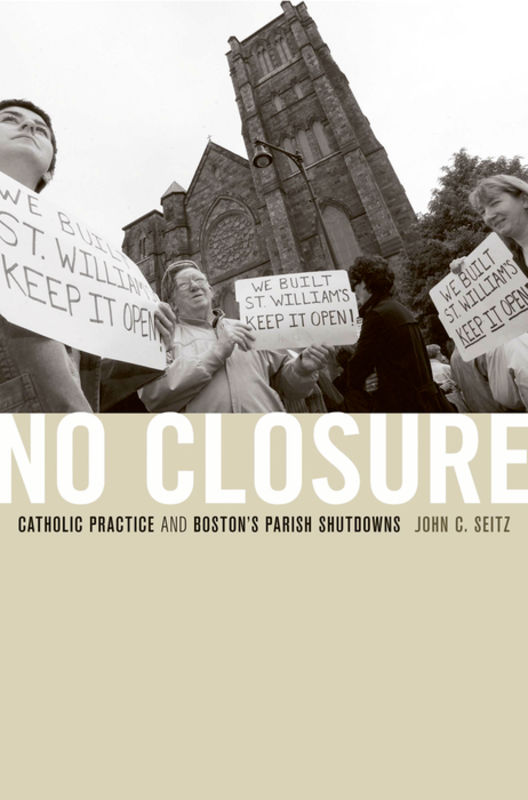
No Closure
In 2004 the Roman Catholic Archdiocese of Boston announced plans to close more than eighty churches. Distraught parishioners occupied several of these buildings in opposition to the decrees. Seitz tells the stories of these resisting Catholics in their own words, illuminating how they were drawn to reconsider the past and its meanings.
eBook

The Book of Pontiffs of the Church of Ravenna (Medieval Texts in Translation)
This translation makes this fascinating text accessible for the first time to an English-speaking audience. A substantial introduction to Agnellus and his composition of the text is included along with a full bibliography
eBook
The conquest of the soul : confession, discipline, and public order in Counter-Reformation Milan
Carlo and Federico Borromeo achieved fame by turning Milan into the foremost laboratory of the Italian Counter-Reformation. This monograph, the first on the subject to appear in English, interprets their program of penitential discipline as a quest to reshape Lombard society by reaching into the souls of its inhabitants.This integration of the public and private spheres had vast implications - the transformation of the clergy into a professional body, a bureaucratic-juridical turn in sacramental practice, interventions in the ritual order (notably the introduction of the confessional), and new models of disciplined and 'civilized' behavior.Catholic confessionalism thus conceived had decidedly mixed outcomes. While it transformed the religious landscape forever, its deepest ambitions foundered amidst political opposition, popular resistance, and bureaucratic accommodation. Milan was never to be a city on a hill.2001 Winner of the Howard R. Marraro Prize of the American Catholic Historical Association.
eBook

Seasons of grace : a history of the Catholic Archdiocese of Detroit
Tentler discusses the issue of Catholics in state and local politics and Catholic practice with regard to abortion, contraception, and intermarriage.
eBook
Erzbischof Hinkmar und die Folgen
The present study is concerned with sources for the history of the dioceses of Reims and Trier since the 8th century. It starts with essential information on the history of these dioceses in the Early Middle Ages which can be traced back mainly to accounts by the influential Archbishop Hinkmar of Reims (845-882). The problems of Hinkmar`s accounts and their continued influence are brought out against the contemporary background of the age of their composition, and their later deformations are followed over time. By taking up the trail of these deformations, the contingency of historical information and transmission becomes clear.
eBook
South Africa and United Nations Peacekee
The creation of the Force Intervention Brigade (FIB) as the sharp tactical edge of the United Nations Stabilisation Mission in the Democratic Republic of the Congo (MONUSCO), tasked with the neutralising of armed groups, was a watershed moment in the history of modern peace missions. What was more significant was that sub-Saharan national leaders were instrumental in the creation of the FIB (South Africa, Tanzania and Malawi), but lacked the resources to deploy such a force and consequently the brigade was deployed under the banner of the UN. With the legacy of an African Renaissance, and its role in the conception of the FIB, South Africa remains a critical player in international peace and security in sub-Saharan Africa, and therefore holds a key strategic role in achieving the FIBs objectives. This comes at a critical time where blue helmets are increasingly exposed to complex and challenging security contexts. The aim of this work is to provide a conceptual model for South African military future operations and UN offensive peacekeeping operations. In this undertaking, a layer of military and Clausewitzian theory is added to offensive peacekeeping operations. Furthermore, there are sections on operational constructs (capstone and operating concepts), doctrine and structural elements, as well a section on mine action. This book contributes towards an understanding of the nature of modern strategy through the lens of UN offensive peacekeeping operations and provides insights into operational challenges.
eBook