
Catalogue Search | MBRL


Are you sure you want to remove the book from the shelf?

{{itemTitle}}
144,948
result(s) for
"CIVIL PROCEDURES"
Sort by:

The Class Action in Common Law Legal Systems
Multi-party litigation is a world-wide legal process, and the class action device is one of its best-known manifestations. As a means of providing access to justice and achieving judicial economies, the class action is gaining increasing endorsement – particularly given the prevalence of mass consumerism of goods and services, and the extent to which the activities and decisions of corporations and government bodies can affect large numbers of people. The primary purpose of this book is to compare and contrast the class action models that apply under the federal regimes of Australia and the United States and the provincial regimes of Ontario and British Columbia in Canada. While the United States model is the most longstanding, there have now been sufficient judicial determinations under each of the studied jurisdictions to provide a constructive basis for comparison. In the context of the drafting and application of a workable class action framework, it is apparent that similar problems have been confronted across these jurisdictions, which in turn promotes a search for assistance in the experience and legal analysis of others. The book is presented in three Parts. The first Part deals with the class action concept and its alternatives, and also discusses and critiques the stance of England where the introduction of the opt-out class action model has been opposed. The second Part focuses upon the various criteria and factors governing commencement of a class action (encompassing matters such as commonality, superiority, suitability, and the class representative). Part 3 examines matters pertaining to conduct of the action itself (such as becoming a class member, notice requirements, settlement, judgments, and costs and fees). The book is written to have practical utility for a wide range of legal practitioners and professionals, such as: academics and students of comparative civil procedure and multi-party litigation; litigation lawyers who may use the reference materials cited to the benefit of their own class action clients; and those charged with law reform who look to adopt the most workable (and avoid the unworkable) features in class action models elsewhere.
eBook

The Litigation State
Of the 1.65 million lawsuits enforcing federal laws over the past decade, 3 percent were prosecuted by the federal government, while 97 percent were litigated by private parties. When and why did private plaintiff-driven litigation become a dominant model for enforcing federal regulation?The Litigation Stateshows how government legislation created the nation's reliance upon private litigation, and investigates why Congress would choose to mobilize, through statutory design, private lawsuits to implement federal statutes. Sean Farhang argues that Congress deliberately cultivates such private lawsuits partly as a means of enforcing its will over the resistance of opposing presidents.
Farhang reveals that private lawsuits, functioning as an enforcement resource, are a profoundly important component of American state capacity. He demonstrates how the distinctive institutional structure of the American state--particularly conflict between Congress and the president over control of the bureaucracy--encourages Congress to incentivize private lawsuits. Congress thereby achieves regulatory aims through a decentralized army of private lawyers, rather than by well-staffed bureaucracies under the president's influence. The historical development of ideological polarization between Congress and the president since the late 1960s has been a powerful cause of the explosion of private lawsuits enforcing federal law over the same period.
Using data from many policy areas spanning the twentieth century, and historical analysis focused on civil rights,The Litigation Stateinvestigates how American political institutions shape the strategic design of legislation to mobilize private lawsuits for policy implementation.
eBook
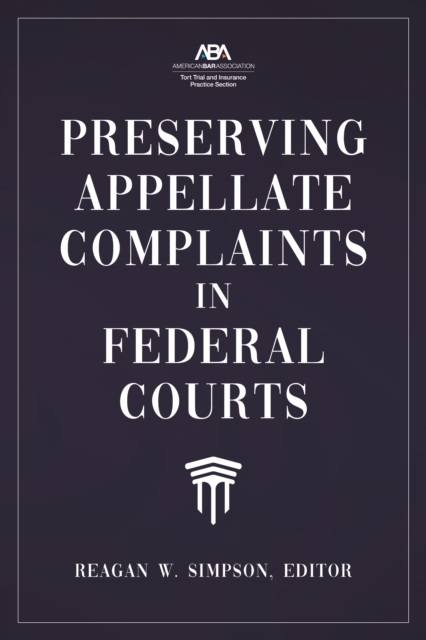
Preserving Appellate Complaints in Federal Courts
Trial lawyers often must make split-second decisions and judgment calls that do not follow all the procedural steps required to ensure presentation of an issue on appeal.Focusing on the preservation of appellate complaints in federal trial courts, this book helps civil trial and civil appellate lawyers take the right steps to ensure preservation.
eBook

Mass arbitration
For decades the class action has been in the crosshairs of defense-side procedural warfare. Repeated attacks on the class action by the defense bar, the US Chamber of Commerce, and other defense-side interest groups have been overwhelmingly successful. None proved more successful than the 'arbitration revolution', a 40-year campaign to eliminate class actions through forced arbitration provisions in private contracts. The effects of this revolution on civil justice have been profound. Scores of claims vanished from the civil justice landscape - claims concerning civil rights, wage theft, sexual harassment, and consumer fraud. The effects on social justice, racial justice, gender justice, and economic justice have been especially profound, as the legal claims of minorities, women, wage-and-hour workers, and the working poor were systematically and disproportionately foreclosed. Yet now, just when one would expect the defense bar to be taking a victory lap, prominent defendants are abandoning the hard-fought right to disable the class action through arbitration and instead seeking refuge in class action suits. Why the about-face? A surprising counter-offensive designed to use individual arbitration to the plaintiff's advantage: 'mass arbitration'. This article presents a foundational analysis of the subject. The article develops the first and only case study of mass arbitration and provides a taxonomy of the results. What emerges is not a variation on old themes, but instead a new and distinct model of dispute resolution. The investigation reveals significant ways in which the mass arbitration model challenges conventional wisdom about the economics of individual claims; uncovers important differences between the mass arbitration model and existing forms of aggregate dispute resolution; recasts long-standing debates in litigation theory and jurisprudence; and provides new perspective on the relationships among private procedural ordering, public procedural reform, and civil justice. Mass arbitration, in other words, is a phenomenon in its own right. More importantly, mass arbitration offers a window into the future of civil justice.
Journal Article
Changes in Judicial Behaviour after the Reform of the Lithuanian Civil Procedure
The article aims to assess whether the procedural innovations introduced by the reform of the civil procedure law of the Republic of Lithuania have brought changes in judges’ behaviour, which the reform intended to achieve. The study analyses the driving reason behind the reform of the civil procedure law, its objectives, and the ways the five innovations brought about by the reform changed the behaviour of the judges. The analysis of the legal sources and the empirical study show that some of the innovations introduced by the Civil Procedure Code have not yet been properly assimilated and that the code, which has been in force for twenty years, is still not fully operational and understood.
Journal Article

Fact Finding in Civil Proceedings
On Friday June 21st 2024, the Spring Meeting of the Dutch Procedural Law Association (NVvP) will take place, with the topic 'Fact-finding in Civil Procedures'.The speakers will be: Judge C.J-A.Seinen (Judge at the District Court of The Hague and PhD candidate in Civil Law at the Vrije Universiteit Amsterdam); Prof.C.
eBook

LAW AND EQUITY ON APPEAL
Most lawyers know that the Federal Rules of Civil Procedure merged the divergent trial procedures of the common law and of equity, but fewer are familiar with the development of federal appellate procedure. Here too there is a story of the merger of two distinct systems. At common law, a reviewing court examined the record for errors of law after the final trial judgment. In the equity tradition, an appeal was a rehearing of the law and the facts that aimed at achieving justice and did not need to await a final judgment. Unlike the story of federal trial procedure, in which we can identify a date of merger (1938, with the Federal Rules) and a winning side (equity), the story of federal appellate procedure laid out in this Article reveals a merger that occurred fitfully over two centuries and yielded a blended system that incorporates important aspects of both traditions.
In addition to revealing the complicated roots and hybrid character of current federal appellate practice, this Article aims to show that an appreciation of the history can explain some current pressures in the system and open our minds to the possibility of reform. Some odd developments in the appellate courts can be understood as suppressed features of equity practice reasserting themselves. With regard to the potential reforms, the suggestion is not that we resurrect the bifurcated procedure of the past. Nonetheless, there are circumstances in which today’s federal courts could benefit from recovering features of the equitable model of appeal.
Journal Article

California v. EPA
In California v. EPA, the Ninth Circuit announced a per se rule that, in such circumstances, a court must dissolve the injunction. Though this outcome may have reflected the most natural reading of precedent, the novel application of this per se rule to enjoined agencies misaligns with the motivations underlying recent jurisprudence on Rule 60(b)(5) of the Federal Rules of Civil Procedure, limits opportunities for judicial review of agency action, and further curtails the ability of agencies to make credible commitments. The Clean Air Act empowers the Environmental Protection Agency (EPA) to promulgate emissions standards for existing, in addition to new, sources of air pollution. EPA regulations pursuant to the Act prescribe a series of deadlines for both states and EPA to meet upon EPA's issuing new emissions standards.
Journal Article

On behalf of all others similarly situated: Class representation and equitable compensation
Class actions require class representation. In class actions, plaintiffs litigate not only on their own behalf but \"on behalf of all others similarly situated.\" For almost fifty years, federal courts have routinely exercised their inherent equitable authority to award modest compensation to deserving class representatives who help recover common funds benefiting the plaintiff class. These discretionary \"incentive awards\" are generally intended to compensate class representatives for shouldering certain costs and risks-which are not borne by absent class members-during the pendency of class litigation.
The ubiquity of permitting class action incentive awards ended in 2020. In an extraordinary ruling, the Eleventh Circuit held that incentive awards are per se unlawful under late nineteenth-century Supreme Court precedent. This holding has ignited a new controversy in the federal courts with far-reaching implications for the future of class actions.
Much of the existing legal scholarship on incentive awards analyzes policy rationales, quantitative trends, and legal standards involving the questions of \"When?\" and \"How much?\" to compensate class representatives. Only recently have scholars turned their attention to the more foundational question of whether federal courts have a sound basis to allocate incentive awards to class representatives under any circumstances. This Note weighs in on that debate by revisiting the Eleventh Circuit's recent decision to categorically ban incentive awards.
More importantly, this Note looks to the future and confronts the reality that other federal circuit courts or the Supreme Court could eventually adopt the Eleventh Circuit's position on incentive awards. Facing that unsettling prospect, this Note presents three proposals-one for policymakers and two for plaintiffside class action practitioners-that could save the equitable tradition of compensating class representatives and reinforce the viability of the class action device itself.
Journal Article

The Disappearance of Civil Trial in the United States
Since the 1930s, the proportion of civil cases concluded at trial has declined from about 20% to below 2% in the federal courts and below 1% in state courts. This Article looks to the history of the civil trial to explain why the trial endured so long and then vanished so rapidly. For the litigants, a civil procedure system serves two connected functions: investigating the facts and adjudicating the dispute. The better the system investigates and clarifies the facts, the more it promotes settlement and reduces the need to adjudicate. The Anglo-American common law for most of its history paid scant attention to the investigative function. This Article points to the role of the jury system in shaping the procedure and restricting the investigative function. Pleading was the only significant component of pretrial procedure, and the dominant function of pleading was to control the jury by narrowing to a single issue the question that the jury would be asked to decide. This primitive pretrial process left trial as the only occasion at which it was sometimes possible to investigate issues of fact. Over time, the jury-free equity courts developed techniques to enable litigants to obtain testimonial and documentary evidence in advance of adjudication. The fusion of law and equity in the Federal Rules of Civil Procedure of 1938 brought those techniques into the merged procedure, and expanded them notably. The signature reform of the Federal Rules was to shift pretrial procedure from pleading to discovery. A new system of civil procedure emerged, centered on the discovery of documents and the sworn depositions of parties and witnesses. Related innovations, the pretrial conference and summary judgment, reinforced the substitution of discovery for trial. This new procedure system has overcome the investigation deficit that so afflicted common law procedure, enabling almost all cases to be settled or dismissed without trial. Pretrial procedure has become nontrial procedure by making trial obsolete.
Journal Article