
Catalogue Search | MBRL


Are you sure you want to remove the book from the shelf?

{{itemTitle}}
18,733
result(s) for
"COMMERCIAL AREAS"
Sort by:

The comprehensive and progressive agreement for Trans-Pacific Partnership : implications for Southeast Asia
\"The Comprehensive and Progressive Agreement for Trans-Pacific Partnership (CPTPP) is a free trade agreement involving major countries across the Asia Pacific region. The trade pact, which entered into force on 30 December 2018, is considered by many to be the \"gold standard\", given its ambitious scope and depth. This volume offers multi-dimensional insights into the CPTPP and its impact on Southeast Asia. It begins with broad analyses covering the historical, economic and geopolitical aspects of the CPTPP. Subsequent chapters focus on the nature and implications of three key path-breaking provisions in the trade agreement, namely investor-state dispute settlement, intellectual property rights and state-owned enterprises. The effect of the CPTPP on Southeast Asia in terms of regional production networks is also examined from the perspective of Japanese multinational enterprises. The potential economic impact of the agreement is analysed for member countries (Vietnam and Malaysia) as well as countries that aspire to join the CPTPP in the future (Indonesia and Thailand). The world trading system is in disarray: the World Trade Organization has been weakened, perhaps terminally; the world's two economic superpowers are locked in deep, politicized disputes; the forces of populism and nationalism are everywhere complicating the return to a more liberal, rules-based order. These trends are challenging one of the building blocks of ASEAN economic development, namely these countries' outward-looking trade and investment policies. With impeccable timing this important volume by a group of eminent authors assesses these issues with reference to the Comprehensive and Progressive Agreement for Trans-Pacific Partnership. The CPTPP excludes the three largest traders—China, the EU and the US—but it is a welcome second-best initiative that may have broader, positive ripple effects. This is the volume to read to gain a deeper understanding of the many complex issues at play.\" -- Hal Hill, H.W. Arndt Professor Emeritus of Southeast Asian Economies, College of Asia & the Pacific, Australian National University
eBook
Airport economics in Latin America and the Caribbean : benchmarking, regulation, and pricing
This report presents the findings of a first-ever, comprehensive study of how Latin America and the Caribbean (LAC) region airports have evolved during a notable period of transition in airport ownership. It is an unbiased, positive analysis of what happened, rather than a normative analysis of what should be done to reform and to attract private sector participation to the airport sector. It takes the first step to respond to the need for more conclusive information about the influence of airport ownership on economic performance. The report centers on the study of three dimensions of performance: productive efficiency, institutional setup for the governance of the sector, and financing. This multifaceted report uses a range of advanced quantitative and qualitative methods to assess the relationship between airport ownership and performance in the LAC region. After a comprehensive overview, chapters 1 and 2 provide the necessary background for the air transport sector and the evolution of private sector participation and investment in airport infrastructure. In chapter 3, questionnaires submitted to airport operators and regulators led to the creation of the unique data sets, which were first used to compare performance across 14 partial performance indicators, and next used to develop aggregate measures of efficiency necessary for the benchmarking exercise. In chapter 4, a qualitative study of the relationship between type of regulating agency (independent or government-led) and transparency, accountability, and bureaucracy provides insight into how recent reforms have also affected the quality of regulatory governance. Chapter 5 provides an in-depth analysis of the evolution of tariff structures in the region as compared to a sample of international airports. Several important topics were not included in this report but should be the focus of future research. In particular, the evolution of the quality of services in airports deserves greater attention, as airports are increasingly becoming business centers and key gateways for trade competitiveness. The other main topic that requires detailed practical research is climate change and its relationship with the airport sector.
eBook
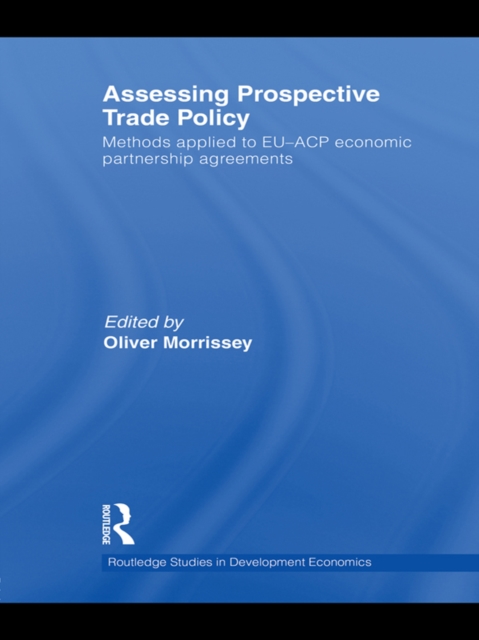
Assessing Prospective Trade Policy
The European Union (EU) has provided trade preferences to the African, Caribbean and Pacific (ACP) countries since 1975. To maintain these preferences, a series of economic partnership agreements (EPAs) between the EU and regional groupings of ACP countries are being agreed, (negotiations started around 2003 and many framework agreements have been signed). As multilateral negotiations within the World Trade Organisation have stalled, EPAs are currently the single most important policy issue for ACP trade. This volume assesses EPAs and the potential impact on ACP countries, provides guidance for ACP negotiators in future negotiations and introduces methods to analyse the impact of future trade reforms.
The essential features are that ACP countries commit to remove tariffs on substantially all imports from the EU and the EU offers improved market access to ACP exporters. For ACP countries the major impacts will be increased imports from the EU, hence a loss of tariff revenue and increased competition from imports in domestic and regional markets, implying significant adjustment costs, which may be offset by some increases in exports to the EU. This collection excellently outlines a variety of analytical methods that can be used to assess the potential economic effects of trade policy reforms, shows how these can be applied to EPAs and derives implications for the issues that should be addressed in negotiating the details of agreements.
This valuable contribution offers a balanced assessment of the issues and should be essential reading for postgraduates and researchers focussing on Development Economics. Furthermore, the book is written in an accessible style and should be an excellent resource for trade negotiators and government officials concerned with trade relations, as well as officials in the European Commission, individual countries (ACP, Commonwealth, EU) and in multilateral organizations (WTO, UNECA, World Bank, UNCTAD).
1. Introduction: EPAs and Prospective Trade Policy Analysis Oliver Morrissey 2. Overview and Comparative Analysis of EPAs Marieke Meyn 3. The Impact of EPAs on ACP Imports and Welfare Oliver Morrissey and Evious Zgovu 4. Adjusting to an EPA: Evidence for Mauritius Chris Milner, Oliver Morrissey and Evious Zgovu 5. Trade and Poverty Impacts for Uganda Ole Boysen and Alan Matthews 6. Trade and Growth Impacts for Kenya Jane Kiringai 7. Import Response to Tariff Reductions in Africa Chris Jones 8. Export Performance of ACP Countries in Perspective Andrew Mold and Annalisa Prizzon 9. EPAs and Food Security Alan Matthews 10. Conclusion: EPAs to Promote ACP Development Oliver Morrissey
Oliver Morrissey is Professor in Development Economics and Director of CREDIT, School of Economics, University of Nottingham, UK.
eBook

Globalization and local adaptation in international trade law
Drawing on case studies from the Pacific Rim, this book traces the selective adaptation of international trade law to local conditions.
eBook

The Trans-Pacific Partnership
The Trans-Pacific Partnership (TPP) talks attempt to link together at least nine countries in three continents to create a 'high-quality, twenty-first century agreement'. Such an agreement is intended to open markets to competition between the partners more than ever before in sectors ranging from goods and services to investment, and includes rigorous rules in the fields of intellectual property, labour protection and environmental conservation. The TPP also aims to improve regulatory coherence, enhance production supply chains and help boost small and medium-sized enterprises. It could transform relations with regions such as Latin America, paving the way to an eventual Free Trade Area of the Asia Pacific, or see innovations translated into the global trade regulatory system operating under the WTO. However, given the tensions between strategic and economic concerns, the final deal could still collapse into something closer to a standard, 'twentieth-century' trade agreement.
eBook


Wohin mit den Ansiedlungen, wenn die Flächen ausgehen?
Due to increasing density-dependent competitions in land use, it is difficult to plan new industrial areas, especially for factories and businesses with a need for large-scaled sites. Economic interest groups demand to plan new industrial areas to keep the region in a competitive position. At the same time, many citizens and local politicians are concerned about new specific land use areas for industries. To locate suitable industrial sites in the catchment area of municipalities with land shortage and a high demand for space and to involve regional stakeholders into the planning process, new regional planning tools are required. The case study about the “Regionale Kooperationsstandorte” planning tool in this paper shows which additional values and challenges the recipients of the plan expect from the new planning approach. Apparently, the new regional planning tool is generally accepted by most of the stakeholders in the Ruhr Metropolis. But specific regulations and particular sites are highly controversial, due to diverging interests of different stakeholders and municipalities or due to changing circumstances, so that it is not possible to reach a consensus on all issues.
Journal Article

Vacant House Characteristics by Use Area and Their Application to Sustainable Community
The problem of vacant houses is important to identify its causes and then solve it. This study aims to determine the factors affecting the occurrence of vacant houses and examines their influence. The results highlight that the residential environment, population, social, physical environment, and geographic factors are statistically significant for the residential areas’ vacant house occurrence, but physical environmental was not significant for the commercial area vacant house occurrence; however, the individual building factor was significant. In residential areas, if the housing itself becomes obsolete or the area is outdated, people often depart from the area, leaving behind empty houses. In the commercial area, it is possible to decrease the number of vacant houses by converting old houses into shops in line with revitalizing a commercial district; a decrease in the number of businesses can be interpreted as a decline in commercial districts and an increase in vacant houses.
Journal Article

Residues of glyphosate and aminomethylphosphonic acid (AMPA) in genetically modified glyphosate tolerant soybean, corn and cotton crops
Glyphosate is a broad-spectrum herbicide capable of controlling a wide range of weed. It uses could cause the occurrence of residues in conventional or genetically modified crops. For this purpose, grains (soybean and corn) and cotton seeds were sampled from commercial areas in 2012/2013 to 2017/2018 seasons in different Brazilian agricultural regions to monitor glyphosate residues levels and its metabolite (aminomethylphosphonic acid - AMPA) after different managements. The glyphosate residues levels in genetically modified corn (GM) ranged from no detected (ND) to 0.15 mg kg-1, in GM soybean values ranged from ND to 2.81 mg kg-1 and in GM cotton ranged from ND to 1.78 mg kg-1. AMPA residues levels indicated a correlation with the glyphosate residues. Glyphosate residues levels in soybean and corn grains and cotton seeds were within the Maximum Residue Limits (MRLs) established by ANVISA and Codex Alimentarius. RESUMO: O glifosato é um herbicida de amplo espectro capaz de controlar uma grande diversidade de ervas daninhas e seu uso pode acarretar na ocorrência de resíduos, seja em culturas convencionais ou geneticamente modificadas. Sendo assim, amostragens de grãos de soja e milho e de sementes de algodão foram realizadas em áreas comerciais nas safras de 2012/2013 a 2017/2018 em diferentes regiões agrícolas brasileiras com o objetivo de monitorar os níveis de resíduos de glifosato e seu metabólito (ácido aminometilfosfônico - AMPA) após diferentes manejos. Os níveis de resíduos de glifosato em milho geneticamente modificados (GM) tolerante ao glifosato variaram desde não detectados (ND) a até 0,15 mg kg-1, em soja GM tolerante ao glifosato os valores variaram de ND a 2,81 mg kg-1 e em algodão GM tolerante ao glifosato os resultados se estabeleceram entre ND a 1,78 mg kg-1. Os valores de resíduos de AMPA indicaram correlação com os resíduos de glifosato. Os níveis de resíduos de glifosato em grãos de soja e milho e sementes de algodão ficaram dentro dos Limites Máximos de Resíduos (LMRs) preconizados pela ANVISA e Codex Alimentarius.
Journal Article

Place-Based Climate-Proofing of Commercial and Industrial Areas: Inventory and Guidelines From a Regional Planning Perspective
In spite of all efforts to reduce greenhouse gases, climate change has become a new reality that requires regional planning to provide effective solutions. This article focuses on commercial and industrial areas (Gewerbegebiete), which are important but often overlooked spaces, by means of examples in the Berlin-Brandenburg region. The article investigates whether and how regional planning can help these areas adapt to climate change. Three commercial and industrial areas in different spatial settings are examined, using an inventory of place-based measures, general standards, and regional networking of planning actors. This inventory is based on a backcasting analysis that compares normative future images of climate-adapted commercial and industrial areas with their current local situation. Spatially differentiated guidelines for the adaptation of commercial and industrial areas are then developed from a regional planning perspective by “climate-proofing” regional plans. These guidelines provide both place-based and general solutions for integrating and governing climate adaptation measures and standards into existing frameworks using a hands-on regional planning approach.
Journal Article