
Catalogue Search | MBRL


Are you sure you want to remove the book from the shelf?

{{itemTitle}}
130,112
result(s) for
"COMMUNICATION PSYCHOLOGY"
Sort by:

The social psychology of nonverbal communication
\"The Social Psychology of Nonverbal Communication gathers together leading scholars of nonverbal communication from around the world to offer insight into a range of issues within the discipline. The collection presents contemporary research and theorization of the nature, functions, and modalities of nonverbal behavior in an array of circumstances, with the aim of rethinking current approaches to the subject. This book will be of great interest to academics and nonverbal communication researchers, as well as to anyone who wants to interpret and better understand nonverbal behavior\"-- Provided by publisher.
Book

Nonverbal synchrony in virtual reality
How might nonverbal synchrony naturally evolve in a social virtual reality environment? And how can avatar embodiment affect how participants coordinate nonverbally with each other? In the following pre-registered between-subjects experiment, we tracked the movements of pairs of users during a collaborative or competitive task in immersive virtual reality. Each conversational partner controlled either a customized avatar body or an abstract cube that responded to their movements. We compared the movements of the actual user pairs between the two conditions, and to an artificial \"pseudosynchrony\" dataset composed of the movements of randomly combined participant pairs who did not actually interact. We found stronger positive and negative correlations between real pairs compared to pseudosynchronous pairs, providing evidence for naturally occurring nonverbal synchrony between pairs in virtual reality. We discuss this in the context of the relationships between avatar appearance, task success, social closeness and social presence.
Journal Article


Brief Report: Randomized Test of the Efficacy of Picture Exchange Communication System on Highly Generalized Picture Exchanges in Children with ASD
A randomized control trial comparing two social-communication interventions in young children with autism examined far-transfer of the use of picture exchange to communicate. Thirty-six children were randomly assigned to one of two treatment conditions, one of which was the Picture Exchange Communication System (PECS). All children had access to picture symbols during assessments. Post-treatment measurement of the number of picture exchanges in a far-transfer, assessment context favored the PECS intervention. These findings were interpreted as support for the hypothesis that the PECS curriculum can successfully teach a generalized means of showing coordinated attention to object and person without requiring eye contact to children with ASD.
Journal Article
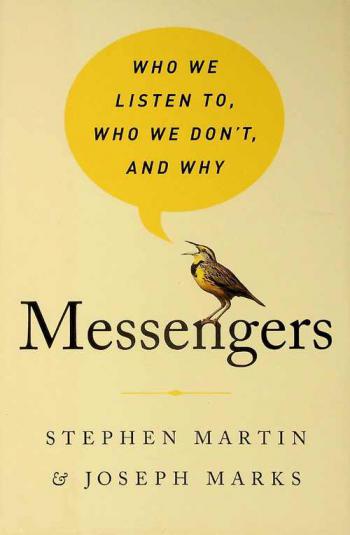
Messengers : who we listen to, who we don't, and why
\"We live in a world where proven facts and verifiable data are freely and widely available. Why, then, are self-confident ignoramuses so often believed over thoughtful experts? And why do seemingly irrelevant details such as a person's appearance or financial status influence whether or not we trust what they are saying, regardless of their wisdom or foolishness? Stephen Martin and Joseph Marks compellingly explain how in our uncertain and ambiguous world, the messenger is increasingly the message. We frequently fail, they argue, to separate the idea being communicated from the person conveying it, explaining why the status or connectedness of the messenger has become more important than the message itself. Messengers influence business, politics, local communities, and our broader society. And Martin and Marks reveal the forces behind the most infuriating phenomena of our modern era, such as belief in fake news and how presidents can hawk misinformation and flagrant lies yet remain.\"-- Provided by publisher.
Randomized Controlled Trial for Early Intervention for Autism: A Pilot Study of the Autism 1-2-3 Project
We piloted a 2-week “Autism-1-2-3” early intervention for children with autism and their parents immediately after diagnosis that targeted at (1) eye contact, (2) gesture and (3) vocalization/words. Seventeen children were randomized into the Intervention (
n
= 9) and Control (
n
= 8) groups. Outcome measures included the Autism Diagnostic Observation Schedule, Ritvo-Freeman Real Life Rating Scale, Symbolic Play Test, and Parenting Stress Index. Children with autism improved in language/communication, reciprocal social interaction, and symbolic play. Parents perceived significant improvement in their children’s language, social interaction, and their own stress level. This intervention can serve as short-term training on communication and social interaction for children with autism, and reduce the stress of their parents during the long waiting time for public health services.
Journal Article

Efficacy of the ASAP Intervention for Preschoolers with ASD: A Cluster Randomized Controlled Trial
The advancing social-communication and play (ASAP) intervention was designed as a classroom-based intervention, in which the educational teams serving preschool-aged children with autism spectrum disorder are trained to implement the intervention in order to improve these children’s social-communication and play skills. In this 4-year, multi-site efficacy trial, classrooms were randomly assigned to ASAP or a business-as-usual control condition. A total of 78 classrooms, including 161 children, enrolled in this study. No significant group differences were found for the primary outcomes of children’s social-communication and play. However, children in the ASAP group showed increased classroom engagement. Additionally, participation in ASAP seemed to have a protective effect for one indicator of teacher burnout. Implications for future research are discussed.
Journal Article

Five stars : the communication secrets to get from good to great /
\"[In this book, the author] breaks down how to apply Aristotle's formula of persuasion to inspire contemporary audiences\"--Amazon.com.
Book

The influence of power posing on cardiac vagal activity
The effects of power posing on hormonal reactions such as testosterone and cortisol have been widely investigated, however, its effects on the autonomic nervous system are rather unknown. Consequently, the aim of this study was to investigate the influence of power posing on cardiac vagal activity (CVA), as indexed by heart rate variability. It was hypothesized that high power poses (HPP) would increase CVA, whereas low power poses (LPP) would decrease CVA, given power posing is expected to decrease stress. Participants (N = 56) performed a total of four power poses, a combination of two power conditions (high vs. low) and two body positions (sitting vs. standing) for 1 min each, in a randomized order. In addition, for each power pose participants were given a role description. Contrary to our hypothesis, CVA decreased significantly during HPP in comparison to the resting measures before and after HPP, and CVA did not change during LPP. Moreover, while holding the power pose, CVA was higher in the LPP than in the HPP condition. Regarding subjective measures our hypotheses were confirmed, felt power was significantly higher after HPP than after LPP. Additionally, perceived stress was higher after LPP than after HPP. Taken together, these results suggest that the immediate impact of PP on the autonomic nervous system is more likely to influence a higher state of activation within the body instead of increasing resources to cope with stress as indexed by CVA, which may be seen only on a more long-term basis.
Journal Article