
Catalogue Search | MBRL


Are you sure you want to remove the book from the shelf?

{{itemTitle}}
1,196
result(s) for
"CONSERVATISM (US POLITICS)"
Sort by:

The Polarization of Contemporary American Politics
Political elites of the United States are deeply polarized. Polarization of the Democratic and Republican Parties is higher than at any time since the end of the Civil War. This essay describes how the modern polarization trend emerged and its implications for mass political behavior and public policy outcomes. We contend that contemporary political polarization must be understood in terms of both the ideological divergence of the parties and the expansion of the liberal–conservative dimension of conflict to a wider set of social and cultural conflicts in American society. We close with the speculation that the Republican Party has become the more fractured of the parties along the liberal–conservative dimension at both the elite and mass level.
Journal Article

Righting feminism : conservative women and American politics
When we think of women's activism in America, figures such as Gloria Steinem and Betty Friedan invariably come to mind—those liberal doyennes who have fought for years to chip away at patriarchy and achieve gender equality. But women's interests are not synonymous with organizations like NOW anymore. As this book shows, the conservative ascendancy that began in the Reagan era has been accompanied by the emergence of a broad-based conservative women's movement. And while firebrands like Ann Coulter and Phyllis Schlafly may be the public face of right-wing women's activism, a handful of large and established women's organizations have proven to be the most effective promoters of the conservative agenda. This book shows that one of the key—albeit overlooked—developments in political activism since the 1980s has been the emergence of conservative women's organizations. It focuses on the most prominent of these groups, Concerned Women for America (CWA) and the Independent Women's Forum (IWF), to reveal how they are using feminist rhetoric for conservative ends: outlawing abortion, restricting pornography, and bolstering the traditional family. But ironically, these organizations face a paradox: to combat the legacy of feminism—particularly its appeal to the majority of American women—they must use the rhetoric of women's empowerment. Indeed, the book illustrates how conservative activists are often the beneficiaries of the very feminist politics they oppose. Yet just as importantly, it demolishes two widely believed truisms: that conservatism holds no appeal to women and that modern conservatism is hostile to the very notion of women's activism.
eBook
Creating Constitutional Conservatism
Although “constitutional conservatism” has become commonplace among American conservatives, its meaning has proven elusive. Revisionist historians and political scientists have looked to its origins in the early twentieth century, when Republican Party elites constructed a conservative interpretation of the Constitution and put it into practice in the era of Harding, Coolidge, and Hoover. Yet these revisionists have told only part of the story, because constitutional conservatism was also the creation of a network of activists and groups who in the 1920s constructed a nationwide campaign to instill a conservative understanding of the Constitution in the American public. This study examines how they built their campaign, defined its purpose, framed a conservative reading of constitutional history and theory, and conveyed it to the public in a bitterly contested political process. By telling this fuller story, it provides a more complete understanding of constitutional conservatism, both in the past and today.
Journal Article
Resurgent Parenthood: Organic Domestic Ideals and the Southern Family Roots of Conservative Ascendancy, 1980–2005
Accounts that focus on the “southernization” of the Republican Party and the subsequent conservative ascendance in American party politics emphasize the role of race and civil rights issues, or battles over sex and gender, but none analyze the significance of family in shaping this partisan rightward shift. Meanwhile, literatures in fields other than party politics have engaged family more centrally, highlighting the rising salience of parents to legal and political development. This article connects and contributes to these literatures by analyzing the impact of parenthood and family on political party development. I demonstrate the increasing salience of “parents” as a political ideal in late twentieth-century policy discourse, reveal an overarching organic family frame in which it was used, and trace this frame to Southern domestic ideals and to the growing importance of the South to the Republican Party. In so doing I provide a “family-centered” account of the late twentieth-century conservative ascendancy and suggest the centrality of family – and parenthood – in defining it.
Journal Article
British Conservatism and American Liberalism in Mid-Twentieth Century: Burkean Themes in Niebuhr and Schlesinger
This article looks at how Reinhold Niebuhr and Arthur Schlesinger, Jr. drew on themes in Edmund Burke’s conservative writings to express ambivalence about equality and populism on behalf of progressive goals, and how they offered an alternative understanding of liberalism as the pursuit of progressive values restrained by respect for conservative virtues. The article pays particular attention to Niebuhr’s and Schlesinger’s views on successful leadership. Like Burke, these mid-century liberal theorists advocated the adoption of the virtues of the British aristocratic ruling class to check leftist populism. On the surface, their praise of aristocratic virtues may seem incompatible with their undeniable celebration of American democracy during the mid-twentieth century. Closer examination suggests, though, that their praise of democracy has a Burkean tinge.
Journal Article
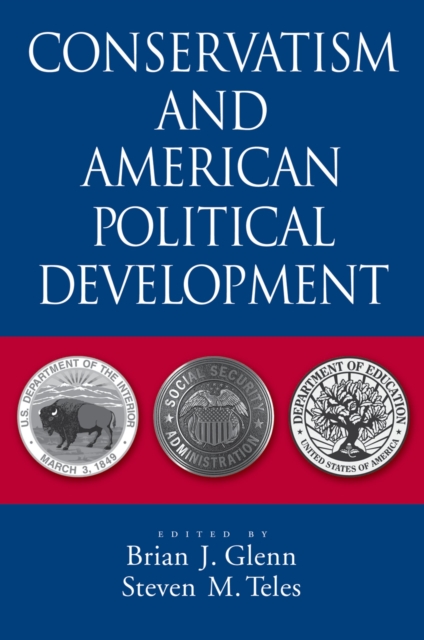
Conservatism and American political development
American political development (APD) is a core subfield in American political science, and focuses on political and policy history. For a variety of reasons, most of the focus in the twentieth century APD has been on liberal policymaking. Yet since the 1970s, conservatives have gradually assumed control over numerous federal policymaking institutions. This book offers an overview of the impact of conservatism on 20th-century American political development, locating its origins in the New Deal and then focusing on how conservatives acted within government once they began to achieve power in the late 1960s. The book is divided into three eras, and in each it focuses on three core issues: social security, the environment, and education. Throughout, the authors emphasize the ironic role of conservatism in the expansion of the American state. Scholars of the state have long focused on liberalism because liberals were the architects of state expansion. However, as conservatives increased their presence in the federal apparatus, they were frequently co-opted into maintaining of ever-expanding public fiscal and regulatory power. At times, conservatives also came to accept the existence of the liberal state, but attempted to use it to achieve conservative policy ends. Despite conservatives' power in US politics and governance, the American state remains gargantuan. As this book shows, the new right has not only helped shape the state, but has been shaped by it as well.
eBook

The Tea Party and the Remaking of Republican Conservatism
The Tea Party and the Remaking of Republican Conservatism combines fine-grained portraits of local Tea Party members and chapters with an overarching analysis of the movement's rise, impact, and likely fate.
eBook
Towards a Pragmatic Presidency? Exploring the Waning of Political Time
In his landmark work The Politics Presidents Make, Stephen Skowronek concludes that an earlier cycle of presidential politics in America is fading. Calling this phenomenon the \"waning of political time\" he predicts the declining importance of the president as a source of political change in American politics, and makes the conjecture that in the future, presidents will act more pragmatically and will more frequently clash with office holders in other political institutions. Applying hypotheses recently advanced by Curt Nichols and Adam Myers, this article considers some additional challenges to presidential authority that complement Skowroneks original thesis. Through a comparison of the presidencies of Obama and Ronald Reagan, the article also illustrates the relevance of the waning-of-political-time thesis to politics today.
Journal Article

Race and the making of American liberalism
This book traces the roots of the contemporary crisis of progressive liberalism deep into the nation's racial past. It argues that the contemporary conservative claim that the American liberal tradition has been rooted in a “color blind” conception of individual rights is inaccurate and misleading. In contrast, American liberalism has alternatively served both to support and oppose racial hierarchy, as well as socioeconomic equity more broadly. Racial politics in the United States have repeatedly made it exceedingly difficult to establish powerful constituencies that understand socioeconomic equity as vital to American democracy and aspire to limit gross disparities of wealth, power, and status. Revitalizing such equalitarian conceptions of American liberalism, the book suggests, will require developing new forms of racial and class identity that support, rather than sabotage such fundamental political commitments.
eBook
African Americans and Obama's Domestic Policy Agenda: A Closer Look at Deracialization, the Federal Stimulus Bill, and the Affordable Care Act
To assess President Obama's deracialized agenda-setting strategy, this article draws from two Gallup Organization polls and a 2010 survey of political behaviors and racial attitudes by the University of Arkansas Diane D. Blair Center of Southern Politics and Society and the Winthrop Rockefeller Institute. We extend the debate about deracialization by focusing on two of Obama's most important policy initiatives: the American Recovery and Reinvestment (ARRA) and the Patient Protection and Affordable Care Act (also referred to as the Affordable Care Act). The debates over ARRA and the Affordable Care Act placed Obama in an unenviable position. The study will show that many African Americans supported these policies despite Obama's use of deracialized rhetoric. This support was not necessarily due to blind faith or racial loyalty. African Americans believed these laws would improve their own vulnerable situations and reinforce the federal government's commitment to remedying racial inequities.
Journal Article