
Catalogue Search | MBRL


Are you sure you want to remove the book from the shelf?

{{itemTitle}}
623
result(s) for
"COOKING / Methods / General."
Sort by:

Plain but wholesome : foodways of the Mormon pioneers
Plain But Wholesome presents a groundbreaking foray into Mormon history. Brock Cheney explores the foodways of Mormon pioneers from their trek west through the arrival of the railroad and reveals new perspectives on the fasci-nating Mormon settlement era. Relying on original diaries, newspaper accounts, and recipe books from the 1850s, Cheney draws a vivid portrait of what Mormon pioneers ate and drank. Although other authors have sketched the subject before, this portrait is the first effort that might be described as scholarly, though the lively prose will interest a broad general audience.
Presented here are the first explicit descriptions of the menus, food processes, and recipes of the Mormon pioneers. While many have supposed that earlier pioneer foodways continued to be handed down through Mormon families, Cheney has confirmed traditions going back generations and covering more than a century. The book also exposes myths and clichés about pioneer piety and hardships, as Cheney examines such pioneer extravagances as fresh “oysters on the half shell” and pioneer trends of alcohol consumption.
A perfect gift for the history buff or Dutch oven chef, Plain But Wholesome will also prove its place among scholars and historians. With its rollicking blend of historical source material and modern interpretation, this book will entertain and educate novice and expert alike.
eBook

The Future of Post-Human Culinary Art
Is culinary art really so exact that, as Delia Smith once wrote, \"cooking is an exact art and not some casual game\"? (BQ 2012) This exact view of cooking can be contrasted with an opposing observation by Tom Jaine, when he argued that, \"if cooking becomes.
eBook

Building a meal
An internationally renowned chemist, popular television personality, and bestselling author, Hervé This heads the first laboratory devoted to molecular gastronomy-the scientific exploration of cooking and eating. By testing recipes that have guided cooks for centuries, and the various dictums and maxims on which they depend, Hervé This unites the head with the hand in order to defend and transform culinary practice.
With this new book, Hervé This's scientific project enters an exciting new phase. Considering the preparation of six bistro favorites-hard-boiled egg with mayonnaise, simple consommé, leg of lamb with green beans, steak with French fries, lemon meringue pie, and chocolate mousse-he isolates the exact chemical properties that tickle our senses and stimulate our appetites. More important, he connects the mind and the stomach, identifying methods of culinary construction that appeal to our memories, intelligence, and creativity. By showing that the creation of a meal is as satisfying as its consumption, Herve This recalibrates the balance between food and our imaginations. The result is a revolutionary perspective that will tempt even the most casual cooks to greater flights of experimentation.
eBook

Mouthfeel
Collaborating in the laboratory and the kitchen, Ole G. Mouritsen and Klavs Styrbæk investigate the multiple ways in which food texture influences taste. Combining scientific analysis with creative intuition and a sophisticated knowledge of food preparation, they write a one-of-a-kind book for food lovers and food science scholars.
eBook

The kitchen as laboratory
Eating is a multisensory experience, yet chefs and scientists have only recently begun to deconstruct food’s components, setting the stage for science-based cooking. In this global collaboration of essays, chefs and scientists advance culinary knowledge by testing hypotheses rooted in the physical and chemical properties of food. Using traditional and cutting-edge tools, ingredients, and techniques, these pioneers create, and sometimes revamp, dishes that respond to specific desires and serve up an original encounter with gastronomic practice.
eBook
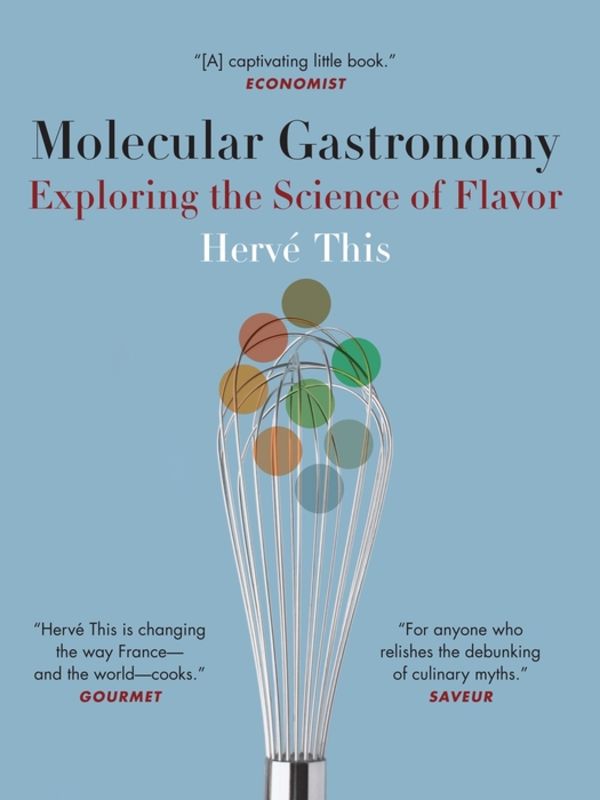
Molecular gastronomy
Hervé This (pronounced \"Teess\") is an internationally renowned chemist, a popular French television personality, a bestselling cookbook author, a longtime collaborator with the famed French chef Pierre Gagnaire, and the only person to hold a doctorate in molecular gastronomy, a cutting-edge field he pioneered. Bringing the instruments and experimental techniques of the laboratory into the kitchen, This uses recent research in the chemistry, physics, and biology of food to challenge traditional ideas about cooking and eating. What he discovers will entertain, instruct, and intrigue cooks, gourmets, and scientists alike.
Molecular Gastronomy, This's first work to appear in English, is filled with practical tips, provocative suggestions, and penetrating insights. This begins by reexamining and debunking a variety of time-honored rules and dictums about cooking and presents new and improved ways of preparing a variety of dishes from quiches and quenelles to steak and hard-boiled eggs. He goes on to discuss the physiology of flavor and explores how the brain perceives tastes, how chewing affects food, and how the tongue reacts to various stimuli. Examining the molecular properties of bread, ham, foie gras, and champagne, the book analyzes what happens as they are baked, cured, cooked, and chilled.
Looking to the future, Herve This imagines new cooking methods and proposes novel dishes. A chocolate mousse without eggs? A flourless chocolate cake baked in the microwave?Molecular Gastronomyexplains how to make them. This also shows us how to cook perfect French fries, why a soufflé rises and falls, how long to cool champagne, when to season a steak, the right way to cook pasta, how the shape of a wine glass affects the taste of wine, why chocolate turns white, and how salt modifies tastes.
eBook

A cleaner burning biomass-fuelled cookstove intervention to prevent pneumonia in children under 5 years old in rural Malawi (the Cooking and Pneumonia Study): a cluster randomised controlled trial
WHO estimates exposure to air pollution from cooking with solid fuels is associated with over 4 million premature deaths worldwide every year including half a million children under the age of 5 years from pneumonia. We hypothesised that replacing open fires with cleaner burning biomass-fuelled cookstoves would reduce pneumonia incidence in young children.
We did a community-level open cluster randomised controlled trial to compare the effects of a cleaner burning biomass-fuelled cookstove intervention to continuation of open fire cooking on pneumonia in children living in two rural districts, Chikhwawa and Karonga, of Malawi. Clusters were randomly allocated to intervention and control groups using a computer-generated randomisation schedule with stratification by site, distance from health centre, and size of cluster. Within clusters, households with a child under the age of 4·5 years were eligible. Intervention households received two biomass-fuelled cookstoves and a solar panel. The primary outcome was WHO Integrated Management of Childhood Illness (IMCI)-defined pneumonia episodes in children under 5 years of age. Efficacy and safety analyses were by intention to treat. The trial is registered with ISRCTN, number ISRCTN59448623.
We enrolled 10 750 children from 8626 households across 150 clusters between Dec 9, 2013, and Feb 28, 2016. 10 543 children from 8470 households contributed 15 991 child-years of follow-up data to the intention-to-treat analysis. The IMCI pneumonia incidence rate in the intervention group was 15·76 (95% CI 14·89–16·63) per 100 child-years and in the control group 15·58 (95% CI 14·72–16·45) per 100 child-years, with an intervention versus control incidence rate ratio (IRR) of 1·01 (95% CI 0·91–1·13; p=0·80). Cooking-related serious adverse events (burns) were seen in 19 children; nine in the intervention and ten (one death) in the control group (IRR 0·91 [95% CI 0·37–2·23]; p=0·83).
We found no evidence that an intervention comprising cleaner burning biomass-fuelled cookstoves reduced the risk of pneumonia in young children in rural Malawi. Effective strategies to reduce the adverse health effects of household air pollution are needed.
Medical Research Council, UK Department for International Development, and Wellcome Trust.
Journal Article

Randomized Controlled Ethanol Cookstove Intervention and Blood Pressure in Pregnant Nigerian Women
Abstract
Rationale
Hypertension during pregnancy is a leading cause of maternal mortality. Exposure to household air pollution elevates blood pressure (BP).
Objectives
To investigate the ability of a clean cookstove intervention to lower BP during pregnancy.
Methods
We conducted a randomized controlled trial in Nigeria. Pregnant women cooking with kerosene or firewood were randomly assigned to an ethanol arm (n = 162) or a control arm (n = 162). BP measurements were taken during six antenatal visits. In the primary analysis, we compared ethanol users with control subjects. In subgroup analyses, we compared baseline kerosene users assigned to the intervention with kerosene control subjects and compared baseline firewood users assigned to ethanol with firewood control subjects.
Measurements and Main Results
The change in diastolic blood pressure (DBP) over time was significantly different between ethanol users and control subjects (P = 0.040); systolic blood pressure (SBP) did not differ (P = 0.86). In subgroup analyses, there was no significant intervention effect for SBP; a significant difference for DBP (P = 0.031) existed among preintervention kerosene users. At the last visit, mean DBP was 2.8 mm Hg higher in control subjects than in ethanol users (3.6 mm Hg greater in control subjects than in ethanol users among preintervention kerosene users), and 6.4% of control subjects were hypertensive (SBP ≥140 and/or DBP ≥90 mm Hg) versus 1.9% of ethanol users (P = 0.051). Among preintervention kerosene users, 8.8% of control subjects were hypertensive compared with 1.8% of ethanol users (P = 0.029).
Conclusions
To our knowledge, this is the first cookstove randomized controlled trial examining prenatal BP. Ethanol cookstoves have potential to reduce DBP and hypertension during pregnancy. Accordingly, clean cooking fuels may reduce adverse health impacts associated with household air pollution.
Clinical trial registered with www.clinicaltrials.gov (NCT02394574).
Journal Article

Liquefied Petroleum Gas or Biomass for Cooking and Effects on Birth Weight
In this randomized trial involving pregnant women in low- and middle-income countries, birth weight was not higher among infants born to women who used LPG stoves than among those born to women who used biomass stoves.
Journal Article
Liquefied Petroleum Gas or Biomass Cooking and Severe Infant Pneumonia
In this trial involving pregnant women in low- and middle-income countries, cooking with LPG instead of biomass did not lead to a lower incidence of severe infant pneumonia, despite lower levels of household air pollutants.
Journal Article