
Catalogue Search | MBRL


Are you sure you want to remove the book from the shelf?

{{itemTitle}}
701
result(s) for
"COULEUR"
Sort by:

Universal principles of color : 100 key concepts for understanding, analyzing, and working with color
\"A comprehensive, cross-disciplinary overview of color, Universal Principles of Color presents 100 core concepts and guidelines that are critical to a successful use of color. Richly illustrated and easy to navigate, it pairs clear explanations of every topic with visual examples of it applied in theory and in practice. The book is organized alphabetically so that principles can be easily and quickly referenced. For those interested in addressing a specific color challenge or application problem, the principles are also indexed by pathways based on nine topics of color study ranging from science, art and design, and industry.\"-- Publisher.
Book

Strangers in Blood
Strangers in Blood explores, in a range of early modern literature, the association between migration to foreign lands and the moral and physical degeneration of individuals. Arguing that, in early modern discourse, the concept of race was primarily linked with notions of bloodline, lineage, and genealogy rather than with skin colour and ethnicity, Jean E. Feerick establishes that the characterization of settler communities as subject to degenerative decline constituted a massive challenge to the fixed system of blood that had hitherto underpinned the English social hierarchy.
Considering contexts as diverse as Ireland, Virginia, and the West Indies, Strangers in Blood tracks the widespread cultural concern that moving out of England would adversely affect the temper and complexion of the displaced individual, changes that could be fought only through willed acts of self-discipline. In emphasizing the decline of blood as found at the centre of colonial narratives, Feerick illustrates the unwitting disassembling of one racial system and the creation of another.
eBook


Color and Empathy
The collection of essays in this book brings together texts from two decades, documenting two of the author's ongoing areas of interest: the poetics of color in film as well as affective viewer responses. Employing a bottom-up approach as a basis for theoretical exploration, each of the essays concentrates on a particular film or a number of related films to come to terms with a set of issues. These include the differences between black-and-white and color, the emergence of bold chromatic schemes in the 1950s, experimental aesthetics of color negative stock, idiosyncratic uses of color, idiosyncratic uses of motor mimicry, genre-specific reactions to the documentary, and empathetic reactions to animals and to architecture in film.
eBook

The cumulative cloth, dry techniques : a guide to fabric color, pattern, construction, and embellishment
A comprehensive how-to reference that teaches dry textile surface design techniques for making custom cloth, including applique, embroidery, layering, and more.
BOOK

Shades of Difference
Was there such a thing as a modern notion of race in the English Renaissance, and, if so, was skin color its necessary marker? In fact, early modern texts described human beings of various national origins-including English-as turning white, brown, tawny, black, green, or red for any number of reasons, from the effects of the sun's rays or imbalance of the bodily humors to sexual desire or the application of makeup. It is in this cultural environment that the seventeenth-centuryLondon Gazetteused the term \"black\" to describe both dark-skinned African runaways and dark-haired Britons, such as Scots, who are now unquestioningly conceived of as \"white.\" InShades of Difference, Sujata Iyengar explores the cultural mythologies of skin color in a period during which colonial expansion and the slave trade introduced Britons to more dark-skinned persons than at any other time in their history. Looking to texts as divergent as sixteenth-century Elizabethan erotic verse, seventeenth-century lyrics, and Restoration prose romances, Iyengar considers the construction of race during the early modern period without oversimplifying the emergence of race as a color-coded classification or a black/white opposition. Rather, \"race,\" embodiment, and skin color are examined in their multiple contexts-historical, geographical, and literary. Iyengar engages works that have not previously been incorporated into discussions of the formation of race, such as Marlowe's \"Hero and Leander\" and Shakespeare's \"Venus and Adonis.\" By rethinking the emerging early modern connections between the notions of race, skin color, and gender,Shades of Differencefurthers an ongoing discussion with originality and impeccable scholarship.
eBook

The art of colour : the history of art in 39 pigments
\"A captivating new history of art told through the storied biographies of colors and pigments. In this refreshing approach to the history of color, Kelly Grovier takes readers on an exciting search for the intriguing and unusual. In Grovier's telling, a color's connotations are never fixed but are endlessly evolving. Knowledge of a pigment and its history can unlock meaning in the works that feature it. Grovier employs the term \"artymology\" to suggest that color is a linguistic device, where pigments stand in for syllables in art's language. Color is the site of invigorating conflict--a battleground where past and present, influence and originality, and superstition and science merge into meanings that complicate and intensify our appreciation of a given work. How might it change our understanding of a well-known masterpiece like Vincent van Gogh's Starry Night to know that the intense yellow moon in that painting was sculpted from clumps of dehydrated urine from cows that were fed nothing but mango leaves? Or that the cobalt blue pigment in Van Gogh's sky shares a material bloodline with the glaze of Ming Dynasty porcelain? Consisting of ten chapters, each presenting a biography of a family of colors, this volume mines a rich vein of pigmentation from prehistoric cave painting to art of the present day. The book also includes beautifully designed features exploring important milestones in the history of color theory from the Enlightenment to the twentieth century.\"--Publisher's website.
Book
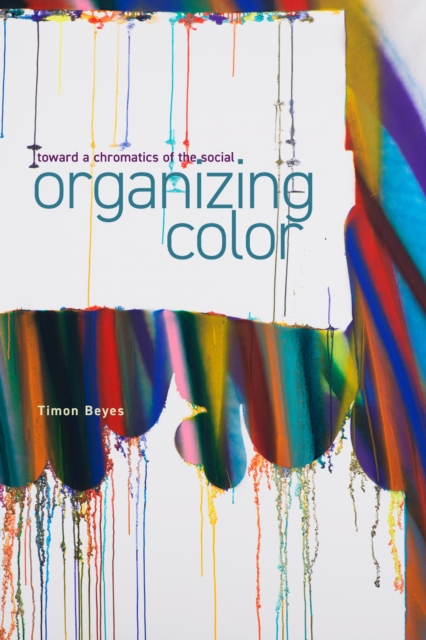
Organizing Color
We live in a world that is saturated with color, but how should we make sense of color's force and capacities? This book develops a theory of color as fundamental medium of the social. Constructed as a montage of scenes from the past two hundred years, Organizing Color demonstrates how the interests of capital, management, governance, science, and the arts have wrestled with color's allure and flux. Beyes takes readers from Goethe's chocolate experiments in search of chromatic transformation to nineteenth-century Scottish cotton mills designed to modulate workers' moods and productivity, from the colonial production of Indigo in India to globalized categories of skin colorism and their disavowal. Tracing the consumption, control and excess of industrial and digital color, other chapters stage encounters with the literary chromatics of Pynchon's Gravity's Rainbow processing the machinery of the chemical industries, the red of political revolt in Godard's films, and the blur of education and critique in Steyerl's Adorno's Grey.Contributing to a more general reconsideration of aesthetic capitalism and the role of sensory media, this book seeks to pioneer a theory of social organization-a \"chromatics of organizing\"-that is attuned to the protean and world-making capacity of color.
eBook

Design happy : colorful homes for the modern family
\"In her first book, interior designer Betsy Wentz shares 13 fabulous family homes. The book is really a practical design guide for anyone who may not want--or simply cannot afford--to hire an interior designer. The story of each home includes color studies, design lessons, and pro tips, plus plenty of practical advice for anyone who might face similar challenges\"-- Provided by publisher.
Book

Foundations of Colour Science
Presents the science of colour from new perspectives and outlines results obtained from the authors' work in the mathematical theory of colour This innovative volume summarizes existing knowledge in the field, attempting to present as much data as possible about colour, accumulated in various branches of science (physics, phychophysics, colorimetry, physiology) from a unified theoretical position. Written by a colour specialist and a professional mathematician, the book offers a new theoretical framework based on functional analysis and convex analysis. Employing these branches of mathematics, instead of more conventional linear algebra, allows them to provide the knowledge required for developing techniques to measure colour appearance to the standards adopted in colorimetric measurements. The authors describe the mathematics in a language that is understandable for colour specialists and include a detailed overview of all chapters to help readers not familiar with colour science. Divided into two parts, the book first covers various key aspects of light colour, such as colour stimulus space, colour mechanisms, colour detection and discrimination, light-colour perception typology, and light metamerism. The second part focuses on object colour, featuring detailed coverage of object-colour perception in single- and multiple-illuminant scenes, object-colour solid, colour constancy, metamer mismatching, object-colour indeterminacy and more. Throughout the book, the authors combine differential geometry and topology with the scientific principles on which colour measurement and specification are currently based and applied in industrial applications. * Presents a unique compilation of the author's substantial contributions to colour science * Offers a new approach to colour perception and measurement, developing the theoretical framework used in colorimetry * Bridges the gap between colour engineering and a coherent mathematical theory of colour * Outlines mathematical foundations applicable to the colour vision of humans and animals as well as technologies equipped with artificial photosensors * Contains algorithms for solving various problems in colour science, such as the mathematical problem of describing metameric lights * Formulates all results to be accessible to non-mathematicians and colour specialists Foundations of Colour Science: From Colorimetry to Perception is an invaluable resource for academics, researchers, industry professionals and undergraduate and graduate students with interest in a mathematical approach to the science of colour.
eBook