
Catalogue Search | MBRL


Are you sure you want to remove the book from the shelf?

{{itemTitle}}
87,270
result(s) for
"COURT OF APPEALS"
Sort by:

The Nominee
President George W. Bush nominated Leslie H. Southwick in 2007
to the federal appeals court, Fifth Circuit, based in New Orleans.
Initially, Southwick seemed a consensus nominee. Just days before
his hearing, though, a progressive advocacy group distributed the
results of research it had conducted on opinions of the state court
on which he had served for twelve years. Two opinions Southwick had
signed off on but not written became the center of the debate over
the next five months. One dealt with a racial slur by a state
worker, the other with a child custody battle between a father and
a bisexual mother. Apparent bipartisan agreement for a quick
confirmation turned into a long set of battles in the Judiciary
Committee, on the floor of the Senate, and in the media.
In early August, Senator Dianne Feinstein completely surprised
her committee colleagues by supporting Southwick. Hers was the one
Democratic vote needed to move the nomination to the full Senate.
Then in late October, by a two-vote margin, he received the votes
needed to end a filibuster. Confirmation followed.
Southwick recounts the four years he spent at the Department of
Justice, the twelve years on a state court, and his military
service in Iraq while deployed with a Mississippi National Guard
Brigade. During the nomination inferno Southwick maintained a diary
of the many events, the conversations and emails, the joys and
despairs, and quite often, the prayers and sense of peace his faith
gave him--his memoir bears significant spiritual content.
Throughout the struggle, Southwick learned that perspective and
growth are important to all of us when making decisions, and he
grew to accept his critics, regardless of outcome. In The
Nominee there is no rancor, and instead the book expresses the
understanding that the difficult road to success was the most
helpful one for him, both as a man and as a judge.
eBook
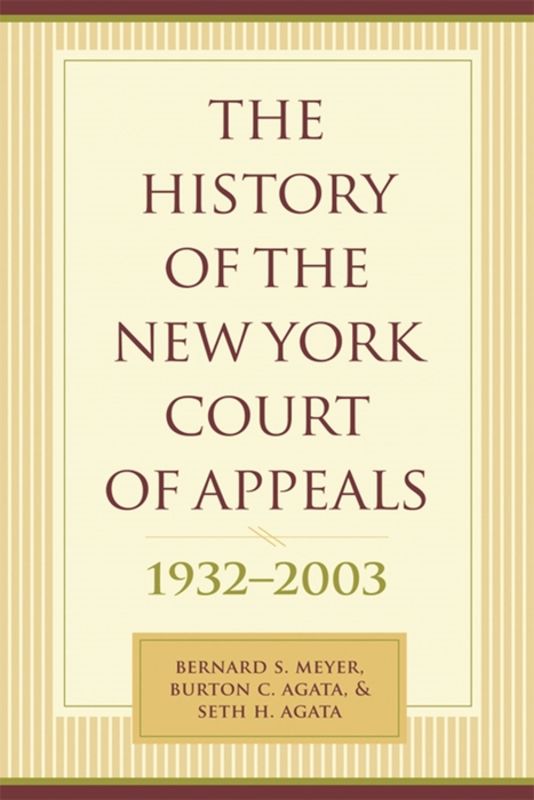
The History of the New York Court of Appeals, 1932 - 2003
From 1932 to 2003, the New York Court of Appeals-the highest court in the state- decided crucial cases pertaining to the social and legal issues of the day. The judges' rulings affected laws regarding motion picture censorship; obscenity, indecency, and immorality; religion; capital punishment; torts; the right to control personal medical care; and abortion. This comprehensive history completes a two volume series that began with The History of the New York Court of Appeals, 1847-1932. Each case is richly recounted and analyzed, detailing the decisions and dissenting opinions. Short biographies are provided for the judges who served during this period, and changes in the selection of judges, as well as the court's jurisdiction, are thoroughly explained. Particular to this volume, the authors provide the legal, social, and political contexts for these cases, showing how the law has evolved over time. They examine the court's view concerning its constitutional power to respond to an economic emergency during the Great Depression; they outline cases in which the judges ruled on the government's role in legislating morals and morality; and they focus on the evolution of the court's opinions regarding statutory interpretation, judicial federalism, censorship, constitutional reform, criminal law and capital punishment, rules of evidence, education, family law, and antitrust and labor law.
eBook

Power of the Pen or the Gavel? Determining Asylum Standards on the Courts of Appeals
The judiciary is subject to constraint from Congress through numerous mechanisms. In particular, Congress can limit judicial discretion through the content of the statutes it passes. After the September 11 attacks, Congress sought to constrain judicial behavior through the REAL ID Act (2005). In response to growing fear of fraud in the asylum process, Congress instructed federal judges reviewing administrative decisions to consider minor inconsistencies in an applicant's testimony as undermining his or her credibility, a crucial component of a refugee's claim. Despite Congress's clear abrogation of the prior rule in these cases, some federal appellate courts have refused to let go of their pre-REAL ID standard. In this article, I investigate the factors explaining when judges on the U.S. Courts of Appeals will defy the express language of a congressional statute in exercising their power of review in asylum cases. The results indicate that congressional directives are not, alone, enough to compel judges to adopt a legal standard. I find that circuit-level legal and policy factors are the strongest predictors of whether a federal court of appeals judge will try to limit the standard designated by Congress. At the same time, evidence suggests that judges consider the risk of a congressional override. My findings not only add to our understanding of legislative-judicial interactions, but also contribute to the growing movement to understand the politics of legal doctrine.
Journal Article

Crusader for Justice
The Honorable Damon J. Keith was appointed to the federal bench in 1967 and has served as a judge on the United States Court of Appeals for the Sixth Circuit since 1977, where he has been an eloquent defender of civil and constitutional rights and a vigorous enforcer of civil rights law. In Crusader for Justice: Federal Judge Damon J. Keith, authors Peter J. Hammer and Trevor W. Coleman present the first ever biography of native Detroiter Judge Keith, surveying his education, important influences, major cases, and professional and personal commitments. Along the way, the authors consult a host of Keith's notable friends and colleagues, including former White House deputy counsel John Dean, Supreme Court Justice Clarence Thomas, and industrialist Edsel Ford II for this candid and comprehensive volume.
Hammer and Coleman trace Keith's early life, from his public school days in Detroit to his time serving in the segregated U.S. army and his law school years at Howard University at the dawn of the Civil Rights era. They reveal how Keith's passion for racial and social justice informed his career, as he became co-chairman of Michigan's first Civil Rights Commission and negotiated the politics of his appointment to the federal judiciary. The authors go on to detail Keith's most famous cases, including the Pontiac Busing and Hamtramck Housing cases, the 1977 Detroit Police affirmative action case, the so-called Keith Case (United States v. U.S. District Court), and the Detroit Free Press v. Ashcroft case in 2002. They also trace Keith's personal commitment to mentoring young black lawyers, provide a candid look behind the scenes at the dynamics and politics of the Sixth Circuit Court of Appeals, and even discuss some of Keith's difficult relationships, for instance with the Detroit NAACP and Supreme Court Justice Clarence Thomas.
Judge Keith's forty-five years on the bench offer a unique viewpoint on a tumultuous era of American and legal history. Readers interested in Civil Rights-era law, politics, and personalities will appreciate the portrait of Keith's fortitude and conviction in Crusader for Justice.
eBook

Establishing Justice in Middle America
Headquartered in St. Louis and serving primarily Midwestern states, the Eighth Circuit Court has ruled on cases that touch some of the most significant issues in American history, including Native American rights, school segregation, and abortion. Jeffrey Brandon Morris covers this court's history, revealing how, in many ways, the history of a regional court is a history of the nation itself.
eBook

Racial Diversity and Judicial Influence on Appellate Courts
This article evaluates the substantive consequences of judicial diversity on the U.S. Courts of Appeals. Due to the small percentage of racial minorities on the federal bench, the key question in evaluating these consequences is not whether minority judges vote differently from nonminority judges, but whether their presence on appellate courts influences their colleagues and affects case outcomes. Using matching methods, I show that black judges are significantly more likely than nonblack judges to support affirmative action programs. This individual-level difference translates into a substantial causal effect of adding a black judge to an otherwise all-nonblack panel. Randomly assigning a black counterjudge—a black judge sitting with two nonblack judges—to a three-judge panel of the Courts of Appeals nearly ensures that the panel will vote in favor of an affirmative action program. These results have important implications for assessing the relationship between diversity and representation on federal courts.
Journal Article

Innovation and competition: An unstable relationship
This paper analyzes how the establishment of the United States Court of Appeals for the Federal Circuit in 1982 has affected the relationship between innovation and competition. Using the same dataset as Aghion et al. (Competition and innovation: an inverted-u relationship. Quarterly Journal of Economics 2005; 120(2):701-728) I find a structural break in the early 1980s. Taking this break into consideration, the inverted-U empirical relationship between innovation and competition found by Aghion et al. does not hold. In fact, I find that there is a positive innovation-competition relationship during the period 1973-1982 and no relationship at all in the 1983-1994 period.
Journal Article

LGBTQI+ Asylum Cases in the U.S. Circuit Court of Appeals
This article examines LGBTQI+ asylum claims in the U.S. Circuit Court of Appeals. The data are part of a larger study that has identified 520 LGBTQI+ claims in the U.S. Circuit of Appeals from 1994 to 2023. It focuses on examples from the 115 cases that were granted a review and analyzes the logic that U.S. Circuit Court justices use when deciding to grant a review of a petition that was denied by a lower court, such as the Board of Immigration Appeals (BIA) and immigration courts. This article argues that the U.S. Circuit of Appeals contests lower court rulings from BIA and immigration court judges based on assumptions about credibility, discretion, persecution, and criminalization for LGBTQI+ asylum seekers. By granting reviews, the Circuit Courts provide an opening for the acceptance of queer asylum claims.
Journal Article

Habit and creativity in judges’ definition and framing of legal questions
The dominant social scientific approach to studying judicial behavior treats judges as strategic actors pursuing their political preferences under institutional constraint. The intellectual roots of this rational choice approach are in American law’s long but sporadic engagement with pragmatist ideas. This article challenges that approach: a fully pragmatist account of judicial action provides a better description of the intellectual and social work of judging, and better explains how judges reach a decision in difficult cases that most affect the development of law and its relationship to society. The article argues that the foundational intellectual problem for appellate judges is how to define the legal questions presented in a case. Definitions of legal questions arise from the interplay of habitual and creative action in the local social context of an appeals court. Professional and local interpretive habits and legal forms ordinarily do a great deal to define the key questions, which are not strictly determined when a case comes before a court. Unscripted small group interactions at oral arguments also figure in question definition; oral arguments are most important in the rare but legally important cases where habitual practices alone are insufficient to delimit the legal question judges must answer. Supported by extensive interviews with federal appeals judges and clerks, the article illustrates judges’ creative, interactional efforts to define an answerable question in a major asylum case decided in the Seventh Circuit Court of Appeals. Building from this case, the article describes the factors that shape judicial question definition, and describes the conditions when creative judicial action is likely to be most prominent.
Journal Article

Precedent-based judgment aggregation in the US Supreme Court
When a case is before the US Supreme Court, a precedent may apply. In cases in which a precedent is being considered, the Court needs to answer three questions: 1) Is the precedent good law? 2) Does the precedent apply to this case? 3) Should the Court uphold the precedent? In the event that the Court answers yes to the first two questions and no to the last, there is what David S. Cohen [2010] calls a precedent-based voting paradox. Cohen has identified eleven instances of this paradox in US Supreme Court decisions prior to 2010. We review Cohen’s paradox and relate it to the doctrinal paradox that has played a foundational role in the judgment aggregation literature. We also identify what is arguably one more instance of a precedent-based voting paradox in the period since Cohen’s article was published.
Journal Article