
Catalogue Search | MBRL


Are you sure you want to remove the book from the shelf?

{{itemTitle}}
589,583
result(s) for
"CRISIS"
Sort by:
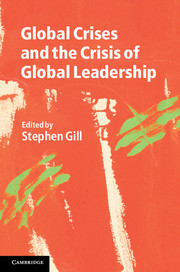
Global Crises and the Crisis of Global Leadership
This groundbreaking collection on global leadership features innovative and critical perspectives by scholars from international relations, political economy, medicine, law and philosophy, from North and South. The book's novel theorization of global leadership is situated historically within the classics of modern political theory and sociology, relating it to the crisis of global capitalism today. Contributors reflect on the multiple political, economic, social, ecological and ethical crises that constitute our current global predicament. The book suggests that there is an overarching condition of global organic crisis, which shapes the political and organizational responses of the dominant global leadership and of various subaltern forces. Contributors argue that to meaningfully address the challenges of the global crisis will require far more effective, inclusive and legitimate forms of global leadership and global governance than have characterized the neoliberal era.
eBook


The Use of Blanket Guarantees in Banking Crises
In episodes of significant banking distress or perceived systemic risk to the financial system, policymakers have often opted for issuing blanket guarantees on bank liabilities to stop or avoid widespread bank runs. In theory, blanket guarantees can prevent bank runs if they are credible. However, guarantee could add substantial fiscal costs to bank restructuring programs and may increase moral hazard going forward. Using a sample of 42 episodes of banking crises, this paper finds that blanket guarantees are successful in reducing liquidity pressures on banks arising from deposit withdrawals. However, banks' foreign liabilities appear virtually irresponsive to blanket guarantees. Furthermore, guarantees tend to be fiscally costly, though this positive association arises in large part because guarantees tend to be employed in conjunction with extensive liquidity support and when crises are severe.
eBook


New Evidence on the Aftermath of Financial Crises in Advanced Countries
This paper examines the aftermath of postwar financial crises in advanced countries. We construct a new semiannual series on financial distress in 24 OECD countries for the period 1967-2012. The series is based on assessments of the health of countries' financial systems from a consistent, real-time narrative source, and classifies financial distress on a relatively fine scale. We find that the average decline in output following a financial crisis is statistically significant and persistent, but only moderate in size. More important, we find that the average decline is sensitive to the specification and sample, and that the aftermath of crises is highly variable across major episodes. A simple forecasting exercise suggests that one important driver of the variation is the severity and persistence of financial distress itself. At the same time, we find little evidence of nonlinearities in the relationship between financial distress and the aftermaths of crises.
Journal Article


Contagion and Global Financial Crises: Lessons from Nine Crisis Episodes
Episodes of extraordinary turbulence in global financial markets are examined during nine crises ranging from the Asian crisis in 1997–98 to the recent European debt crisis of 2010–13. After dating each crisis using a regime switching model, the analysis focuses on changes in the dependence structures of equity markets through correlation, coskewness and covolatility to address a range of hypotheses regarding contagion transmission. The results show that the great recession is a true global financial crisis. Finance linkages are more likely to result in crisis transmission than trade and emerging market crises transmit unexpectedly, particularly to developed markets.
Journal Article

From Financial Crash to Debt Crisis
Newly developed historical time series on public debt, along with data on external debts, allow a deeper analysis of the debt cycles underlying serial debt and banking crises. We test three related hypotheses at both \"world\" aggregate levels and on an individual country basis. First, external debt surges are an antecedent to banking crises. Second, banking crises (domestic and those in financial centers) often precede or accompany sovereign debt crises; we find they help predict them. Third, public borrowing surges ahead of external sovereign default, as governments have \"hidden domestic debts\" that exceed the better documented levels of external debt.
Journal Article