
Catalogue Search | MBRL


Are you sure you want to remove the book from the shelf?

{{itemTitle}}
1,006
result(s) for
"Cabala"
Sort by:

Language, Eros, Being
This long-awaited, magisterial study-an unparalleled blend of philosophy, poetry, and philology-draws on theories of sexuality, phenomenology, comparative religion, philological writings on Kabbalah, Russian formalism, Wittgenstein, Rosenzweig, William Blake, and the very physics of the time-space continuum to establish what will surely be a highwater mark in work on Kabbalah. Not only a study of texts, Language, Eros, Being is perhaps the fullest confrontation of the body in Jewish studies, if not in religious studies as a whole.Elliot R. Wolfson explores the complex gender symbolism that permeates Kabbalistic literature. Focusing on the nexus of asceticism and eroticism, he seeks to define the role of symbolic and poetically charged language in the erotically configured visionary imagination of the medieval Kabbalists. He demonstrates that the traditional Kabbalistic view of gender was a monolithic and androcentric one, in which the feminine was conceived as being derived from the masculine. He does not shrink from the negative implications of this doctrine, but seeks to make an honest acknowledgment of it as the first step toward the redemption of an ancient wisdom.Comparisons with other mystical traditions-including those in Christianity, Buddhism, and Islam-are a remarkable feature throughout the book. They will make it important well beyond Jewish studies, indeed, a must for historians of comparative religion, in particular of comparative mysticism.Praise for Elliot R. Wolfson:\"Through a Speculum That Shines is an important and provocative contribution to the study of Jewish mysticism by one of the major scholars now working in this field.\"-Speculum
eBook

Spherical Sefirot in Early Kabbalah
In the vein of important observations made by several scholars, in this article I discuss a variegated corpus of early sefirotic passages attesting to the prevalence and conventionality of spherical perceptions of the sefirot, already at the earliest stages of the sefirotic literature known to us. First, I show that for at least a substantial number of the earliest authors, seeing the sefirot as a set of concentric, hierarchical spherical divine entities was a self-evident premise. Second, I offer a tripartite division of the material, based on the different types of inner hierarchies characterizing the spherical descriptions. For each of these types I offer a relevant ideational context, related to contemporary cosmological conventions as well as to various theological notions.
Journal Article

Keeping the mystery alive : Jewish mysticism in Latin American cultural production
\"This book delves into creative renditions of key aspects of Jewish Mysticism in Latin American literature, film, and art from the perspective of literary and cultural studies. The overarching question is whether the authors presented question, or reproduce literally, traditional renditions of the Jewish mysticism, and how this aspect of their literature and visual art relates to the Latin American canon to which they belong\"-- Provided by publisher.
BOOK
On Practical Uses of Ten Sefirot: Material Readings in an Early Modern Kabbalistic Collectaneum (MS Michael 473)
By the end of the sixteenth century, textual manifestations of kabbalah—a variety of Jewish mysticism that first emerged in medieval Provence and Catalonia—achieved the status of elite but authoritative lore in Eastern and Central Europe, even if at times they stirred religious opposition. At the same time, and especially in the seventeenth century, the so-called practical kabbalah, associated with magic and a talismanic approach to religious ritual, gained substantial popularity among Ashkenazi (i.e., Eastern and Central European) Jews. This study centers on a multiple-text and composite codex, Oxford-Bodleian MS Michael 473, and throws into relief the dynamics of circulation of various kabbalistic traditions in early modern Eastern and Central Europe. By zooming in on a single codex, this article foregrounds the hermeneutic potential of contextual reading of texts in complex manuscripts and of interpreting material choices taken by their cocreators. It does so with a methodological agenda that goes beyond tracing of authorial genealogies, and beyond the sociology of texts and their producers, toward exploring the interpretive relations of literary and material form in early modern handwritten kabbalistic texts. The article showcases a single textual unit, Qabbalat ‘Eser Sefirot, that MS Michael 473 contains, in order to focus on the position of practical kabbalistic texts and practices within the spectrum of kabbalistic traditions of seventeenth- and early eighteenth-century Eastern and Central Europe, ushered in by the contemporary modes of reading and transcription of texts.
Journal Article

The ruined house : a novel
Andrew P. Cohen, a professor of comparative culture at New York University, is at the zenith of his life. Adored by his classes and published in prestigious literary magazines, he is about to receive a coveted promotion--the crowning achievement of an enviable career. He is on excellent terms with Linda, his ex-wife, and his two grown children admire and adore him. His girlfriend, Ann Lee, a former student half his age, offers lively companionship. A man of elevated taste, education, and culture, he is a model of urbanity and success. But the manicured surface of his world begins to crack when he is visited by a series of strange and inexplicable visions involving an ancient religious ritual that will upend his comfortable life. Beautiful, mesmerizing, and unsettling, The Ruined House unfolds over the course of one year, as Andrew's world unravels and he is forced to question all his beliefs. Ruby Namdar's brilliant novel embraces the themes of the American Jewish literary canon as it captures the privilege and pedantry of New York intellectual life in the opening years of the twenty-first century.
Book
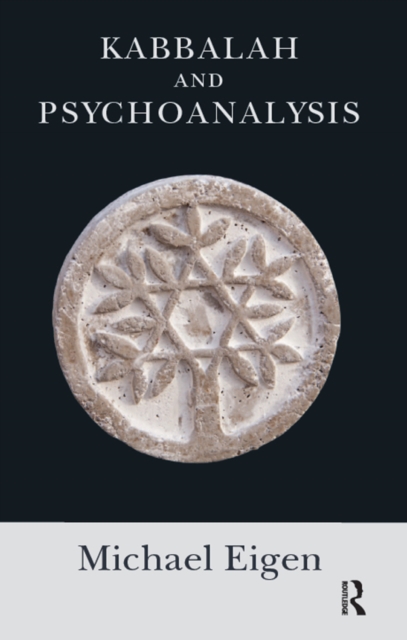
Kabbalah and Psychoanalysis
Wilfred Bion once said, \"I use the Kabbalah as a framework for psychoanalysis.\" Both are preoccupied with catastrophe and faith, infinity and intensity of experience, shatter and growth of being that supports dimensions which sensitivity opens. Both are preoccupied with ontological implications of the Unknown and the importance of emotional life. This work is a psychospiritual adventure touching the places Kabbalah and psychoanalysis give something to each other. Michael Eigen uses aspects of Bion, Winnicott, Akivah, Luria and Nachman (and many more) as colours on a palette to open realities for growth of experience. Bion called faith \"the psychoanalytic attitude\" and Eigen here explores creative, paradoxical, multidimensional aspects of faith. Eigen previously wrote of psychoanalysis as a form of prayer in The Psychoanalytic Mystic. In Kabbalah and Psychoanalysis he writes of creative faith. Sessions as crucibles in which diverse currents of personality mix in new ways, alchemy or soul chemistry perhaps, or simply homage to our embryonic nature which responds to the breath of feeling moment to moment.
eBook

Sleep, death, and rebirth : mystical practices of Lurianic Kabbalah
\"In the sixteenth century, the famous kabbalist Isaac Luria transmitted a secret trove of highly complex mystical practices to a select groups of students. These meditations were designed to capitalize on sleep and death states in order to effectively split one's soul into multiple parts, and which, when properly performed, permitted the adept to free oneself from the cycle of rebirth. Through an in-depth analysis of these contemplative practices within the broader context of Lurianic literature, Zvi Ish-Shalom guides us on a penetrating scholarly journey into a realm of mystical teachings and practices never before available in English, illuminating a radically monistic vision of reality at the heart of Kabbalistic metaphysics and practice\"-- Provided by publisher.
BOOK
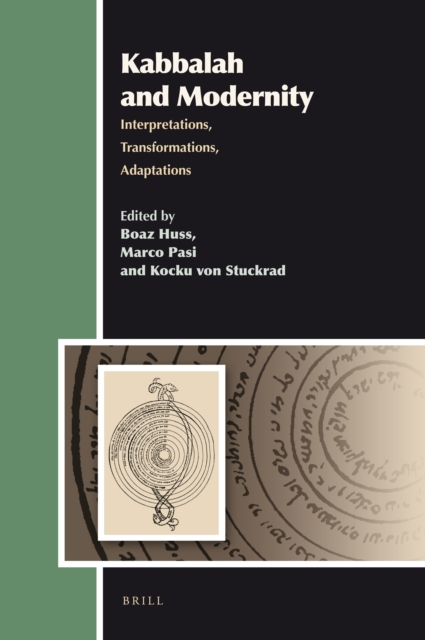
Kabbalah and Modernity
This volume brings together leading representatives of the recent debate about the persistence of kabbalah in the modern world. It breaks new ground for a better understanding of the role of kabbalah in modern religious, intellectual, and political discourse.
eBook