
Catalogue Search | MBRL


Are you sure you want to remove the book from the shelf?

{{itemTitle}}
17
result(s) for
"Cahokia Mounds State Historic Park (Ill.)"
Sort by:
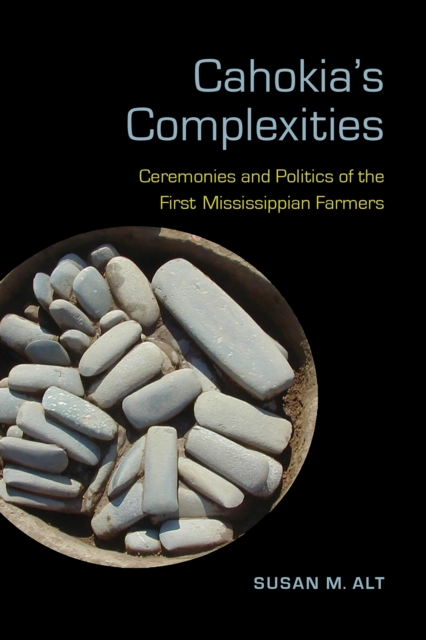
Cahokia's Complexities
Critical new discoveries and archaeological patterns increase understanding of early Mississippian culture and society The reasons for the rise and fall of early cities and ceremonial centers around the world have been sought for centuries.In the United States, Cahokia has been the focus of intense archaeological work to explain its mysteries.
eBook

Climate and Culture Change in North America AD 900–1600
Climate change is today's news, but it isn't a new phenomenon. Centuries-long cycles of heating and cooling are well documented for Europe and the North Atlantic. These variations in climate, including the Medieval Warm Period (MWP), AD 900 to 1300, and the early centuries of the Little Ice Age (LIA), AD 1300 to 1600, had a substantial impact on the cultural history of Europe. In this pathfinding volume, William C. Foster marshals extensive evidence that the heating and cooling of the MWP and LIA also occurred in North America and significantly affected the cultural history of Native peoples of the American Southwest, Southern Plains, and Southeast.
Correlating climate change data with studies of archaeological sites across the Southwest, Southern Plains, and Southeast, Foster presents the first comprehensive overview of how Native American societies responded to climate variations over seven centuries. He describes how, as in Europe, the MWP ushered in a cultural renaissance, during which population levels surged and Native peoples substantially intensified agriculture, constructed monumental architecture, and produced sophisticated works of art. Foster follows the rise of three dominant cultural centers-Chaco Canyon in New Mexico, Cahokia on the middle Mississippi River, and Casas Grandes in northwestern Chihuahua, Mexico-that reached population levels comparable to those of London and Paris. Then he shows how the LIA reversed the gains of the MWP as population levels and agricultural production sharply declined; Chaco Canyon, Cahokia, and Casas Grandes collapsed; and dozens of smaller villages also collapsed or became fortresses.
eBook

Feeding Cahokia
An authoritative and thoroughly accessible overview of farming and food practices at Cahokia
Agriculture is rightly emphasized as the center of the economy in most studies of Cahokian society, but the focus is often predominantly on corn. This farming economy is typically framed in terms of ruling elites living in mound centers who demanded tribute and a mass surplus to be hoarded or distributed as they saw fit. Farmers are cast as commoners who grew enough surplus corn to provide for the elites.
Feeding Cahokia: Early Agriculture in the North American Heartland presents evidence to demonstrate that the emphasis on corn has created a distorted picture of Cahokia’s agricultural practices. Farming at Cahokia was biologically diverse and, as such, less prone to risk than was maize-dominated agriculture. Gayle J. Fritz shows that the division between the so-called elites and commoners simplifies and misrepresents the statuses of farmers—a workforce consisting of adult women and their daughters who belonged to kin groups crosscutting all levels of the Cahokian social order. Many farmers had considerable influence and decision-making authority, and they were valued for their economic contributions, their skills, and their expertise in all matters relating to soils and crops. Fritz examines the possible roles played by farmers in the processes of producing and preparing food and in maintaining cosmological balance.
This highly accessible narrative by an internationally known paleoethnobotanist highlights the biologically diverse agricultural system by focusing on plants, such as erect knotweed, chenopod, and maygrass, which were domesticated in the midcontinent and grown by generations of farmers before Cahokia Mounds grew to be the largest Native American population center north of Mexico. Fritz also looks at traditional farming systems to apply strategies that would be helpful to modern agriculture, including reviving wild and weedy descendants of these lost crops for redomestication. With a wealth of detail on specific sites, traditional foods, artifacts such as famous figurines, and color photos of significant plants, Feeding Cahokia will satisfy both scholars and interested readers.
eBook

The ascent of chiefs: Cahokia and Mississippian politics in Native North America
This ambitious book provides a theoretical explanation of how prehistoric Cahokia became a stratified society, and ultimately the pinnacle of Native American cultural achievement north of Mexico. Considering Cahokia in terms of class struggle, Pauketat claims that the political consolidation in this region of the Mississippi Valley happened quite suddenly, around A.D. 1000, after which the lords of Cahokia innovated strategies to preserve their power and ultimately emerged as divine chiefs. The new ideas and new data in this volume will invigorate the debate surrounding one of the most important developments in North American prehistory.
eBook

The Cahokia Mounds
A Dan Josselyn Memorial PublicationThis edition of Moorehead's excavations at Cahokia provides a comprehensive collection of Moorehead's investigations of the nation's largest prehistoric mound center.Covering almost fourteen square kilometers in Illinois, Cahokia Mounds State Historic Site is the largest prehistoric mound center in North America and has been designated a World Heritage Site by the United Nations. Built between A.D. 1050 and 1350, Cahokia originally contained the remains of over 100 earthen mounds that were used as places for Native American rituals, homes of chiefs, or elite tombs. Earlier scientists debated whether the mounds were part of the natural landscape, and many were destroyed by urban and industrial developmentThis book is a report of archaeological investigations conducted at Cahokia from 1921 to 1927 by Warren K. Moorehead, who confirmed that the mounds were built by indigenous peoples and who worked to assure preservation of the site. The volume includes Moorehead's final 1929 report along with portions of two preliminary reports, covering both Cahokia and several surrounding mound groups.John Kelly's introduction to the book sets Moorehead's investigations in the context of other work conducted at Cahokia prior to the 1920s and afterwards. Kelly reviews Moorehead's work, which employed 19th-century excavation techniques combined with contemporary analytical methods, and explains how Moorehead contended with local social and political pressures.Moorehead's work represented important excavations at a time when little other similar work was being done in the Midwest. The reissue of his findings gives us a glimpse into an important archaeological effort and helps us better appreciate the prehistoric legacy that he helped preserve.
eBook

The Cahokia Mounds
A Dan Josselyn Memorial Publication This edition of Moorehead's excavations at Cahokia provides a comprehensive collection of Moorehead's investigations of the nation's largest prehistoric mound center. Covering almost fourteen square kilometers in Illinois, Cahokia Mounds State Historic Site is the largest prehistoric mound center in North America and has been designated a World Heritage Site by the United Nations. Built between A.D. 1050 and 1350, Cahokia originally contained the remains of over 100 earthen mounds that were used as places for Native American rituals, homes of chiefs, or elite tombs. Earlier scientists debated whether the mounds were part of the natural landscape, and many were destroyed by urban and industrial development This book is a report of archaeological investigations conducted at Cahokia from 1921 to 1927 by Warren K. Moorehead, who confirmed that the mounds were built by indigenous peoples and who worked to assure preservation of the site. The volume includes Moorehead's final 1929 report along with portions of two preliminary reports, covering both Cahokia and several surrounding mound groups. John Kelly's introduction to the book sets Moorehead's investigations in the context of other work conducted at Cahokia prior to the 1920s and afterwards. Kelly reviews Moorehead's work, which employed 19th-century excavation techniques combined with contemporary analytical methods, and explains how Moorehead contended with local social and political pressures. Moorehead's work represented important excavations at a time when little other similar work was being done in the Midwest. The reissue of his findings gives us a glimpse into an important archaeological effort and helps us better appreciate the prehistoric legacy that he helped preserve.
eBook
Native America. Episode 3, Cities of the sky
Native America challenges everything we thought we knew about the Americas before and since contact with Europe. It travels through 15,000-years to showcase massive cities, unique systems of science, art, and writing, and 100 million people connected by social networks and spiritual beliefs spanning two continents. The series reveals some of the most advanced cultures in human history and the Native American people who created it and whose legacy continues, unbroken, to this day. This series explores this extraordinary world through an unprecedented combination of cutting edge science and traditional indigenous knowledge. It is Native America as never seen before -featuring sacred rituals filmed for the first time, history changing scientific discoveries, and rarely heard voices from the living legacy of Native American culture. Native America rediscovers a past whose splendor and sophistication is only now being realized, and whose story has for too long remained untold. It reveals a unifying belief that inspires these diverse cultures - people are deeply connected to earth, sky, water, and all living things. This belief is rooted in millennia of living on this land and continues to resonate in the lives of Native Americans to this day. Cities of the Sky explores the creation of some of the ancient world’s largest and most splendid cities. Were people across Native America inspired by celestial phenomenon to build their communities? Answers are revealed in American urban centers that bloomed from the Mexican jungle, a massive multi-cultural city in Central Mexico that is among the largest urban centers in history, and the capital of South America’s greatest empire.
Streaming Video