
Catalogue Search | MBRL


Are you sure you want to remove the book from the shelf?

{{itemTitle}}
452
result(s) for
"Calderon de la Barca, Pedro, 1600-1681"
Sort by:
Reason and the Passions in the 'Comedias' of Calderon
Introduction In 1675, six years before the death of Calderon, Benedict de Spinoza began to circulate cautiously among his friends and colleagues in the Netherlands the manuscripts of what was to be published posthumously as the Ethics.
eBook

Life's a Dream (La Vida es Sueño)
A beautiful and haunting tale of love, betrayal, knowledge, and power, Life's a Dream (La vida es sueño, 1636) is the best known and most widely admired play of Catholic Europe's greatest dramatist, Pedro Calderón de la Barca (1600-1681). Calderón's long life witnessed both the pinnacle and collapse of Spanish political power as well as the great flowering of Spanish classical literature. Michael Kidd's new prose translation renders Calderón's masterpiece into a transparent, modern American idiom that preserves the beauty and complexity of Calderón's Baroque Spanish. The result is a highly readable and adaptable text that is enhanced by a generous selection of supporting materials, including a thorough critical introduction and glossary.
eBook
Gustos y disgustos son no más que imaginación di Pedro Calderón de la Barca e la rappresentazione per le nozze di Carlo II e Maria Luisa d'Orléans
The comedy Gustos y disgustos son no más que imaginación was written by Pedro Calderón de la Barca in the Thirties and it was performed at court in 1680 on the occasion of the wedding of king Charles II with the French Marie Louise d’Orléans, Louis XIV’s niece, just a year before the death of the author. This paper explores, from a diachronic perspective, the different meanings and aims conveyed by the various vital stages of this Calderonian comedy – writing, performance and publication – with a specific focus on its 1680 performance at court.
Journal Article
Judas Macabeo
Se edita en este volumen la temprana comedia de Calderón de la Barca Judas Macabeo, representada por primera vez en 1623 y una de de las tres que compuso a partir de argumentos bíblicos. De la obra existen dos versiones, una más larga conservada en dos manuscritos y otra más breve, la recogida en la Segunda parte de las comedias de Calderón, que ha sido la base de todas las ediciones de la comedia efectuadas hasta hoy. En este libro se recogen ambas por primera vez y se pone a disposición de los lectores y estudiosos el texto de la versión manuscrita, inédito hasta la fecha.
eBook

Calderón
Although Pedro Calderón de la Barca was one of the greatest and most prolific playwrights of Spain's Golden Age, most of his nonallegoricalcomedias-- 118 in all -- have remained unknown. Robert ter Horst presents here the first full-length study of these works, a sustained, meditative analysis dealing with more than 80 plays, conveying a sense of the whole of Calderón's secular theater.
To approach so vast a body of literature, Mr. ter Horst examines the meaning and function in Calderón of three broad subjects -- myth, honor, and history -- the warp threads across which the playwright weaves a subtle tapestry of contrasts, dualities, and conflicts: the private person versus the public person, the inner realm versus the outer, masculine against feminine, poet against prince.
The Calderón who emerges is a consciously consummate artist whose lifelong study was the passions of the human mind and body. In addition, he is seen as a synthesizer of his Spanish literary heritage and especially as a brilliant adapter of Cervantes' insights to the stage. Robert ter Horst's profound and far-ranging analysis sheds light on many fine works previously neglected and finds new depths in such supreme achievements asNo hay cosa como callar, El segundo Escipión,andLa vida es suefio.
eBook
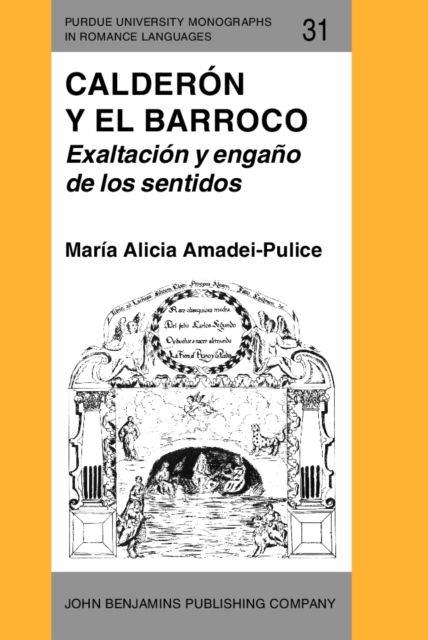
Calderón y el Barroco
Amadei-Pulice examines the conflict between Lope's dramatic formula (comedia) and the new polytechnic formula that in the hands of Calderon merged dramatic poetry with visual and auditory effects (comedia de teatro). The author places the Spanish baroque theater within the wider context of a revolution in the theory of representation, signs, and meanings that took place at the beginning of the seventeenth century and marked the appearance of a new dramatic style: the stile rappresentativo. Special attention is given to the techniques and applications of perspectival scenery, stagecraft, optics, and the creation of visual and sound effects contributed by the Florentine melodramma. The highlighting of Italian dramatic theory and practice reveals that Calderon was an innovator and creator of a new concept in theater.
eBook


Alegorías del poder
Crítica metafórica de los reinados de Felipe III y de Felipe IV en las obras dramáticas de Lope de Vega, Tirso de Molina y Calderón de la Barca.
eBook

Bringing the Violence into the Light: #YoTeCreo, 'El caso manada' and La vida es sueño
Iñigo Rodríguez-Claro and Carlota Gaviño of Grumelot Compañía Teatral staged a version of Pedro Calderón de la Barca's La vida es sueño. Their version, conceived as \"una reflexión sobre nuestra convivencia con el mundo de lo virtual. Mundo que, a pesar de ser cada vez más relevante para nuestra existencia, interpretamos como ilusión, como irrealidad, como engaño de los sentidos (o no),\" closely follows Segismundo's own journey of discovery of what is real, and what is not.
Journal Article