
Catalogue Search | MBRL


Are you sure you want to remove the book from the shelf?

{{itemTitle}}
16
result(s) for
"California San Francisco Golden Gate Bridge"
Sort by:

The Golden Gate Bridge
\"Explains the history behind and the process of building the Golden Gate Bridge\"-- Provided by the publisher.
Book
The final leap
The Golden Gate Bridge is one of the most beautiful and most photographed structures in the world. It's also the most deadly. Since it opened in 1937, more than 1,500 people have died jumping off the bridge, making it the top suicide site on earth. It's also the only international landmark without a suicide barrier. Weaving drama, tragedy, and politics against the backdrop of a world-famous city, The Final Leap is the first book ever written about Golden Gate Bridge suicides. John Bateson leads us on a fascinating journey that uncovers the reasons for the design decision that led to so many deaths, provides insight into the phenomenon of suicide, and examines arguments for and against a suicide barrier. He tells the stories of those who have died, the few who have survived, and those who have been affected—from loving families to the Coast Guard, from the coroner to suicide prevention advocates.
eBook

Building the Golden Gate Bridge
\"From idea to national landmark, this early chapter book highlights the building sequence of the Golden Gate Bridge showing elementary readers how it was engineered and built\"-- Provided by publisher.
Book
Iconic America. Season 1, Episode 8, The Golden Gate Bridge
Witness the architectural marvel and historical importance of the Golden Gate Bridge. Symbolizing San Francisco and the United States, the episode explores the bridge's cultural impact and enduring legacy. The episode also discusses modern transportation and its potential future, including interviews with engineers currently working on California’s high-speed rail project.
Streaming Video

The Golden Gate Bridge
In 1933, no one believed it was possible to build a bridge across the Golden Gate Strait near San Francisco. Many people doubted that a bridge could be built to withstand the strait's treacherous waves, heavy fog, and salty air. Joseph Strauss believed he could build a bridge to connect the people of northern California to San Francisco. Since 1937, the Golden Gate Bridge has withstood earthquakes and severe weather. Discover the story of how Strauss's dream of creating this massive, beautiful structure almost never happened and how it has become beloved and respected by people around the world.
Book
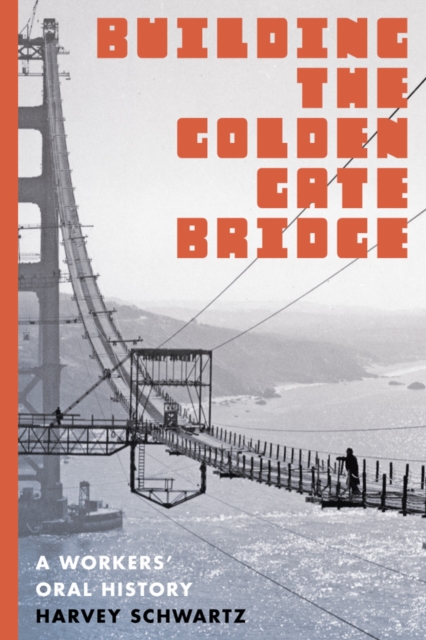
Building the Golden Gate Bridge
Silver Award Winner, 2016 Nautilus Book Award in Young Adult (YA) Non-Fiction
Moving beyond the familiar accounts of politics and the achievements of celebrity engineers and designers, Building the Golden Gate Bridge is the first book to primarily feature the voices of the workers themselves. This is the story of survivors who vividly recall the hardships, hazards, and victories of constructing the landmark span during the Great Depression.
Labor historian Harvey Schwartz has compiled oral histories of nine workers who helped build the celebrated bridge. Their powerful recollections chronicle the technical details of construction, the grueling physical conditions they endured, the small pleasures they enjoyed, and the gruesome accidents some workers suffered. The result is an evocation of working-class life and culture in a bygone era.
Most of the bridge builders were men of European descent, many of them the sons of immigrants. Schwartz also interviewed women: two nurses who cared for the injured and tolerated their antics, the wife of one 1930s builder, and an African American ironworker who toiled on the bridge in later years. These powerful stories are accompanied by stunning photographs of the bridge under construction.
An homage to both the American worker and the quintessential San Francisco landmark, Building the Golden Gate Bridge expands our understanding of Depression-era labor and California history and makes a unique contribution to the literature of this iconic span.
eBook

The building of the Golden Gate bridge
Gives readers a behind-the-scenes look at the building of the Golden Gate Bridge. Additional features include a table of contents, a Fast Facts spread, critical-thinking questions, primary source quotes and accompanying source notes, a phonetic glossary, an index, and sources for further research.-- amazon.com.
Book

Bridge over troubled discourse: the influence of the Golden Gate Bridge on community discourse and suicide
Purpose
– The purpose of this paper is to examine the Golden Gate Bridge (GGB) as a work of art and the role of the bridge in shaping community identity and discourse. Particular attention is focussed on the discourse surrounding mental illness and suicide, which perpetuate the problem of suicides involving the bridge as a means and mechanism of death. An analysis of the person who attempts or completes suicide is also performed.
Design/methodology/approach
– Multiple research articles, writings, and a cinematic production are drawn on to frame the argument in terms of Michel Foucault's adaption of Pantopticism Theory and Jacques Lacan's Mirror Theory, which includes the concepts of the Real, the Imaginary, and the Symbolic.
Findings
– The GGB is a major factor in shaping the discourse on mental illness and suicide in the San Francisco community. The influences the GGB exerts combines with and exacerbates a culture of stigma, which perpetuates negative discourse and increases the risk of suicides in those already vulnerable.
Research limitations/implications
– The research for this paper was performed at a distance and was conducted, with the exception of one personal communication, by literature search and application to theory. Ethnographic research would be a logical next step to study the phenomenon further.
Practical implications
– Theory developed from this paper could be used in determining a relevant course of action for adding to existing suicide prevention efforts in the San Francisco Area and any other community with a prominent icon, such as the GGB, that may be exerting a negative influence on the suicide rates of that area.
Social implications
– An awareness of how art, culture, and psychology interact would increase awareness of the creation of a stigmatized environment and perhaps precipitate a change in the underlying negative discourse.
Originality/value
– This paper takes a fresh look at the phenomenon of violent death by suicide where a physical object/icon (the GGB) is used as a means to die. The particular theories and approach used to explain the interactions that intensify the suicide death rate have never been combined and interwoven in such an interdisciplinary way to seek an explanation.
Journal Article

Golden Gate Bridge at 80
\"Saturday, May 27 [2017], is the 80th anniversary of the opening of the iconic Golden Gate Bridge connecting San Francisco with Marin County, California. One of the largest and most spectacular suspension bridges in the world, it spans the Golden Gate Strait at the entrance of San Francisco Bay. The Golden Gate Bridge opened to pedestrians on May 27, 1937, and thousands of people took in the spectacular views as they crossed the bridge on that first day. The next day, May 28, a caravan of cars crossed the bridge--which is part of U.S. Route 101--for the first time.\" (World Book Online Behind the Headlines) Read more about the Golden Gate Bridge.
Web Resource