
Catalogue Search | MBRL


Are you sure you want to remove the book from the shelf?

{{itemTitle}}
185
result(s) for
"Calligraphy, Japanese"
Sort by:


Japanese Calligraphy As a Way to Make the Invisible Visible
The book is an academic work addressed to beginners in the study of the Japanese language, literature and art, as well as to those fascinated by Japanese culture or by the secrets of Japanese calligraphy in particular. The book combines, in an exciting and unique way, a theoretical analysis with the practice of calligraphy. In short, the book highlights the 'process of becoming' on the path of Japanese calligraphy, harmoniously reuniting the perspective of an external, distant, abstract view, with a subjective, practical, internal one. Because the author studied this art under the guidance of Japanese masters, the book also contains the author's Japanese calligraphy works. Today, in the digital age, this book on Japanese calligraphy emphasizes the creative synergy of handwriting, through which the calm swiftness of the brush movement in a moment of concentration, attention and freedom, reveals a contemplative mental act. The book is, eventually, an inner journey on the path of Japanese calligraphy, as it combines the practice and theory of calligraphic art, rediscovering handwriting through the reveries of the calligraphy brush in the contemporary digital age: writing by painting and painting by writing.
eBook

The art and life of Fukuda Kodōjin : Japan's great poet and landscape artist
\"The most comprehensive book on Kodojin's art ever published--beautiful and mysterious--a collection of more than 100 paintings with English translations of the inscribed poems.The Art and Life of Fukuda Kodōjin is the first publication in English to offer an in-depth examination of Kodōjin's life, painting, and poetry. This fully illustrated publication draws from institutions and private collections worldwide, and is the result of fifteen years of extensive research into almost eight hundred works of inscribed poetry, literati landscapes, brush paintings and calligraphy. A beautiful and contemplative look into the world of Kodōjin, this coveted edition accompanies a special exhibition held at the Minneapolis Institute of Art.Fukuda Kodōjin (1865-1944) was a multifaceted artist, recognized for his poetry, painting and calligraphy, and is one of a handful of artists who continued the tradition of Japanese literati painting (nanga) into the twentieth century. Kodōjin's painting style is characterized by bizarrely shaped mountain forms rendered in vivid color or monochromatic ink, often with a solitary scholar enjoying the expansive beauty of nature and bits of inscribed poetry. Creating over 700 works in his lifetime, he also made simple paintings of plants and flowers in his dramatic brushwork, and distinctive literati landscapes.Kodōjin literally means 'Old Taoist' which seems to reflect the path he chose of resilience of an old tradition facing new conditions and new challenges, and is theme felt throughout his art. There is both beauty and mystery in his life and work, and his landscapes can be rich in costly green and blue pigments, detailed layers of ink shading and strokes, or purely abstract.Unique, mysterious and distinctively expressive, The Art and Life of Fukuda Kodojin offers an unprecedented walk through the Old Taoist's mind, sure to both surprise and enlighten the curious reader, scholar, or literati enthusiast.\"-- Provided by publisher.
BOOK

Shodo
Shodo, or Japanese brush calligraphy, is a traditional art that is much-loved in Japan. In Shodo, respected Japanese master calligrapher Shozo Sato teaches this art form through the power and wisdom of Zen poetry. Designed for all learners, from beginner to advanced, Shodo will inspire all with the intersection of Japanese aesthetics and Zen Buddhist thought found within its pages. Shodo is practiced regularly by all students of Zen Buddhism in Japan, since this art form is thought to be one of the key disciplines in fostering the focused, meditative state of mind so essential to Zen. In this book, Shozo Sato guides beginning and advanced shodo students alike to a deeper understanding of this unique brush painting art form. The basic supplies and fundamental brushstroke skills are clearly laid out, and 30 selected zengo or single-line Zen koan aphorisms are included. Examples of classic shodo masterwork by a skilled Zen monk or master calligrapher appear throughout, along with a set of guided step-by-step instructions showing you how to paint the Zen koan in a number of styles (Kaisho, Gyosho, Sosho). Discover the quiet joy and introspection Japanese calligraphy can bring with Shodo.
eBook

The Use of Japanese Calligraphy when Promoting Japanese Traditional Products
The article depicts the use of Japanese calligraphy (shodō) as a way to artistically create the logos of Japanese or Japanese-inspired products and restaurants in the food industry. Japanese calligraphy is a complex art that developed gradually, together with the writing system in Japan and, as a result, it manages to encompass both traditional elements that have remained unchanged over the course of years, as well as modern elements that reflect the calligrapher’s unique view. For this reason, shodō has been used in creating Japanese and Japanese-themed products, as means to portray tradition and authenticity within a brand. This practice is still used in the present, with more and more businesses opting for a calligraphic logo, not only in Japan, but also outside the country. This article analyses the use of shodō as means to promote and create a brand’s image, as well as the unique benefits of calligraphy. In order to better understand this phenomenon, the article ultimately assesses the logo of a Japanese restaurant situated in Romania that uses as logomark a calligraphic work created by the Romanian calligrapher Rodica Frențiu.
Journal Article

Doing reflecting: Embodied solitary confirmation of instructed enactment
Employing conversation analysis, this article investigates instructions in lessons for guitar and Japanese calligraphy. In receiving an instruction, the students in the guitar lessons are expected to immediately follow the instruction. In contrast to the guitar lessons, the students in the calligraphy lessons are not institutionally expected to immediately follow the teacher’s instructions but to receive them. However, the students often gesticulate what they learned from and could make sense of the prior instruction upon completion of an instruction activity. I call this phenomenon embodied solitary confirmation. By demonstrating the interactional procedure for this practice, this article respecifies reflection as an interactional phenomenon and elucidates an organization of multiactivity.
Journal Article

Traditional Art Portrayal in Modern Media: Nuances of Shodō Expression in Manga
The present article analyses how Japanese calligraphy (shodō) is portrayed in the media, particularly in the Japanese comic book (manga) Barakamon. Although it is an art strongly anchored in tradition, shodö has continuously found new ways to reinvent itself and to become an integral part of everyday life. In order to observe the role of Japanese calligraphy in the media, the article will analyse the manga series Barakamon, showcasing several issues related to calligraphy, and how they are treated in the manga: the link between the visuals and the text of a calligraphic work (and how it might create difficulties for the manga's translators), the issue of value within a calligraphic work and the importance of the calligrapher's individuality and of finding a unique style.
Journal Article
Japanese Calligraphy as Expression of Beauty and Communicative Act
This study focuses on the dual function of Japanese calligraphy (shodo): expressive and pragmatic. The study will assess the way in which the calligrapher's ideas are conveyed through shodo and how the public perceives them, illustrating the importance of both visual and linguistic components of calligraphic works. In order to highlight this phenomenon, two works created by contemporary Romanian calligrapher Rodica Frenţiu will be analysed: ... Passion and ... Snow. Moon. Flower. Conclusions show that the two functions are closely linked and present within each calligraphic work, as they help the calligrapher express their vision and later on support the public to understand it.
Journal Article
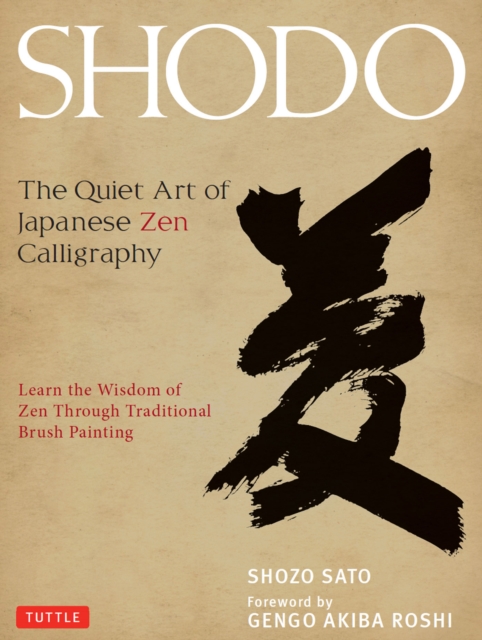
Shodo: the quiet art of Japanese Zen calligraphy
This beautiful book teaches the traditional Japanese art of calligraphy through the power and wisdom of Zen poetry. It is designed for all learners, from beginner to advanced. Anyone interested in the arts will be inspired by the intersection of Japanese aesthetics and Zen Buddhist thought found in this extraordinary book. Single-line Zen Buddhist koan aphorisms or zengo are one of the most common subjects for traditional Japanese brush calligraphy (shodo). This art form is practiced regularly by all students of Zen Buddhism in Japan, since shodo is thought to be one of the key disciplines in fostering the focused, meditative state of mind so essential to Zen. These poetic Zen sayings normally consist of five to seven characters and contain enigmatic nuggets of ancient, often seemingly elusive, wisdom. In this book, Japanese master calligrapher Shozo Sato guides beginning and advanced shodo students alike to a deeper understanding of this unique brush painting art form. He begins by offering a brief history of Japanese calligraphy and its close relationship with the teaching of Zen Buddhism through the ages. This is followed by a clear introduction to the basic supplies and fundamental brushstroke skills that you'll need. Finally, he presents 30 selected zengo or single-line Zen koan aphorisms. For each zengo, the author provides: - An example of a classic shodo masterwork by a skilled Zen monk or master calligrapher - An explanation of the individual characters and the Zen koan as a whole, teaching us the deeper meanings underlying the words and providing insights to the various styles of writing them--all of which combine to give the art of shodo such tremendous power - A set of guided step-by-step instructions showing you how to paint the Zen phrases in a number of styles (Kaisho, Gyosho, Sosho)
eBook

Religious art and meditative contemplation in Japanese calligraphy and byzantine iconography
Far Eastern calligraphy has always been regarded by the Occident as an \"esoteric\" issue, laden with a peculiar \"mysticism,\" which presents spiritual and philosophical aspects too outlandish to truly comprehend. That is probably the reason why calligraphy was amongst the last artistic \"disciplines\" to gain access to the international world of the arts. This study focuses on Japanese calligraphy as a visual and verbal image, conducting a hermeneutic investigation into the nature and function of this type of image, into the value and significance of this way of representing the sacred in accordance with Japanese spirituality. undertaking an unusual exploration, this research draws together the symbolism of calligraphic art and that of Byzantine icons, looking for similarities and differences between them, seeing them as intuitive gateways to the mysteries of the universe, to revelations of an ontologically superior nature.
Journal Article