
Catalogue Search | MBRL


Are you sure you want to remove the book from the shelf?

{{itemTitle}}
355
result(s) for
"Cambodia -- Economic conditions"
Sort by:


The Political Economy of Cambodia's Transition, 1991-2001
Cambodia underwent a triple transition in the 1990s: from war to peace, from communism to electoral democracy, and from command economy to free market. This book addresses the political economy of these transitions, examining how the much publicised international intervention to bring peace and democracy to Cambodia was subverted by the poverty of the Cambodian economy and by the state's manipulation of the move to the free market. This analysis of the material basis of obstacles to Cambodia's democratisation suggests that the long-established theoretical link between economy and democracy stands, even in the face of new strategies of international democracy promotion.
eBook
Cambodia's Neoliberal Order
Neoliberal economics have emerged in the post-Cold War era as the predominant ideological tenet applied to the development of countries in the global south. For much of the global south, however, the promise that markets will bring increased standards of living and emancipation from tyranny has been an empty one. Instead, neoliberalisation has increased the gap between rich and poor and unleashed a firestorm of social ills.
This book deals with the post-conflict geographies of violence and neoliberalisation in Cambodia. Applying a geographical analysis to contemporary Cambodian politics, the author employs notions of neoliberalism, public space, and radical democracy as the most substantive components of its theoretical edifice. He argues that the promotion of unfettered marketisation is the foremost causal factor in the country’s inability to consolidate democracy following a United Nations sponsored transition. The book demonstrates Cambodian perspectives on the role of public space in Cambodia's process of democratic development and explains the implications of violence and its relationship with neoliberalism.
Taking into account the transition from war to peace, authoritarianism to democracy, and command economy to a free market, this book offers a critical appraisal of the political economy in Cambodia.
1. Introduction: Setting the Stage for Neoliberalisation 2. Caught in the Headlights of Culture and Neoliberalism: Public Space as a Vision for Democracy and Development from Below in the Global South 3. From Genocide to Elections to Coup d’État: Public Space in Cambodia’s Transitional Political Economy 4. Cambodia’s Battle for Public Space: The Neoliberal Doctrine or Order versus the Democratic Expression of the People’s Will 5. Conclusion: Sowing the Seeds of a New Revolution?
Simon Springer is Assistant Professor in the Department of Geography at the National University of Singapore. His ongoing research focuses on the intersections between neoliberalism and violence.
eBook
Cambodia and the Politics of Aesthetics
Illuminating developments in contemporary Cambodia with political and aesthetic theory, this book analyses the country's violent transition from socialism to capitalism through an innovative method that combines the aesthetic approach and critical theory.
To understand the particularities of the country's transition and Cambodia's unfolding encounter with neoliberal capitalism, the book pursues the circuits of desire connecting the constellation of objects and relations, which is identified as Cambodia. Chapters focus on the pre-colonial empire of Angkor, the invasions of Siam and Vietnam in the nineteenth century, the devastation of the Khmer Rouge genocide and the subsequent Vietnamese occupation, and the present rapacity of Hun Sen's neoliberal government.
A creative combination of auto-ethnography, critical theory, and area studies and the analysis of a historical moment, the book is of interest to academics working on comparative politics, Asian studies, holocaust studies, critical theory, and in the politics of aesthetics.
eBook
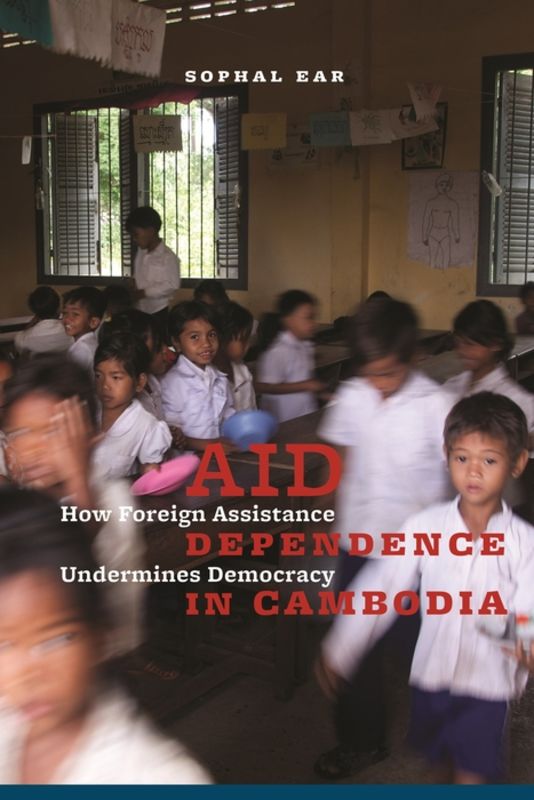
Aid dependence in Cambodia
International intervention liberated Cambodia from pariah state status in the early 1990s and laid the foundations for more peaceful, representative rule. Yet the country's social indicators and the integrity of its political institutions declined rapidly within a few short years, while inequality grew dramatically. Conducting an unflinching investigation into these developments, Sophal Ear reveals the pernicious effects of aid dependence and its perversion of Cambodian democracy. International intervention and foreign aid resulted in higher maternal (and possibly infant and child) mortality rates and unprecedented corruption by the mid-2000s. Similarly, in example after example, Ear finds the more aid dependent a country, the more distorted its incentives to develop sustainably. Contrasting Cambodia's clothing sector with its rice and livestock sectors and internal handling of the avian flu epidemic, he showcases the international community's role in preventing Cambodia from controlling its national development. A postconflict state unable to refuse aid, Cambodia is rife with trial-and-error donor experiments and their unintended consequences, such as bad governance and poor domestic and tax revenue performance—a major factor curbing sustainable, nationally owned growth. By outlining the terms through which countries can achieve better ownership of their development, Ear offers alternatives for governments still on the brink of collapse, despite ongoing dependence on foreign intervention and aid.
eBook


Unsettled Frontiers
Unsettled Frontiers provides a
fresh view of how resource frontiers evolve over time.
Since the French colonial era, the Cambodia-Vietnam borderlands
have witnessed successive waves of market integration, migration,
and disruption. The region has been reinvented and depleted as new
commodities are exploited and transplanted: from vast French rubber
plantations to the enforced collectivization of the Khmer Rouge;
from intensive timber extraction to contemporary crop booms. The
volatility that follows these changes has often proved challenging
to govern.
Sango Mahanty explores the role of migration, land claiming, and
expansive social and material networks in these transitions, which
result in an unsettled frontier, always in flux, where communities
continually strive for security within ruptured landscapes.
eBook

Old and \New\ Chinese Business in Cambodia's Capital
China's influence over economic and political affairs in Cambodia is undisputed. It is the biggest investor in Cambodia, adding nearly US5.3 billion between 2013 and 2017, especially into real estate development, the garment industry and the tourism sector. For Phnom Penh's SMEs, \"new\" Chinese migrants are an increasingly important clientele, and raw materials, machinery, consumer goods and capital from Greater China have been vital resources. At the same time, they face competition from entrepreneurs from China entering the Cambodian market. For Cambodia's elite entrepreneurs, known as oknha, China is an export destination for Cambodian timber and cash crops, and \"new\" Chinese investments provide business opportunities in the form of construction contracts and joint ventures in real estate and tourism development, industrial parks or the energy sector.Recent Chinese investments and migrants have reinforced Cambodia's established politico-economic order, which is characterized by ethnic Chinese economic dominance as well as a divide between the business-state elite and the general population.
eBook
