
Catalogue Search | MBRL


Are you sure you want to remove the book from the shelf?

{{itemTitle}}
8
result(s) for
"Cambodia -- History -- 1975-1979 -- Biography"
Sort by:


Facing the Khmer Rouge
As a child growing up in Cambodia, Ronnie Yimsut played among the ruins of the Angkor Wat temples, surrounded by a close-knit community. As the Khmer Rouge gained power and began its genocidal reign of terror, his life became a nightmare. In this stunning memoir, Yimsut describes how, in the wake of death and destruction, he decides to live.
Escaping the turmoil of Cambodia, he makes a perilous journey through the jungle into Thailand, only to be sent to a notorious Thai prison. Fortunately, he is able to reach a refugee camp and ultimately migrate to the United States, where he attended the University of Oregon and became an influential leader in the community of Cambodian immigrants.Facing the Khmer Rougeshows Ronnie Yimsut's personal quest to rehabilitate himself, make a new life in America, and then return to Cambodia to help rebuild the land of his birth.
eBook


War, Genocide, and Justice
In the three years, eight months, and twenty days of the Khmer Rouge's deadly reign over Cambodia, an estimated 1.7 million Cambodians perished as a result of forced labor, execution, starvation, and disease. Despite the passage of more than thirty years, two regime shifts, and a contested U.N. intervention, only one former Khmer Rouge official has been successfully tried and sentenced for crimes against humanity in an international court of law to date. It is against this background of war, genocide, and denied justice that Cathy J. Schlund-Vials explores the work of 1.5-generation Cambodian American artists and writers.
Drawing on what James Young labels \"memory work\"-the collected articulation of large-scale human loss-War, Genocide, and Justiceinvestigates the remembrance work of Cambodian American cultural producers through film, memoir, and music. Schlund-Vials includes interviews with artists such as Anida Yoeu Ali, praCh Ly, Sambath Hy, and Socheata Poeuv. Alongside the enduring legacy of the Killing Fields and post-9/11 deportations of Cambodian American youth, artists potently reimagine alternative sites for memorialization, reclamation, and justice. Traversing borders, these artists generate forms of genocidal remembrance that combat amnesic politics and revise citizenship practices in the United States and Cambodia.
Engaged in politicized acts of resistance, individually produced and communally consumed, Cambodian American memory work represents a significant and previously unexamined site of Asian American critique.
eBook

Stay Alive, My Son
On April 17, 1975, the Khmer Rouge entered Phnom Penh to open a new and appalling chapter in the story of the twentieth century. On that day, Pin Yathay was a qualified engineer in the Ministry of Public Works. Successful and highly educated, he had been critical of the corrupt Lon Nol regime and hoped that the Khmer Rouge would be the patriotic saviors of Cambodia.
In Stay Alive, My Son , Pin Yathay provides an unforgettable testament of the horror that ensued and a gripping account of personal courage, sacrifice and survival. Documenting the 27 months from the arrival of the Khmer Rouge in Phnom Penh to his escape into Thailand, Pin Yathay is a powerful and haunting memoir of Cambodia's killing fields.
With seventeen members of his family, Pin Yathay were evacuated by the Khmer Rouge from Phnom Penh, taking with them whatever they might need for the three days before they would be allowed to return to their home. Instead, they were moved on from camp to camp, their possessions confiscated or abandoned. As days became weeks and weeks became months, they became the New People, displaced urban dwellers compelled to live and work as peasants, their days were filled with forced manual labor and their survival dependent on ever more meager communal rations. The body count mounted, first as malnutrition bred rampant disease and then as the Khmer Rouge singled out the dissidents for sudden death in the darkness.
Eventually, Pin Yathay's family was reduced to just himself, his wife, and their one remaining son, Nawath. Wracked with pain and disease, robbed of all they had owned, living on the very edge of dying, they faced a future of escalating horror. With Nawath too ill to travel, Pin Yathay and his wife, Any, had to make the heart-breaking decision whether to leave him to the care of a Cambodian hospital in order to make a desperate break for freedom. Stay alive, my son, he tells Nawath before embarking on a nightmarish escape to the Thai border.
First published in 1987, the Cornell edition of Stay Alive, My Son includes an updated preface and epilogue by Pin Yathay and a new foreword by David Chandler, a world-renowned historian of Cambodia, who attests to the continuing value and urgency of Pin Yathay's message.
eBook

Children of Cambodia's Killing Fields
No detailed description available for \"Children of Cambodia's Killing Fields\".
eBook

Brother Number One : a political biography of Pol Pot
In the tragic recent history of Cambodia—a past scarred by a long occupation by Vietnamese forces and by the preceding three-year reign of terror by the brutal Khmer Rouge—no figure looms larger or more ominously than that of Pol Pot. As secretary of the Central Committee of the Communist Party of Kampuchea (CPK) since 1962 and as prime minister of Democratic Kampuchea (DK), he has been widely blamed for trying to destroy Cambodian society. By implementing policies whose effects were genocidal, he oversaw the deaths of more than one million of his nation’s people.The political career of Saloth Sar, better known by his nom de guerre Pol Pot, forms a critical but largely inaccessible portion of twentieth-century Cambodian history. What we know about his life is sketchy: a comfortable childhood, three years of study in France, and a short career as a schoolteacher preceded several years—spent mostly in hiding—as a guerrilla and the commander of the victorious army in Cambodia’s civil war. His career reached a climax when he and his associates, coming to power, attempted to transform their country along lines more radical than any attempted by a modern regime. Driven into hiding in 1979 by invading Vietnamese forces, Pol Pot maintained his leadership of a Khmer Rouge guerrilla army in exile, remaining a power and a threat.In this political biography, David P. Chandler throws light on the shadowy figure of Pol Pot. Basing his study on interviews and on a wide range of sources in English, Cambodian, and French, the author illuminates the ideas and behavior of this enigmatic man and his entourage against the background of post–World War II events, providing a key to understanding this horrific, pivotal period of Cambodian history. In this revised edition, Chandler provides new information on the state of Cambodia and the Khmer Rouge following the death of Pol Pot in 1997.
eBook
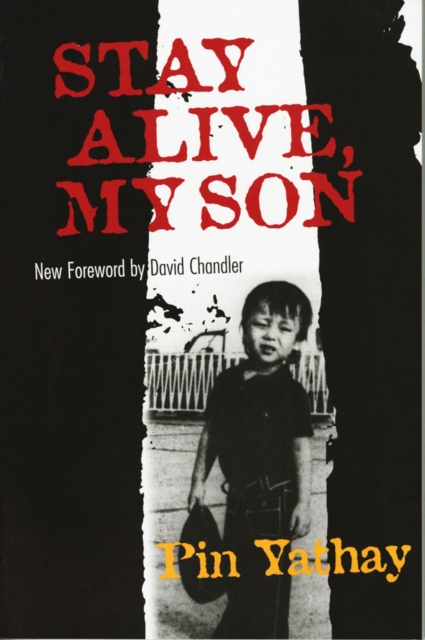
Stay Alive, My Son
On April 17, 1975, the Khmer Rouge entered Phnom Penh to open a new and appalling chapter in the story of the twentieth century. On that day, Pin Yathay was a qualified engineer in the Ministry of Public Works. Successful and highly educated, he had been critical of the corrupt Lon Nol regime and hoped that the Khmer Rouge would be the patriotic saviors of Cambodia.
InStay Alive, My Son, Pin Yathay provides an unforgettable testament of the horror that ensued and a gripping account of personal courage, sacrifice and survival. Documenting the 27 months from the arrival of the Khmer Rouge in Phnom Penh to his escape into Thailand, Pin Yathay is a powerful and haunting memoir of Cambodia's killing fields.
With seventeen members of his family, Pin Yathay were evacuated by the Khmer Rouge from Phnom Penh, taking with them whatever they might need for the three days before they would be allowed to return to their home. Instead, they were moved on from camp to camp, their possessions confiscated or abandoned. As days became weeks and weeks became months, they became the \"New People,\" displaced urban dwellers compelled to live and work as peasants, their days were filled with forced manual labor and their survival dependent on ever more meager communal rations. The body count mounted, first as malnutrition bred rampant disease and then as the Khmer Rouge singled out the dissidents for sudden death in the darkness.
Eventually, Pin Yathay's family was reduced to just himself, his wife, and their one remaining son, Nawath. Wracked with pain and disease, robbed of all they had owned, living on the very edge of dying, they faced a future of escalating horror. With Nawath too ill to travel, Pin Yathay and his wife, Any, had to make the heart-breaking decision whether to leave him to the care of a Cambodian hospital in order to make a desperate break for freedom. \"Stay alive, my son,\" he tells Nawath before embarking on a nightmarish escape to the Thai border.
First published in 1987, the Cornell edition ofStay Alive, My Sonincludes an updated preface and epilogue by Pin Yathay and a new foreword by David Chandler, a world-renowned historian of Cambodia, who attests to the continuing value and urgency of Pin Yathay's message.
eBook