
Catalogue Search | MBRL


Are you sure you want to remove the book from the shelf?

{{itemTitle}}
102
result(s) for
"Campaign funds - Law and legislation - United States"
Sort by:

Plutocrats united : campaign money, the Supreme Court, and the distortion of American elections
\"Campaign financing is one of today's most divisive political issues. The left asserts that the electoral process is rife with corruption. The right protests that the real aim of campaign limits is to suppress political activity and protect incumbents. Meanwhile, money flows freely on both sides. In Plutocrats United, Richard Hasen argues that both left and right avoid the key issue of the new Citizens United era: balancing political inequality with free speech. The Supreme Court has long held that corruption and its appearance are the only reasons to constitutionally restrict campaign funds. Progressives often agree but have a much broader view of corruption. Hasen argues for a new focus and way forward: if the government is to ensure robust political debate, the Supreme Court should allow limits on money in politics to prevent those with great economic power from distorting the political process\"--Jacket.
Book

Small change
Reformers lament that, with every effort to regulate the sources of campaign funding, candidates creatively circumvent the new legislation. But in fact, political fundraisers don't need to look for loopholes because, as Raymond J. La Raja proves, legislators intentionally design regulations to gain advantage over their partisan rivals. La Raja traces the history of the U.S. campaign finance system from the late nineteenth century through the passage of the Bipartisan Campaign Reform Act (BCRA) of 2002. Then, using the 2004 presidential election as a case study, he compares the ways in which Democrats and Republicans adapted their national fund-raising and campaigning strategies to satisfy BCRA regulations. Drawing upon this wealth of historical and recent evidence, he concludes with recommendations for reforming campaign finance in ways that promote fair competition among candidates and guarantee their accountability to voters.
eBook


The Campaign Finance Cases
Rarely does the Supreme Court reverse itself as quickly and
profoundly as it did in recent campaign finance cases, with the
Citizens United decision of 2010 undoing the constraints
of the McCain-Feingold Act upheld in McConnell v. Federal
Election Commission (2003). And rarely have the stakes seemed
so high, as billionaires vie for elected office and dark money
floods political campaigns. In timely fashion, this new edition
updates Melvin Urofsky's classic study of campaign finance law,
bringing his cogent analysis of the relevant statutes and court
cases up to date. Urofsky explains in clear and convincing language
what was-and is-at stake in the twists and turns of campaign
finance laws taken up by the nation's highest court in the past
decades. Beginning with Buckley v. Valeo (1976) and moving
through McConnell, Citizens United , and finally
McCutcheon v. Federal Election Commission (2014), Urofsky
discusses the two principles at issue in these cases: freedom of
political speech, and the protection of the political process from
undue influence. Conventional wisdom holds that in such cases
liberals want greater restrictions and conservatives want
corporations to have greater freedom to influence voters. But
working from a rich store of primary sources, probing the
motivations and ideas of all participants in the campaign finance
legal story, Urofsky reveals a far more complex picture, one whose
significance transcends simple political ideologies. In a time of
controversies over political speech in the blogosphere, social
media, and cable news, and claims of electoral fraud, The
Campaign Finance Cases offers a much-needed, balanced account
of how issues critical to American democracy figure in the
adjudication of campaign finance law, and how a changing political
and media landscape might alter the process.
eBook

Buying the vote : a history of campaign finance reform
\"Campaign finance reform has always been motivated by a definition of democracy that does not count corporations as citizens and holds that self-government works best by reducing political inequality. In the early years of the twentieth century, Congress recognized the strength of these principles by prohibiting corporations from making campaign contributions, passing a disclosure law, and setting limits on campaign expenditures. These reforms were not controversial at the time, but conservative opposition to them appeared in the 1970s. That opposition was well represented in the Supreme Court, which has rolled back reform by granting First Amendment rights to corporations and declaring the goal of reducing political inequality to be unconstitutional. Buying the Vote analyzes the rise and decline of campaign finance reform by tracking changes in the way presidential campaigns have been funded since the late nineteenth century, and changes in the debate over how to reform fundraising practices. A close examination of major Supreme Court decisions shows how the Court has fashioned a new and profoundly inegalitarian redefinition of American democracy\"-- Provided by publisher.
Book
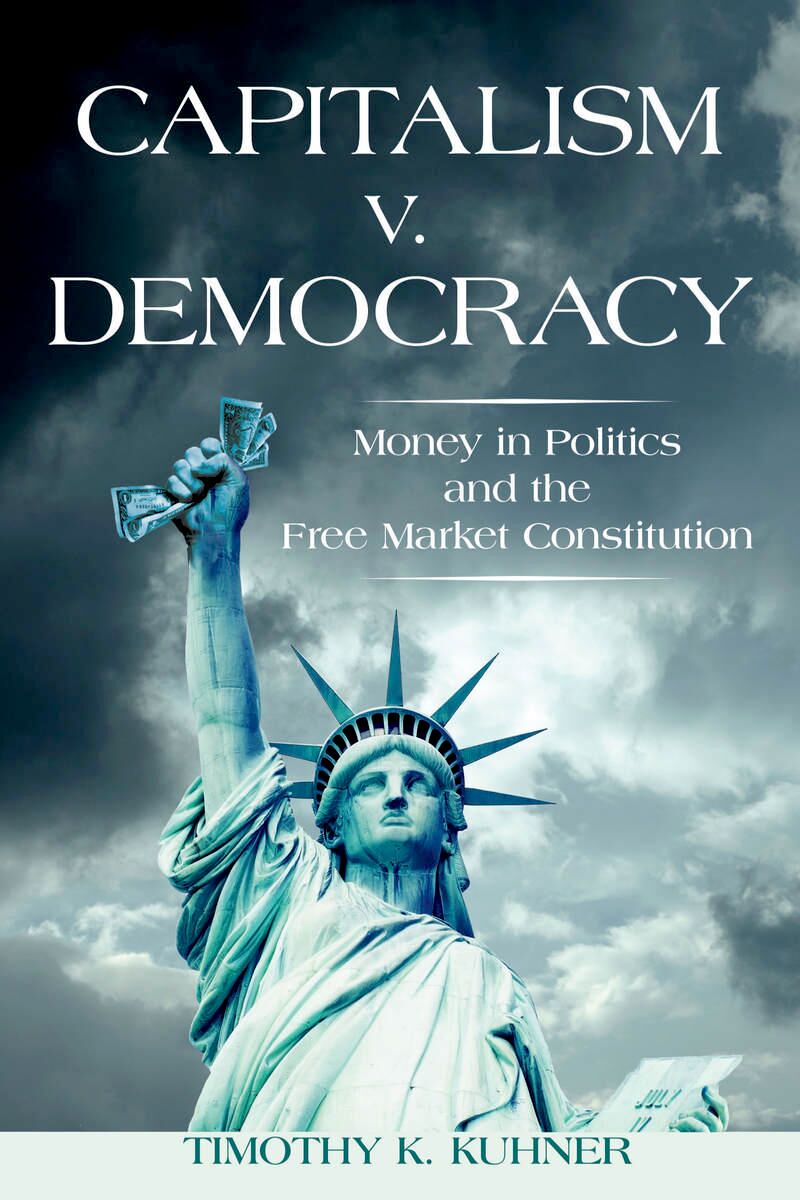
Capitalism v. democracy : money in politics and the free market constitution
As of the latest national elections, it costs approximately $1 billion to become president, $10 million to become a Senator, and $1 million to become a Member of the House. High-priced campaigns, an elite class of donors and spenders, superPACs, and increasing corporate political power have become the new normal in American politics. In Capitalism v. Democracy, Timothy Kuhner explains how these conditions have corrupted American democracy, turning it into a system of rule that favors the wealthy and marginalizes ordinary citizens. Kuhner maintains that these conditions have corrupted capitalism as well, routing economic competition through political channels and allowing politically powerful companies to evade market forces. The Supreme Court has brought about both forms of corruption by striking down campaign finance reforms that limited the role of money in politics. Exposing the extreme economic worldview that pollutes constitutional interpretation, Kuhner shows how the Court became the architect of American plutocracy.
Capitalism v. Democracy offers the key to understanding why corporations are now citizens, money is political speech, limits on corporate spending are a form of censorship, democracy is a free market, and political equality and democratic integrity are unconstitutional constraints on money in politics. Supreme Court opinions have dictated these conditions in the name of the Constitution, as though the Constitution itself required the privatization of democracy. Kuhner explores the reasons behind these opinions, reveals that they form a blueprint for free market democracy, and demonstrates that this design corrupts both politics and markets. He argues that nothing short of a constitutional amendment can set the necessary boundaries between capitalism and democracy.
eBook

Free to judge : the power of campaign money in judicial elections
The idea that wealthy people use their money to influence things, including politics, law, and media will surprise very few people. However, as Michael S. Kang and Joanna Shepherd argue in this readable and rich study of the state judiciary, the effect of money on judicial outcomes should disturb and anger everyone. In the current system that elects state judges, the rich and powerful can spend money to elect and re-elect judges who decide cases the way they want. Free to Judge is about how and why money increasingly affects the dispensation of justice in our legal system, and what can be done to stop it.
One of the barriers to action in the past has been an inability to prove that campaign donations influence state judicial decision-making. In this book, Kang and Shepherd answer that challenge for the first time, with a rigorous empirical study of campaign finance and judicial decision-making data. Pairing this with interviews of past and present judges, they create a compelling and persuasive account of people like Marsha Ternus, the first Iowa state supreme court justice to be voted out of office after her decision in a same-sex marriage case. The threat of such an outcome, and the desire to win reelection, results in judges demonstrably leaning towards the interests and preferences of their campaign donors across all cases.
Free to Judge is thus able to identify the pieces of our current system that invite bias, such as judicial reelection, and what reforms should focus on. This thoughtful and compellingly written book will be required reading for anybody who cares about creating a more just legal system.
eBook

Inside the Campaign Finance Battle: Court Testimony on the New Reforms
In 2002 Congress enacted the Bipartisan Campaign Reform Act (BCRA), the first major revision of federal campaign finance law in a generation. In March 2001, after a fiercely contested and highly divisive seven-year partisan legislative battle, the Senate passed S. 27, known as the McCain-Feingold legislation. The House responded by passing H.R. 2356, companion legislation known as Shays-Meehan, in February 2002. The Senate then approved the House-passed version, and President George W. Bush signed BCRA into law on March 27, 2002, stating that the bill had \"flaws\" but overall \"improves the current system of financing for federal campaigns.\" The Reform Act was taken to court within hours of the President's signature. Dozens of interest groups and lawmakers who had opposed passage of the Act in Congress lodged complaints that challenged the constitutionality of virtually every aspect of the new law. Following review by a special three-judge panel, the case is expected to reach the U.S. Supreme Court in 2003. This litigation constitutes the most important campaign finance case since the Supreme Court issued its decision in Buckley v. Valeo more than twenty-five years ago. The testimony, submitted by some of the country's most knowledgeable political scientists and most experienced politicians, constitutes an invaluable body of knowledge about the complexities of campaign finance and the role of money in our political system. Unfortunately, only the lawyers, political scientists, and practitioners actually involved in the litigation have seen most of this writing -until now. Inside the Campaign Finance Battle makes key testimony in this historic case available to a general readership, in the process shedding new light on campaign finance practices central to the congressional debate on the reform act and to the landmark litigation challenging its constitutionality.
eBook
The fallacy of campaign finance reform
At first glance, campaign finance reform looks like a good idea. McCain-Feingold, for instance, regulates campaigns by prohibiting national political parties from accepting soft money contributions from corporations, labor unions, and wealthy individuals. But are such measures, or any of the numerous and similarly restrictive proposals that have circulated through Washington in recent years, really good for our democracy? John Samples says no, and here he takes a penetrating look into the premises and consequences of the long crusade against big money in politics. How many Americans, he asks, know that there is little to no evidence that campaign contributions really influence members of Congress? Or that so-called negative political advertising actually improves the democratic process by increasing voter turnout and knowledge? Or that limits on campaign contributions make it harder to run for office, thereby protecting incumbent representatives from losing their seats of power? Posing tough questions such as these, Samples uncovers numerous fallacies beneath proposals for campaign finance reform. He argues that our most common concerns about money in politics are misplaced because the ideals implicit in our notion of corruption are incoherent or indefensible. The chance to regulate money in politics allows representatives to serve their own interests at a cost to their constituents. And, ironically, this long crusade against the corruption caused by campaign contributions allows public officials to reduce their vulnerability by suppressing electoral competition. Defying long-held ssumptions and conventional political wisdom, The Fallacy of Campaign Finance Reform is a provocative and decidedly nonpartisan work that will be essential for anyone concerned about the future of American government.
eBook
Buying the Vote
Buying the Vote: A History of Campaign Finance Reform analyzes the rise and decline of campaign finance reform by tracking changes in the funding of presidential campaigns and changes in the debate over reforming fundraising practices. An examination of Supreme Court decisions shows how the Court has fashioned a profoundly inegalitarian redefinition of American democracy.
eBook