
Catalogue Search | MBRL


Are you sure you want to remove the book from the shelf?

{{itemTitle}}
279
result(s) for
"Canada-Social policy"
Sort by:

Caring for children : social movements and public policy in Canada
\"Social inequality. Selective political attention. Insufficient funding and access. Caring for Children provides a comprehensive, interdisciplinary examination of the crisis in care for Canadian children and their caregivers. Couched in the language of choice, government policies on the care of Canadian children over the past decade have favoured professional, nuclear families while doing little to assist children with the greatest needs, including those from low-income, immigrant, and Aboriginal families. This feminist collection explores the politics of the care crisis, drawing on historical and contemporary materials to document policy shifts and associated social movement responses, and using comparative examples from across Canada to illustrate how public policies have both caused and emerged from the crisis. Analyzing the connections between services and programs, the contributors reveal how childcare, parental leave, informal care, live-in caregiver programs, and child tax benefits affect the well-being of Canadian children, caregivers, and families. They explain how social movements are fighting to change contemporary approaches to the care of children and affirm the urgent necessity of questioning Canadian political attitudes and arrangements.\"-- Provided by publisher.
Book

Not This Time
Drugs are part of every society, consumed for ritual or religious purposes, for pleasure, to enhance athletic performance, or as a means to relieve pain. Throughout the twentieth century, however, an arbitrary and shifting distinction was made between legal drugs that were prescribed and administered by the medical profession, and illegal drugs that were subject to state control and suppression.
Illegal in Canada since 1923, marijuana is the most controversial of illegal drugs. Because it lacks the same addictive and harmful qualities of other illegal substances, such as heroin and cocaine, marijuana's negative social impact is questionable. In the 1960s interest groups – including university student associations, certain physicians, and others – began demanding changes to the Narcotics Control Act, which governed the legal status of drugs, to decriminalize or legalize the possession of marijuana.
In Not This Time , Marcel Martel explores recreational use of marijuana in the 1960s and its emergence as a topic of social debate. He demonstrates how the media, interest groups, state institutions, bureaucrats and politicians influenced the development and implementation of public policy on drugs. Martel illustrates how two loose coalitions both made up of interest groups, addiction research organizations and bureaucrats – one supporting the existing drug legislation, and the other favoring liberalization of the Narcotics Control Act – dominated the debate over the legalization of marijuana, and how those favoring liberalized drug laws, while influential, had difficulty presenting a unified front and problems justifying their cause while the health benefits of marijuana use were still in question. Exploring both sides of the debate, Martel presents the invigorating history of a question that continues to reverberate in the minds of Canadians.
Electronic Format Disclaimer: Images removed at the request of the rights holder.
eBook

Universality and social policy in Canada
\"This book surveys the many contested meanings of universality (i.e., availability of programs to all citizens) in relation to specific social pogroms, to the field of social policy and, more generally, to the modern welfare state-subjects taught in numerous courses on social welfare policy. The focus of the discussion is on Canada, though comparative references are made to help highlight key features of the Canadian experience. In addition to universality, the related ideas of universalism and universalization are discussed in order to understand important political ideas and the social processes of change in discourse and programs design in social policy. The book argues that, while universality is a major value under-girding certain areas of state intervention ( most notably health care and education), the contributory principle of social insurance and the selectivity principle of income assistance are also highly significant precepts in practice. The politics of universality are multiple, relating to diverse values and beliefs, several policy instruments and administrative techniques, and demographic and socio-economic trends.Beyond the survey of the meaning and implications of the universality principle in social welfare, individual chapters consider specific policy cases such as medicare, disability support, old age security, citizenship and immigration, as well as fiscal implications.\"-- Provided by publisher.
Book

Household Politics
Through in-depth research from a wide variety of sources, Fahrni brings together family history, social history, and political history to look at a wide variety of Montreal families - French-speaking and English-speaking; Catholic, Protestant, and Jewish - makingHousehold Politicsa particularly unique and erudite study.
eBook


\Real\ Indians and others : mixed-blood urban native peoples and indigenous nationhood
Mixed-blood urban Native peoples in Canada are profoundly affected by federal legislation that divides Aboriginal peoples into different legal categories. In this pathfinding book, Bonita Lawrence reveals the ways in which mixed-blood urban Natives understand their identities and struggle to survive in a world that, more often than not, fails to recognize them.
In \"Real\" Indians and Others Lawrence draws on the first-person accounts of thirty Toronto residents of Native heritage, as well as archival materials, sociological research, and her own urban Native heritage and experiences. She sheds light on the Canadian government's efforts to define Native identity through the years by means of the Indian Act and shows how residential schooling, the loss of official Indian status, and adoption have affected Native identity. Lawrence looks at how Natives with \"Indian status\" react and respond to \"nonstatus\" Natives and how federally recognized Native peoples attempt to impose an identity on urban Natives.
Drawing on her interviews with urban Natives, she describes the devastating loss of community that has resulted from identity legislation and how urban Native peoples have wrestled with their past and current identities. Lawrence also addresses the future and explores the forms of nation building that can reconcile the differences in experiences and distinct agendas of urban and reserve-based Native communities.
eBook

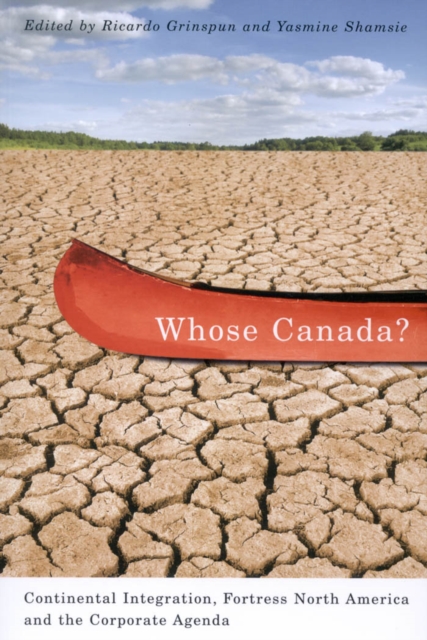
Whose Canada?
Contributors include Sharryn Aiken (Queen's), Maude Barlow (Council of Canadians), Dorval Brunelle (UQAM), Duncan Cameron (SFU), Bruce Campbell (Canadian Centre for Policy Alternatives, CCPA), Tony Clarke (Polaris Institute), Stephen Clarkson (Toronto), Marjorie Griffin Cohen (Simon Fraser), Kathy Corrigan (Canadian Union of Public Employees), Murray Dobbin (CCPA), Jim Grieshaber-Otto (CCPA), Andrew Jackson (Canadian Labour Congress), Marc Lee (CCPA), Benoît Lévesque (UQAM), Elizabeth May (Green Party), Garry Neil (International Network for Cultural Diversity), Larry Pratt (Alberta), David Robinson (Canadian Association for University Teachers), Mario Seccareccia (Ottawa), Steven Shrybman (Sack, Goldblatt, & Mitchell), Scott Sinclair (CCPA), Steven Staples (Ceasefire.ca), and Michelle Swenarchuk (Canadian Environmental Law Association).
eBook


Economic Rights in Canada and the United States
Readers in Western developed countries are most familiar with abuses of political and civil rights, but the international human rights regime also embraces a set of laws regarding economic rights. These rights include the right to work and to just and favorable working conditions; the right to join and form trade unions; the right to social security; specific rights for the family; the right to an adequate standard of living, including food, clothing, housing, and \"the continuous improvement of living conditions\"; and the right to \"the highest attainable standard of physical and mental health.\" In original essays by scholars senior and junior, this volume explains how these rights are realized-or violated-in Canada and the United States. Contributors analyze the philosophy, law, and politics of economic rights and discuss specific issues such as poverty, health care, and the rights of people with disabilities. Central to the problems of both countries are the human rights abuses evident in all contemporary capitalist societies. When the inequalities among citizens are not cushioned by a national commitment to economic rights, or when governments fail to maintain social safety nets for all citizens, economic rights are at risk. Contributors consider the problem from the perspective of their own countries: Canada, the United States, and, for contrast, the Netherlands. They do so in order to explore whether their own countries fall short of meeting international standards of economic rights. They also address the criticism often made by non-Western scholars of human rights-that their Western colleagues preach human rights abroad without regard to the human rights flaws at home.
eBook