
Catalogue Search | MBRL


Are you sure you want to remove the book from the shelf?

{{itemTitle}}
180
result(s) for
"Cape of Good Hope"
Sort by:


Knowledge and Colonialism: Eighteenth-century Travellers in South Africa
Knowledge and Colonialism examines writings and drawings of eighteenth-century scientific travellers in South Africa against the background of administrative and commercial discourses. It is argued that these travellers benefited more from their relationship with the colonial order than the other way around.
eBook

Slave emancipation and racial attitudes in nineteenth-century South Africa
\"This book examines the social transformation wrought by the abolition of slavery in 1834 in South Africa's Cape Colony. It pays particular attention to the effects of socioeconomic and cultural changes in the way both freed slaves and dominant whites adjusted to the new world. It compares South Africa's relatively peaceful transition from a slave to a non-slave society to the bloody experience of the US South after abolition, analyzing rape hysteria in both places as well as the significance of changing concepts of honor in the Cape. Finally, the book examines the early development of South Africa's particular brand of racism, arguing that abolition, not slavery itself, was a causative factor; although racist attitudes were largely absent while slavery persisted, they grew incrementally but steadily after abolition, driven primarily by whites' need for secure, exploitable labor\"-- Provided by publisher.
Book

Genocide on Settler Frontiers: When Hunter-Gatherers and Commercial Stock Farmers Clash
European colonial conquest included many instances of indigenous peoples being exterminated. Cases where invading commercial stock farmers clashed with hunter-gatherers were particularly destructive, often resulting in a degree of dispossession and slaughter that destroyed the ability of these societies to reproduce themselves. The experience of aboriginal peoples in the settler colonies of southern Africa, Australia, North America, and Latin America bears this out. The frequency with which encounters of this kind resulted in the annihilation of forager societies raises the question of whether these conflicts were inherently genocidal, an issue not yet addressed by scholars in a systematic way.
eBook

Imagining the Cape Colony : history, literature, and the South African nation
\"David Johnson considers a variety of writers, from European intellectuals Camنoes, Southey, Rousseau and Adam Smith to travel writers like Franًcois Levaillant and Lady Anne Barnard, and from the diaries of settler rebels and early African nationalists to the courtroom testimonies of African slaves and farm workers. These are combined with discussions of the many subsequent literary works and histories of the Cape Colony. By returning to the writing of and about the Cape Colony from 1770 to 1830 - when modern definitions of 'nation' and 'colony' were both constituted and contested - this book addresses current debates about settler nationalism, anti-colonial resistance and the imprint of 18th-century colonial histories on contemporary neo-colonial politics. By imagining the post-apartheid South African nation, Johnson critically re-reads the history of the Cape Colony, paying particular attention to the extensive commentaries on literature and history associated with the Thabo Mbeki presidencies.\"--Publisher's website.
Book

Imagining the Cape Colony
By returning to a pivotal moment in South African history - the Cape Colony in the period 1770-1830 - this book addresses current debates about nationalism colonialism and neo-colonialism and postcolonial/post-apartheid culture.
eBook

To the fairest cape : European encounters in the Cape of Good Hope
\"Crossing the remote, southern tip of Africa has fired the imagination of European travelers from the time Bartholomew Dias opened up the passage to the East by rounding the Cape of Good Hope in 1488. Dutch, British, French, Danes and Swedes formed an endless stream of seafarers who made the long journey southwards in pursuit of wealth, adventure, science, and missionary, as well as outright national, interest. Beginning by considering the early hunter-gatherer inhabitants of the Cape and their culture, Malcolm Jack focusses in his account on the encounter that the European visitors had with the Khoisan peoples, sometimes sympathetic but often exploitative from the time of the Portuguese to the abolition of slavery in the British Empire in 1833. This commercial and colonial background is key to understanding the development of the vibrant city that is modern Cape Town, as well as the rich diversity of the Cape hinterland\"-- Provided by publisher.
Book

Status and Respectability in the Cape Colony, 1750–1870
In a compelling example of the cultural history of South Africa, Robert Ross offers a subtle and wide-ranging study of status and respectability in the colonial Cape between 1750 and 1850. His 1999 book describes the symbolism of dress, emblems, architecture, food, language, and polite conventions, paying particular attention to domestic relationships, gender, education and religion, and analyses the values and the modes of thinking current in different strata of the society. He argues that these cultural factors were related to high political developments in the Cape, and offers a rich account of the changes in social identity that accompanied the transition from Dutch to British overrule, and of the development of white racism and of ideologies of resistance to white domination. The result is a uniquely nuanced account of a colonial society.
eBook

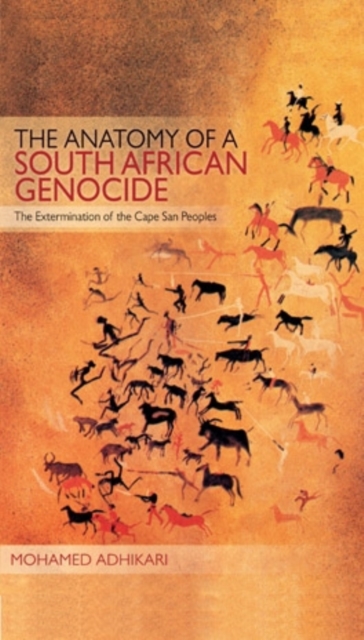
The Anatomy of a South African Genocide
In 1998 David Kruiper, the leader of the ‡Khomani San who today live in the Kalahari Desert in South Africa, lamented, \"We have been made into nothing.\" His comment applies equally to the fate of all the hunter-gatherer societies of the Cape Colony who were destroyed by the impact of European colonialism. Until relatively recently, the extermination of the Cape San peoples has been treated as little more than a footnote to South African narratives of colonial conquest.During the eighteenth and nineteenth centuries, Dutch-speaking pastoralists who infiltrated the Cape interior dispossessed its aboriginal inhabitants. In response to indigenous resistance, colonists formed mounted militia units known as commandos with the express purpose of destroying San bands. This ensured the virtual extinction of the Cape San peoples. InThe Anatomy of a South African Genocide,Mohamed Adhikariexamines the history of the San and persuasively presents the annihilation of Cape San society as genocide.
eBook