
Catalogue Search | MBRL


Are you sure you want to remove the book from the shelf?

{{itemTitle}}
230
result(s) for
"Capitalism Forecasting."
Sort by:


Predictive Knowledge Infrastructures and Future-related Expertise Before the Cold War
Experts, Social Scientists, and Techniques of Prognosis in Cold War America
convincingly demonstrates the importance of RAND’s Delphi method and political gaming as techniques of prognosis that were central to the construction of Cold War futures expertise. The book begins from the premise that although expertise in various forms of prognosis, prediction, and forecasting predated the creation of RAND, different modes of interaction among experts at RAND defined a new form of future-oriented expertise during the Cold War. This visual essay will use this premise as an entry point into other, earlier historical examples of interaction, albeit in different forms, that also produced expert knowledge about the future: 1.) nineteenth-century meteorological knowledge infrastructures and what Aitor Anduaga has described as “epistemic networks,” 2.) agricultural statistics and cooperative bureaucracy, and 3.) early twentieth-century business forecasting and what Seth Rockman has identified as the “paper technologies of capitalism.”
This visual essay examines three images that illuminate earlier historical examples of expert interaction in predictive knowledge infrastructures in the late nineteenth- and early twentieth-century United States. The essay employs historian Paul Edwards’s definition of
knowledge infrastructures
as “robust networks of people, artifacts, and institutions that generate, share, and maintain specific knowledge about the human and natural worlds.” An infrastructural framework, as Edwards observes, shifts away from “thinking about knowledge as pure facts, theories, and ideas” and instead “views knowledge as an enduring, widely shared sociotechnical system.” The visual essay format makes visible the material components of a knowledge infrastructure as well as its symbolic meanings, and it also reminds us to ask what is
not
pictured and why. This essay focuses on how these knowledge infrastructures have combined data, information, judgment, and opinion to produce expert knowledge about the future, and it asks us to consider how future-oriented expertise has emerged historically and who counts as an expert. It will explore three main questions: How has interaction among experts historically taken place at a distance and in person? How did knowledge infrastructures, bureaucracies, and paperwork shape the production of expert knowledge about the future before the Cold War? How has expert foreknowledge historically relied on various forms of “futurework” as labor?
Journal Article


Depression, capitalism and radical care
This article examines depression as both an inevitable feature of, and a construct produced within, contemporary Western society, shaped by the forces of late capitalism and neoliberal ideology. Building on Mark Fisher's call to politicise depression, it engages with Marxist, critical mental health, and anti- psychiatry scholarship to argue that the definition and treatment of depression by the psy-professions serve the interests of the neoliberal agenda. Rather than viewing depression as an apolitical, individualised 'disorder', the article situates it as a deeply political phenomenon rooted in systemic conditions. At the same time, it acknowledges the undeniable reality of lived experiences of depression, which necessitate forms of care. The discussion explores alternatives to psychiatric 'treatment', highlighting the possibilities found in radical therapy and, more radically still, in the abolition of psychiatric hegemony in favour of transformative, collective forms of care.
Journal Article


The New Capitalism, the Old Capitalism, and the Administrative State
This Essay concerns the evolving relationship between the economy, specifically the economy of the British North America that became the United States, and the methods society deployed to legitimate, control, and channel economic behavior, especially religion and law. Using the recently published work of three eminent academics—Benjamin Friedman, Jonathan Levy, and William Novak—it addresses the changes in thought necessary to legitimate acquisitive economic behavior and the consequent centering of law as the secular replacement for religion. Having unleashed that behavior, society, yet wary of it, at least in its extreme forms, had to develop mechanisms to channel that behavior in ways that created social benefit and limit its antisocial extremes. That behavior became known as capitalism. The state had always regulated economic behavior, of course, but the purposes of regulation, and its mechanisms, changed as capitalism evolved, and as understandings of capitalism evolved in tandem with the economy itself.
In the United States, that evolution was marked by a continuing attention to democratic aspirations, aspirations both political and egalitarian. As capitalism fostered wider markets, as its evolution embodied industrialism and commercialism, it created problems that the regulatory state could not handle. In America, the transition from regulatory to administrative state was complicated by its federal structure and background democratic egalitarian yearnings. Friedman, Levy, and Novak illustrate and elucidate aspects of that evolution. This Essay suggests that reading them together explains more than each separately and ends by noting how the tensions they explain usefully add to our understanding of American law, and, coincidentally, the potentially transformational administrative law decisions of the Supreme Court in the 2023–2024 term.
Journal Article
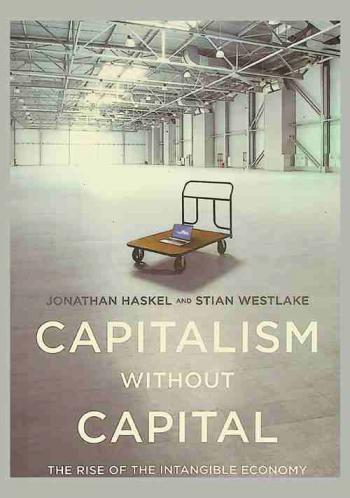
Capitalism without capital : the rise of the intangible economy
\"Early in the twenty-first century, a quiet revolution occurred. For the first time, the major developed economies began to invest more in intangible assets, like design, branding, and software, than in tangible assets, like machinery, buildings, and computers. For all sorts of businesses, the ability to deploy assets that one can neither see nor touch is increasingly the main source of long-term success. But this is not just a familiar story of the so-called new economy. Capitalism without Capital shows that the growing importance of intangible assets has also played a role in some of the larger economic changes of the past decade, including the growth in economic inequality and the stagnation of productivity. Jonathan Haskel and Stian Westlake explore the unusual economic characteristics of intangible investment and discuss how an economy rich in intangibles is fundamentally different from one based on tangibles. Capitalism without Capital concludes by outlining how managers, investors, and policymakers can exploit the characteristics of an intangible age to grow their businesses, portfolios, and economies\"--Page 4 of cover.

Notes on COVID 19 and the Contradictions of Capital II
The commentaries in this issue are a response to a call for a follow- up to Notes on COVID 19 and the Contradictions of Capital, a symposium published in the September 2020 issue of Dialectical Anthropology (44:3) In our second symposium on COVID 19, we asked for commentaries that explore the possibility for socialist resolutions to the current chaos. We asked for these commentaries in light of our belief that the forces that undermine the political consciousness and concerted action of the international working class have been successful at exploiting the pandemic, and that none of the political institutions that lead or seek to lead the working class have the ability right now to engage in the forecasting, planning and execution necessary to provide an alternative anti-capitalist praxis. All this is, despite an unprecedented increase in social struggle around the planet. Our call asked for contributions that unpack and parse these processes, and think about what the future might look like. What scenarios are the capitalist class preparing for action and reaction and how might we respond? Hope is famously dangerous, but we asked authors to consider what a socialist solution and plan for a pandemic free future could look like
Journal Article


Marx, population and freedom
Marxists have long moved beyond a perception of Marx as a Promethean ecological vandal. Yet those disputing his environmental credentials are generally united in deploring the unhappy history of population control. They implicitly accept the idea of currently forecast future population levels as consistent with a Marxist view of human emancipation. This assumption should be challenged, on the basis of what resources a truly unalienated future may require in order to achieve real freedom for each future individual.
Journal Article