
Catalogue Search | MBRL


Are you sure you want to remove the book from the shelf?

{{itemTitle}}
5,639
result(s) for
"Capitalism Social aspects."
Sort by:

Superyachts : luxury, tranquility and ecocide
A superyacht is a boat that exceeds 30 metres in length, with some surpassing even 100 metres - more than a football field. At the beginning of the 21st century, there were about 2,000 of these vessels in the world; two decades and a financial crisis later, there are three times as many. Gregory Salle argues that these are not whimsical fads: on the contrary, luxury yachting highlights the social exclusivity of the wealthiest and the environmental waste they emit. Rather than being simply the plaything of billionaires with extravagant lifestyles, the superyacht offers a disconcerting reflection of the world as it is.
Book

The Culture of the New Capitalism
The distinguished sociologist Richard Sennett surveys major differences between earlier forms of industrial capitalism and the more global, more febrile, ever more mutable version of capitalism that is taking its place. He shows how these changes affect everyday life-how the work ethic is changing; how new beliefs about merit and talent displace old values of craftsmanship and achievement; how what Sennett calls \"the specter of uselessness\" haunts professionals as well as manual workers; how the boundary between consumption and politics is dissolving.
In recent years, reformers of both private and public institutions have preached that flexible, global corporations provide a model of freedom for individuals, unlike the experience of fixed and static bureaucracies Max Weber once called an \"iron cage.\" Sennett argues that, in banishing old ills, the new-economy model has created new social and emotional traumas. Only a certain kind of human being can prosper in unstable, fragmentary institutions: the culture of the new capitalism demands an ideal self oriented to the short term, focused on potential ability rather than accomplishment, willing to discount or abandon past experience. In a concluding section, Sennett examines a more durable form of self hood, and what practical initiatives could counter the pernicious effects of \"reform.\"
eBook


The making of a transnational capitalist class
Throughout the world, there has been a growing wave of interest in global corporate power and the rise of a transnational capitalist class, triggered by economic and political transformations that have blurred national borders and disembedded corporate business from national domiciles. With an indepth analysis that spans three decades, The Making of a Transnational Capitalist Class maps the changing field of power generated by elite relations among the world's largest corporations and related political organizations. Using social network analysis, William Carroll charts the making of a capitalist class which reaches beyond national forms of organization into a global field, but which faces spirited opposition from below in an ongoing struggle over alternative global futures.
eBook


Violence in Capitalism
What, James Tyner asks, separates the murder of a runaway youth
from the death of a father denied a bone-marrow transplant because
of budget cuts? Moving beyond our culture's reductive emphasis on
whether a given act of violence is intentional-and may therefore
count as deliberate murder-Tyner interrogates the broader forces
that produce violence. His uniquely geographic perspective
considers where violence takes place (the workplace, the home, the
prison, etc.) and how violence moves across space.
Approaching violence as one of several methods of constituting
space, Tyner examines everything from the way police departments
map crime to the emergence of \"environmental criminology.\"
Throughout, he casts violence in broad terms-as a realm that is not
limited to criminal acts and one that can be divided into the
categories of \"killing\" and \"letting die.\" His framework extends
the study of biopolitics by examining the state's role in producing
(or failing to produce) a healthy citizenry. It also adds to the
new literature on capitalism by articulating the interconnections
between violence and political economy. Simply put, capitalism
(especially its neoliberal and neoconservative variants) is
structured around a valuation of life that fosters a particular
abstraction of violence and crime.
eBook

The Sharing Economy
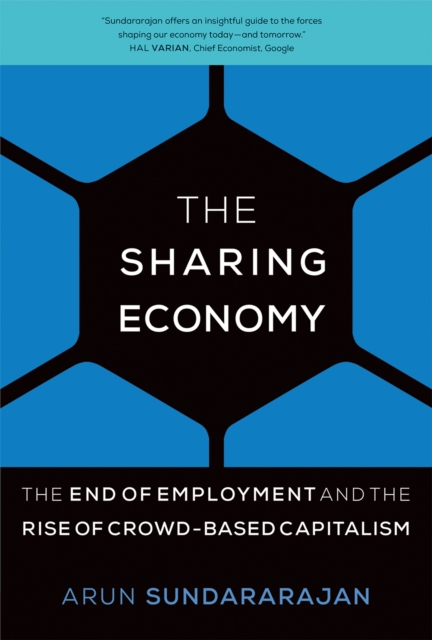
Sharing isn't new. Giving someone a ride, having a guest in your spare room, running errands for someone, participating in a supper club -- these are not revolutionary concepts. What is new, in the \"sharing economy,\" is that you are not helping a friend for free; you are providing these services to a stranger for money. In this book, Arun Sundararajan, an expert on the sharing economy, explains the transition to what he describes as \"crowd-based capitalism\" -- a new way of organizing economic activity that may supplant the traditional corporate-centered model. As peer-to-peer commercial exchange blurs the lines between the personal and the professional, how will the economy, government regulation, what it means to have a job, and our social fabric be affected?Drawing on extensive research and numerous real-world examples -- including Airbnb, Lyft, Uber, Etsy, TaskRabbit, France's BlaBlaCar, China's Didi Kuaidi, and India's Ola, Sundararajan explains the basics of crowd-based capitalism. He describes the intriguing mix of \"gift\" and \"market\" in its transactions, demystifies emerging blockchain technologies, and clarifies the dizzying array of emerging on-demand platforms. He considers how this new paradigm changes economic growth and the future of work. Will we live in a world of empowered entrepreneurs who enjoy professional flexibility and independence? Or will we become disenfranchised digital laborers scurrying between platforms in search of the next wedge of piecework? Sundararajan highlights the important policy choices and suggests possible new directions for self-regulatory organizations, labor law, and funding our social safety net.
eBook


Empire of Normality
'Groundbreaking … [provides] a deep history of the invention of the \"normal\" mind as one of the most damaging and oppressive tools of capitalism. To read it is to see the world more clearly' Steve Silberman, author of NeuroTribes
'Argues that a radical politics of neurodiversity is necessary, not only for neurodivergent folk, but for our collective liberation' Professor Hel Spandler, editor, Asylum magazine
'A vital book that kindles the flames of a neurodivergent revolution' Beatrice Adler-Bolton, co-author of Health Communism
Neurodiversity is on the rise. Awareness and diagnoses have exploded in recent years, but we are still missing a wider understanding of how we got here and why. Beyond simplistic narratives of normativity and difference, this groundbreaking book exposes the very myth of the 'normal' brain as a product of intensified capitalism.
Exploring the rich histories of the neurodiversity and disability movements, Robert Chapman shows how the rise of capitalism created an 'empire of normality' that transformed our understanding of the body into that of a productivity machine. Neurodivergent liberation is possible – but only by challenging the deepest logics of capitalism. Empire of Normality is an essential guide to understanding the systems that shape our bodies, minds and deepest selves – and how we can undo them.
Robert Chapman is a neurodivergent philosopher who has taught at King's College London and Bristol University. They are currently Assistant Professor in Critical Neurodiversity Studies at Durham University. They blog at Psychology Today and at Critical Neurodiversity.
eBook