
Catalogue Search | MBRL


Are you sure you want to remove the book from the shelf?

{{itemTitle}}
10,685
result(s) for
"Carbon dioxide content"
Sort by:


Ocean Acidification
The ocean has absorbed a significant portion of all human-made carbon dioxide emissions. This benefits human society by moderating the rate of climate change, but also causes unprecedented changes to ocean chemistry. Carbon dioxide taken up by the ocean decreases the pH of the water and leads to a suite of chemical changes collectively known as ocean acidification. The long term consequences of ocean acidification are not known, but are expected to result in changes to many ecosystems and the services they provide to society. Ocean Acidification: A National Strategy to Meet the Challenges of a Changing Ocean reviews the current state of knowledge, explores gaps in understanding, and identifies several key findings.
Like climate change, ocean acidification is a growing global problem that will intensify with continued CO2 emissions and has the potential to change marine ecosystems and affect benefits to society. The federal government has taken positive initial steps by developing a national ocean acidification program, but more information is needed to fully understand and address the threat that ocean acidification may pose to marine ecosystems and the services they provide. In addition, a global observation network of chemical and biological sensors is needed to monitor changes in ocean conditions attributable to acidification.
eBook
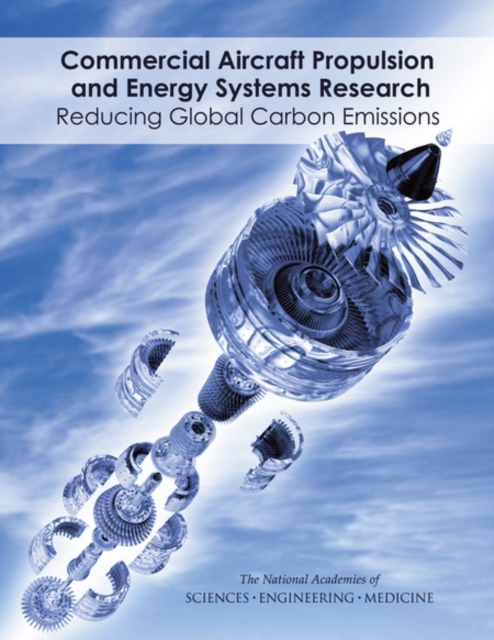
Commercial Aircraft Propulsion and Energy Systems Research
The primary human activities that release carbon dioxide (CO2) into the atmosphere are the combustion of fossil fuels (coal, natural gas, and oil) to generate electricity, the provision of energy for transportation, and as a consequence of some industrial processes. Although aviation CO2 emissions only make up approximately 2.0 to 2.5 percent of total global annual CO2 emissions, research to reduce CO2 emissions is urgent because (1) such reductions may be legislated even as commercial air travel grows, (2) because it takes new technology a long time to propagate into and through the aviation fleet, and (3) because of the ongoing impact of global CO2 emissions.
Commercial Aircraft Propulsion and Energy Systems Research develops a national research agenda for reducing CO2 emissions from commercial aviation. This report focuses on propulsion and energy technologies for reducing carbon emissions from large, commercial aircraft- single-aisle and twin-aisle aircraft that carry 100 or more passengers-because such aircraft account for more than 90 percent of global emissions from commercial aircraft. Moreover, while smaller aircraft also emit CO2, they make only a minor contribution to global emissions, and many technologies that reduce CO2 emissions for large aircraft also apply to smaller aircraft.
As commercial aviation continues to grow in terms of revenue-passenger miles and cargo ton miles, CO2 emissions are expected to increase. To reduce the contribution of aviation to climate change, it is essential to improve the effectiveness of ongoing efforts to reduce emissions and initiate research into new approaches.
eBook


Gas Injection for Disposal and Enhanced Recovery
This is the fourth volume in a series of books focusing on natural gas engineering, focusing on two of the most important issues facing the industry today: disposal and enhanced recovery of natural gas. This volume includes information for both upstream and downstream operations, including chapters on shale, geological issues, chemical and thermodynamic models, and much more.
eBook

Behind the Curve
In 1958, Charles David Keeling began measuring the concentration of carbon dioxide in the earth's atmosphere at the Mauna Loa Observatory in Hawaii. His project kicked off a half century of research that has expanded our knowledge of climate change. Despite more than fifty years of research, however, our global society has yet to find real solutions to the problem of global warming. Why?
In Behind the Curve, Joshua Howe attempts to answer this question. He explores the history of global warming from its roots as a scientific curiosity to its place at the center of international environmental politics. The book follows the story of rising CO2 illustrated by the now famous Keeling Curve through a number of historical contexts, highlighting the relationships among scientists, environmentalists, and politicians as those relationships changed over time.
The nature of the problem itself, Howe explains, has privileged scientists as the primary spokespeople for the global climate. But while the science first forms of advocacy they developed to fight global warming produced more and better science, the primacy of science in global warming politics has failed to produce meaningful results. In fact, an often exclusive focus on science has left advocates for change vulnerable to political opposition and has limited much of the discussion to debates about the science itself.
As a result, while we know much more about global warming than we did fifty years ago, CO2 continues to rise. In 1958, Keeling first measured CO2 at around 315 parts per million; by 2013, global CO2 had soared to 400 ppm. The problem is not getting better - it's getting worse. Behind the Curve offers a critical and levelheaded look at how we got here.
eBook


The evolution of Earth's climate
Written by a group of the most experienced and well-known environmental engineers in the world, from a unique perspective, this volume explores the hot-button issue of climate change, its causes, and the future of the planet. Climate change is one of the most controversial and argued issues in the world today, and it has been for years. It has been politicized by politicians on all sides, some scientists have used the study of it for their own material gain above true scientific discovery, and some scientific theories surrounding it have been believed even though proven false. But there is not, by any means, complete agreement among all scientists throughout the world on this issue. Written by two of the world's most well-respected environmental and petroleum engineers, this book is meant to be one voice in the scientific literature on this important subject. Other books, also available from Wiley-Scrivener, take the opposite stance, but it is important, in our scientific journey, to listen to all voices and rely on facts, rather than opinions. We trust the reader to make his or her decisions based on all of the facts, and not just some of them.
eBook

Earth's Climate Evolution
To understand climate change today, we first need to know how Earth's climate changed over the past 450 million years. Finding answers depends upon contributions from a wide range of sciences, not just the rock record uncovered by geologists. In Earth's Climate Evolution, Colin Summerhayes analyzes reports and records of past climate change dating back to the late 18th century to uncover key patterns in the climate system. The book will transform debate and set the agenda for the next generation of thought about future climate change. The book takes a unique approach to the subject providing a description of the greenhouse and icehouse worlds of the past 450 million years since land plants emerged, ignoring major earlier glaciations like that of Snowball Earth, which occurred around 600 million years ago in a world free of land plants. It describes the evolution of thinking in palaeoclimatology and introduces the main players in the field and how their ideas were received and, in many cases, subsequently modified. It records the arguments and discussions about the merits of different ideas along the way. It also includes several notes made from the author's own personal involvement in palaeoclimatological and palaeoceanographic studies, and from his experience of working alongside several of the major players in these fields in recent years. This book will be an invaluable reference for both undergraduate and postgraduate students taking courses in related fields and will also be of interest to historians of science and/or geology, climatology and oceanography. It should also be of interest to the wider scientific and engineering community, high school science students, policy makers, and environmental NGOs. Reviews: \"Outstanding in its presentation of the facts and a good read in the way that it intersperses the climate story with the author's own experiences. [This book] puts the climate story into a compelling geological history.\" -Dr. James Baker \"The book is written in very clear and concise prose, [and takes] original, enlightening, and engaging approach to talking about 'ideas' from the perspective of the scientists who promoted them.\" -Professor Christopher R. Scotese \"A thrilling ride through continental drift and its consequences.\" - Professor Gerald R. North \"Written in a style and language which can be easily understood by laymen as well as scientists.\" - Professor Dr Jörn Thiede \"What makes this book particularly distinctive is how well it builds in the narrative of change in ideas over time.\" - Holocene book reviews, May 2016 \"This is a fascinating book and the author's biographical approach gives it great human appeal.\" - E Adlard
eBook

Carbon Responsibility and Embodied Emissions
Climate change policy and the reduction of greenhouse gas emissions are currently discussed at all scales, ranging from the Kyoto Protocol to the increasingly frequent advertisement of ''carbon neutrality'' in consumer products. However, the only policy option usually considered is the reduction of direct emissions. Another potential policy tool, currently neglected, is the reduction of indirect emissions, i.e., the emissions embodied in goods and services, or the payments thereof.
This book addresses the accounting of indirect carbon emissions (as embodied in international trade) within the framework of input-output analysis and derives an indicator of environmental responsibility as the average of consumer and producer responsibility. A global multi-regional input-output model is built, using databases on international trade and greenhouse gas emissions, from which embodied carbon emissions and carbon responsibilities are obtained.
Carbon Responsibility and Embodied Emissions consists of a theoretical part, concerning the choice of environmental indicators, and an applied part, reporting an environmental multi-regional input-output model. It will be of particular interest to postgraduate students and researchers in Ecological Economics, Environmental Input-Output Analysis, and Industrial Ecology.
João F. D. Rodrigues is currently a Researcher at the Center for Innovation, Technology and Policy Research (IN+), Instituto Superior Técnico (IST), Lisbon, Portugal. Alexandra P.S. Marques is currently a MIT Portugal Program PhD student at IST in the area of Sustainable Energy Systems. Tiago M. D. Domingos is an Assistant Professor at the Environment and Energy Scientific Area, DEM, IST, and a Researcher at IN+.
1. Introduction 2. Accounting indirect emissions 3. Carbon indicators 4. Carbon responsibility 5. Multi-regional IO model 6. Carbon responsibility of world regions 7. Discussion
eBook