
Catalogue Search | MBRL


Are you sure you want to remove the book from the shelf?

{{itemTitle}}
97,014
result(s) for
"Carroll"
Sort by:

Alice's Oxford : people and places that inspired Wonderland
This volume is both a guide and a history, exploring the curious and entertaining glories of Oxford through two of the most famous fantasies in world literature.
BOOK

The Place of Lewis Carroll in Children's Literature
This study examines the literary impact of Lewis Carroll's children's books on the history of English children's literature. Susina elucidates the cultural content of Carroll's work and situates the Alice books in relation to Carroll's juvenilia, his letters, photographs of children and his attempt to combine children's and adult literatures.
eBook

Alice in space : the sideways Victorian world of Lewis Carroll
An examination of Carroll's books about Alice explores the contextual knowledge of the time period in which it was written, addressing such topics as time, games, mathematics, and taxonomies.
Book
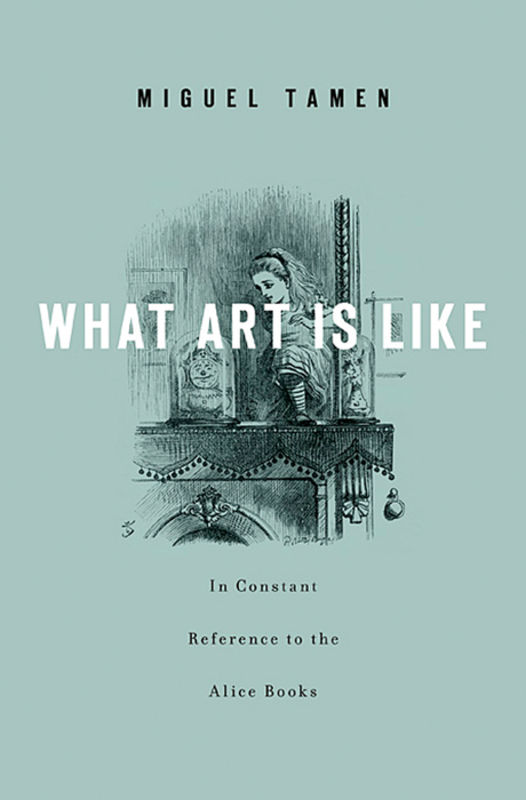
What Art Is Like, In Constant Reference to the Alice Books
This comic, serious inquiry into the nature of art takes its technical vocabulary from Alice’s Adventures in Wonderland and Through the Looking-Glass. It is ridiculous to think of poems, paintings, or films as distinct from other things in the world, including people. Talking about art should be contiguous with talking about other relevant matters.
eBook

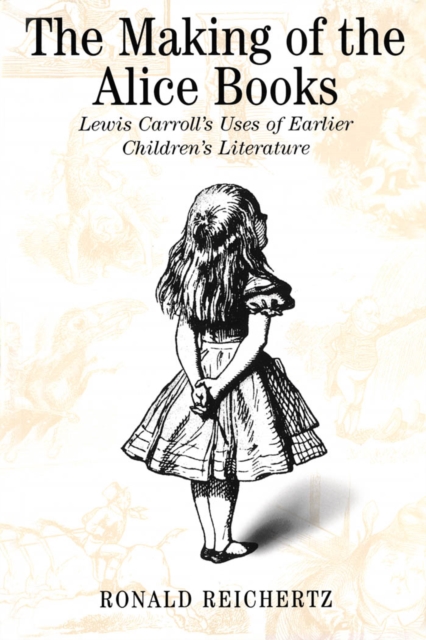
Making of the Alice Books
Analysing Lewis Carroll's Alice books in the context of children's literature from the seventeenth through the nineteenth century, Ronald Reichertz argues that Carroll's striking originality was the result of a fusion of his narrative imagination and formal and thematic features from earlier children's literature. Drawing examples from a wide range of children's literature Reichertz demonstrates that the Alice books are infused with conventions of and allusions to earlier works and identifies precursors of Carroll's upside-down, looking-glass, and dream vision worlds. Key passages from related books are reprinted in the appendices, making available many hard-to-find examples of early children's literature.
eBook

Carroll–Schrödinger equation as the ultra-relativistic limit of the tachyon equation
The Poincaré symmetry can be contracted in two ways to yield the Galilei symmetry and the Carroll symmetry. The well-known Schrödinger equation exhibits the Galilei symmetry and is a fundamental equation in Galilean quantum mechanics. However, the question remains: what is the quantum equation that corresponds to the Carroll symmetry? In this paper, we derive a novel equation in two dimensions, called the “Carroll–Schrödinger equation”, which describes the quantum dynamics in the Carrollian framework. We also construct the so-called “Carroll–Schrödinger algebra” in two dimensions, which is a conformal extension of the centrally extended Carroll algebra with a dynamical exponent of
. We demonstrate that this algebra is the symmetry algebra of the Carroll–Schrödinger field theory. Moreover, we apply the method of canonical quantization to the theory and utilize it to compute the transition amplitude. Finally, we discuss higher dimensions and identify the so-called “generalized Carroll–Schrödinger equation”.
Journal Article

One fun day with Lewis Carroll : a celebration of wordplay and a girl named Alice
The wordsmith Lewis Carroll is famed for the freewheeling world of Wonderland in his beloved classics Alice's Adventures in Wonderland and Through the Looking Glass. In this gloriously illustrated picture book, Carroll's childlike love of life is showcased alongside his brilliance at creating and adapting playful words and phrases.
BOOK

Reasoning and Presuppositions
It is a platitude that when we reason, we often take things for granted, sometimes even justifiably so. Although it is a platitude that we often take things for granted when we reason—whether justifiably or not—one might think that we do not have to. In fact, it is a natural expectation that were we not pressed by time, lack of energy or focus, we could always in principle make explicit in the form of premises every single presupposition we make in the course of our reasoning. In other words, it is natural to expect it to be true that presuppositionless reasoning is possible. In this essay, I argue that it is false: presuppositionless reasoning is impossible. Indeed, I think this is one of the lessons of a long-standing paradox about inference and reasoning known as Lewis Carroll’s (1985) regress of the premises. Many philosophers agree that Carroll’s regress teaches us something foundational about reasoning. I part ways about what it is that it teaches us. What it teaches us is that the structure of reasoning is constitutively presuppositional.
Journal Article