
Catalogue Search | MBRL


Are you sure you want to remove the book from the shelf?

{{itemTitle}}
34
result(s) for
"Cartesian linguistics."
Sort by:

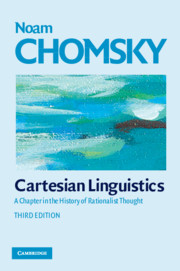
Cartesian Linguistics
In this extraordinarily original and profound work, Noam Chomsky discusses themes in the study of language and mind since the end of the sixteenth century in order to explain the motivations and methods that underlie his work in linguistics, the science of mind, and even politics. This edition includes a new and specially written introduction by James McGilvray, contextualising the work for the twenty-first century. It has been made more accessible to a larger audience; all the French and German in the original edition has been translated, and the notes and bibliography have been brought up to date. The relationship between the original edition (published in 1966) and contemporary biolinguistic work is also explained. This challenging volume is an important contribution to the study of language and mind, and to the history of these studies since the end of the sixteenth century.
eBook

Un estudio de las fuentes de la «Lingüística cartesiana»: Ralph Cudworth (1617-1688)
This article studies three of the most relevant works by Ralph Cudworth (1617-1688), mentioned by Chomsky in his Cartesian Linguistics. Regarding methodology, we assume the pillars of the historiography of linguistics as exposed by Swiggers, and also Brekle’s division into internal and external dimensions, using the theory of textual series as the key instrument (Hassler; Zamorano Aguilar 2013). The hypothesis defended and demonstrated in this work is that Chomsky, in dealing with the Cudworthian theory –even though he includes some epistemologically fundamental elements– obviates key aspects of Cudworth’s contribution not only to 17th century English rationalist philosophy, but also to historiography in general. Thus, we observe, apart from the mention to just one of the works of Cudworth, the partiality in the description of his theory developed by Chomsky. En este artículo se realiza un estudio de tres de las obras más relevantes de Ralph Cudworth (1617-1688), mencionado por Chomsky en Lingüística cartesiana. Metodológicamente nos basamos en los pilares de la historiografía de la lingüística según Swiggers y la división en dimensión interna y externa de Brekle, utilizando como instrumento fundamental la teoría de las series textuales (Hassler; Zamorano Aguilar 2013). La hipótesis defendida y cuya demostración se desempeña en este trabajo es que el uso de la teoría cudworthiana por parte de Chomsky, si bien recoge algunos elementos epistemológicamente fundamentales, obvia aspectos claves para comprender la aportación de aquel no solo a la teoría racionalista inglesa del siglo XVII, sino también a la historiografía en general. En este sentido, percibimos, además de la alusión a una única obra de Cudworth, la parcialidad en la descripción de su teoría por parte de Chomsky.
Journal Article
Kartezjusz Chomsky’ego. Uwagi o znaczeniu myśli Kartezjusza dla badań Chomsky’ego nad językiem i poznaniem
The article focuses on Chomsky’s interpretation of the philosophy of Descartes as well as on the importance of selected Descartes’s ideas for the theories of language and cognition developed by Chomsky. The main questions concerns the actual influence of Descartes on the theory proposed by Chomsky, especially on the so called Cartesian linguistics. The thesis is advanced that although it is possible to point out several Cartesian ideas that influenced Chomsky’s thought, it cannot be said that this influence was essential to the development of his theory of language and cognition. Descartes played no essential role in the development of the linguistic tradition that continued until the 19th century and that is still visible in the present day linguistics. The term “Cartesian linguistics” does not refer to any coherent body of knowledge concerning language. The alleged representatives of Cartesian linguistics do not share any essential assumptions and thus they cannot be seen as representatives of the same tradition.
Journal Article
A semiotic reconstruction of Ryle's critique of Cartesianism
While reconstructing Gilbert Ryle's (1900-76) critique of Cartesianism and his arguments as to what philosophy is, defines and critiques the tendency to handle a philosophical enquiry into concepts as though it were an enquiry into object-domain, then elucidates an alternative way of prosecuting such an enquiry and demonstrates its implications. Th
eBook

The 'language instinct' debate
When it was first published in 1997, Geoffrey Sampson's Educating Eve was described as the definitive response to Steven Pinker's The Language Instinct and Noam Chomsky's nativism.In this revised and expanded new edition, Sampson revisits his original arguments in the light of fresh evidence that has emerged since the original publication.
eBook
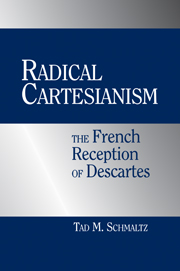
Radical Cartesianism
This is a book-length study of two of Descartes's most innovative successors, Robert Desgabets and Pierre-Sylvain Regis, and of their highly original contributions to Cartesianism. The focus of the book is an analysis of radical doctrines in the work of these thinkers that derive from arguments in Descartes: on the creation of eternal truths, on the intentionality of ideas, and on the soul-body union. As well as relating their work to that of fellow Cartesians such as Malebranche and Arnauld, the book also establishes the important though neglected role played by Desgabets and Regis in the theologically and politically charged reception of Descartes in early modern France. This is a major contribution to the history of Cartesianism that will be of special interest to historians of early modern philosophy and historians of ideas.
eBook

The inheritance and innateness of grammars
Is language somehow innate in the structure of the human brain, or is it completely learned? This debate is still at the heart of linguistics, especially as it intersects with psychology and cognitive science. In collecting papers which discuss the evidence and arguments regarding this difficult question, The Inheritance and Innateness of Grammars considers cases ranging from infants who are just beginning to learn the properties of a native language to language-impaired adults who will never learn one. These studies show that, while precursors of language exist in other creatures, the abilities necessary for constructing full-fledged grammars are part of the biological endowment of human beings. The essays that comprise this volume test the range and specificity of that endowment, while also contributing to our understanding of the intricate and complex relationship between language and biology.
eBook

Capacity of Linguistic Communication Channels in Literary Texts: Application to Charles Dickens’ Novels
In the first part of the article, we recall our general theory of linguistic channels—based on regression lines between deep language parameters—and study their capacity and interdependence. In the second part, we apply the theory to novels written by Charles Dickens and other authors of English literature, including the Gospels in the King James version of the Bible. In literary works (or in any long texts), there are multiple communication channels. The theory considers not only averages but also correlation coefficients. The capacity of linguistic channels is a Gaussian stochastic variable. The similarity between two channels is measured by the likeness index. Dickens’ novels show striking and unexpected mathematical/statistical similarity to the synoptic Gospels. The Pythagorean distance, defined in a suitable Cartesian plane involving deep language parameters, and the likeness index correlate with an inverse proportional relationship. A similar approach can be applied to any literary corpus written in any alphabetical language.
Journal Article

Dislocating the Language of Modernity in Amitav Ghosh's The Circle of Reason
Engaging with Amitav Ghosh's recent essays that link imperial modernity's mechanistic view of the world to the novel's failure to imagine climate change, this article examines how Ghosh's fiction attempts to dislocate narratives of modernity to reveal a world constructed by capital and naturalized through reason. Drawing on the work of postcolonial theorists on the introduction of Western science to India, this article returns to Ghosh's first novel, The Circle of Reason , to focus on the intimate scale of the transformations that imperial modernity enacted on the human body and psyche. Though underrepresented in scholarship on Ghosh, this novel is a critical site for understanding Ghosh's view of how the ideology of modernity gets entrenched as scientific reason, reshaping humankind's relationship with the human body and the surrounding world. The novel's representation of the body, moreover, proposes an intimate and uncanny space that discloses alternative ways of imagining the world.
Journal Article